
Sacrificing Freedom for "Security": What Should Abkhazia Expect from Integration with Russia's System of Constitutional Dictatorship
23/12/2020 15:29:54 Conflicts
For clarity, let us begin with one of the defining events of the year coming to a close — the coronavirus pandemic. It made starkly clear that the leaders of Russia's political system care very little about their citizens, merely performing the appearance of concern for them. As analysts point out, while more or less developed countries of the world were allocating an average of 20% of GDP over the course of the year to assist their populations, businesses, and entrepreneurs, Russia's figure was several times lower. In America, for instance, three packages of assistance were passed — the latest literally just days ago, amounting to 900 billion dollars — while in Russia only once, in the spring, were 5,000 rubles allocated per child under the age of eight. Such is the stark difference. And this despite the fact that the National Wealth Fund at the time held approximately 10 trillion rubles, while Russia's foreign exchange and gold reserves stood at around 38 trillion.
Is this greed or stupidity? Neither — it is a different policy altogether, one whose logic lies in confrontation with the West and in reserving funds for that confrontation: that the economy is declining and living standards are falling — this is unimportant; what matters is that there are resources for the military-industrial complex and the arms race. Meanwhile, the healthcare system — even in major Russian cities, to say nothing of the remote regions — has been pushed to the breaking point and all capacity for hospitalizing citizens has been exhausted. The result: poverty and high mortality. According to official government figures — which have repeatedly been demonstrated to be seriously understated — Russia's population will shrink this year by 352,500 people: that is, ten times more than in 2019.
But there is more on the subject of the pandemic — a new dimension has emerged: it was already known before the epidemic that power in present-day Russia is closed and unaccountable, but the epidemic revealed that the Kremlin is now using it as cover to deploy new digital technologies for the total surveillance of the population. This amounts to a kind of digital enslavement of the country's citizens through electronic passports, movement permits, facial recognition, and personal data — all used for undeclared government purposes.
And throughout all these recent months, entirely regardless of any pandemic, the country has been actively and continuously adopting thoroughly repressive laws — consistent with the political system formalized on July 1st during the constitutional amendment plebiscite. Further repressive laws, rubber-stamped by the State Duma for President Putin's signature in the very last days, are set to come into force in early 2021. The cumulative result is a new and extremely aggressive environment within which all civic, political, and public life in the country will henceforth be conducted.
Analysts speak of July 1st marking the end of Russia's failed post-Soviet modernization era and the beginning of a new phase of hyper-authoritarianism — a regime of unlimited personal power that prohibits virtually any action deviating even slightly from what it considers the norm.
Who bears responsibility for this? Undoubtedly, Vladimir Putin — as the architect of this system and the conductor of the entire process — and his security-service associates. But responsibility also lies with all those who on July 1st supported the constitutional amendments resetting Putin's presidential terms. Although one must acknowledge that the authorities, in the finest tradition of "sovereign democracy," did everything possible to mislead the population — coupling this reset in the proposed amendments with promises on pensions, wages, social welfare, care for the Russian language, and all manner of other things. The public, which had already seen plenty from this government, once again took the bait. The authorities, for their part, were finally confirmed in their conviction that citizens will accept anything that happens in the country. And what has been the result? Instead of social protection, from July to the present the population has seen from parliament nothing but laws on "all-Russian renovation" — envisaging, for instance, the forced expropriation of citizens' apartments; any form of social activism in the country is harshly and systematically suppressed; state political terror against the opposition and against all dissenters is in plain view. And given that the regime of unlimited personal power — a kind of corporate state — has now been formally enshrined in Russian law and in the Constitution, it is hard to disagree with analysts' forecasts that this extremely brutal system will only intensify in the future. For if today a full package of ten laws can be adopted per day without any discussion, if one can vote for 227 amendments by pressing a single button, why not tomorrow adopt in the same manner as many laws as one pleases — such as those already passed on the police, on "foreign agents," on the concealment of information about security service personnel, and so on?
So the era when some in Russia were still murmuring "we are building democracy, there are just certain deviations from it" is over. It is now clear to everyone that no one is building any democracy; instead, a totalitarian regime is being constructed — or, as scholars put it, a regime of constitutional dictatorship based on Putinist Bonapartism — and the population has the worst still to come.
And all of this is served up by Kremlin propaganda under the following ideological "sauce": "The people must be united, they must have a leader, and everyone around them is an enemy." Combined with a kind of victory mania — a cult of victory. It is on this foundation that Russia's relations with its neighbors are built. It is precisely for this reason, in analysts' view, that a ring of tension surrounds Russia. Moscow is attempting to control an enormous expanse of territory — doing so in an extremely aggressive manner, including by imposing its own system. Thus Belarusian leader Alexander Lukashenko, for instance — ordering direct gunfire against his own citizens who have been taking to the streets for nearly half a year in their struggle against lies, falsification, and dictatorship — does so because he has Putinist Russia standing behind him, observers are convinced. In their view, Moscow needs this in order — as with Armenia, though these countries are very different — to bring unwanted governments to their knees and eliminate them as political subjects. What happens to the people on the ground is of no interest to Moscow; what interests it is a policy of limited sovereignty. The essence is to push matters to the extreme, and then declare to the population: "We will send our National Guard; it will strangle every one of you — but if you still wish, you may continue protesting." And if any given government submits, it will be supported, with the tacit understanding: "If you need to shoot, shoot — do whatever you want." And so they do whatever they want.
The turn has now come for other neighboring territories. The Kremlin has decided to export its system to Abkhazia — having sent Sukhumi, back in December of last year, the "Program for the Formation of a Common Social and Economic Space Based on the Harmonization of Legislation." Given the state described above — in which the population of Russia finds itself, having supported what amounts to constitutional dictatorship — our Abkhazian reader can easily imagine what awaits them and their compatriots in the event of the "harmonization" of Abkhazian laws with such Russian legislation.
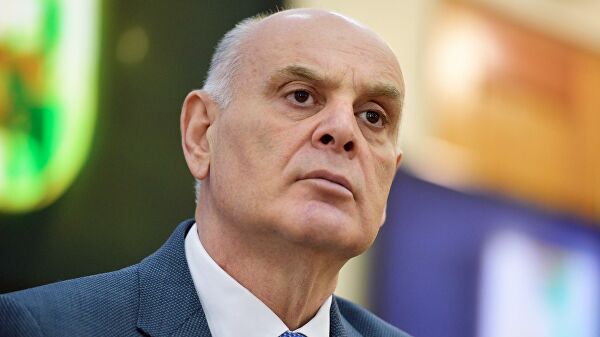
But this is far from all that Russia is "amicably offering" Abkhazia. As the Abkhazian leader Aslan Bzhania recently admitted — following his Sochi meeting with Vladimir Putin — the Russian president put forward a "proposal" to integrate into a new Union State being created by Moscow on the post-Soviet space "with the participation of a group of countries." So far, only two participant countries are known: Russia and Belarus. Moscow envisions in this union the entities it has recognized — along with a few other states — the so-called DNR, LNR, Transnistria, South Ossetia, Abkhazia, and possibly Armenia. Although following the second Karabakh war, scenarios even more alarming have been voiced regarding Armenia — ideas about its direct incorporation into Russia. "Yes, such a development may be assessed positively by some, but it must be an act of free expression of the will of Armenian citizens," stated Konstantin Zatulin, First Deputy Chairman of the State Duma Committee on CIS Affairs, Eurasian Integration, and Relations with Compatriots, on December 24th at a discussion organized by the Union of Armenians of Russia. And if Moscow has the audacity to propose such a thing to universally recognized Armenia, Sukhumi — recognized to this day by only a handful of Russian satellite states — would do well to receive this not even as a subtle hint but as a blunt statement of very substantial intentions. And Moscow plans to achieve these "substantial intentions" through a method already tested in many parts of the world — a "fair, objective, and democratic" referendum.
Given that the word "referendum" has already been spoken in Sukhumi on several occasions — first by Aslan Bzhania himself after his Sochi meeting with Putin, and then by the head of the presidential Commission on Constitutional Reform, Natella Akaba, who stated that "if constitutional amendments are ultimately proposed, a referendum must absolutely be held" — changes appear to be not far off, despite the clear protest of those who already understand what integration with Russia's system of constitutional dictatorship and Putinist Bonapartism holds in store for Abkhazia.
"I wonder, how would the referendum questions be formulated? 'Do you want the authorities to steal the Russian money arriving in the country again, and in exchange we hand over all our energy sector and allow Russian citizens to buy our real estate?' Or: 'Do you want us to align our legislation with that of the Russian Federation and adopt the same idiotic anti-popular laws that have been adopted in the RF over the past few years?' Or: 'Are you in favor of Abkhazia having no ability to develop independently, under the vigilant supervision of the strategic partner?' Or perhaps: 'Do you approve of Russia's failure to provide assistance to Armenia during the recent events in Nagorno-Karabakh, and do you consider the presence of Russian military in our country to be effective?' Or maybe this: 'Do you want the same kind of "fair" elections as in Russia?' Or: 'Do you like the impunity of corrupt officials in the RF, and would you like the same for Abkhazia?' Or: 'Are you certain that the rightlessness, poverty, and hopelessness that are the lot of 90% of the population of present-day Russia are very well suited to the people of Abkhazia too?' Or: 'Are you prepared for the same permanent non-rotation of power as in the RF?' Or: 'Do you approve of the barbaric attitude toward nature practiced in Russia, and do you wish the same for our country?' All the questions must be formulated honestly, Aslan Georgievich!" — an Abkhazian internet user addresses Aslan Bzhania, who has spoken of a possible referendum, of Abkhazia having nowhere to go without Russia, and of the intention to integrate into the Union State.
And I have this question for Mr. Bzhania: are you certain that Abkhazia will perish without Russia? Might it not be precisely the other way round — that it will perish with Russia, or inside Russia? For the history of the most varied countries and governments in their dealings with Moscow has repeatedly confirmed the wisdom of Thomas Jefferson's words: "He who sacrifices freedom for security deserves neither and will lose both."
Ekaterine Tsanava
The material was prepared as part of a joint project of the Accent news agency and the non-governmental organization GRASS, implemented with the financial support of the Open Information Partnership (OIP).