
Fires and Politics
10/01/2021 12:36:05 Conflicts
The first week of the new year in Abkhazia was marked by bad news; to the rising coronavirus death toll were added fires breaking out across several districts simultaneously. And although the Sukhumi authorities are assuring the public that there is no cause for panic, the numerous reports, photographs, and videos appearing on social media are providing precious little grounds for optimism.
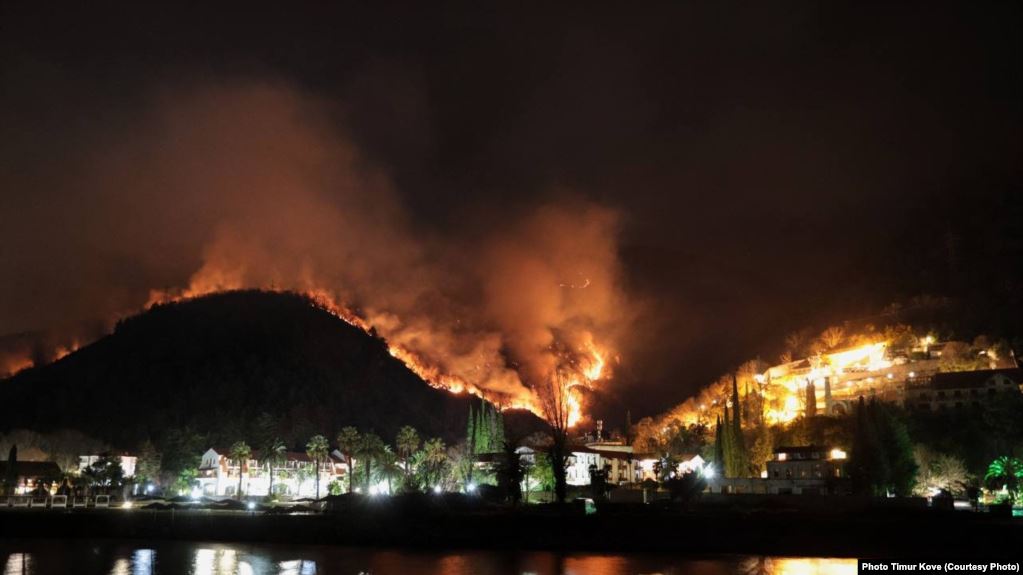
Forest fires broke out in Abkhazia in the very first days of the new year. Reports of major outbreaks in the Gali, Ochamchyra, Gagra, and Gudauta districts came pouring in one after another. In the Gali district, three houses burned to the ground. Hundreds of hectares of forested hazelnut groves — the main source of income for the local population — went up in flames. And in the Gagra district, a fire is still at this moment destroying a unique pine forest to the north of the city, having come within 150 to 200 meters of inhabited settlements. The total area of the outbreaks in the district has already exceeded 250 hectares.
On January 8th, in the morning, the Abkhazian "government" issued a statement reporting that on January 7th, fires had been brought under control in the villages of Mgudzyrkhva, Reka, and Baslakhu in the Gudauta district, in the village of Ganakhleba in the Ochamchyra district, and in the Gali district, while in the Gagra district "the main sources of fire have been fragmented." "There are outbreaks in the highland part of the city; in the coastal area — isolated outbreaks of low intensity. Four fire brigades and one rescue brigade from the Sukhumi and Gagra districts are working to extinguish the fire," the statement read. But later in the day, and again on January 9th, the Abkhazian segment of social media continued to receive dispiriting news, photographs, and videos attesting to the gravity of the actual situation. And on January 10th, the chief of staff of the fire and rescue unit for the protection of the Gagra district, under the Abkhazian "Ministry" of Emergency Situations, David Bgamba, informed the public that the rain that had fallen over the Gagra district had failed to stop the fire and the flames were continuing to spread.
To make matters worse, a forest fire in the vicinity of the Moskva sanatorium triggered a rockslide onto the republican highway Psou-Inguri passing through the mountains of the Gagra district. According to the press service of the Abkhazian "Ministry" of Emergency Situations, the road at the entrance to Gagra was blocked by enormous boulders.
Faced with extremely meager resources, the Sukhumi authorities — who are attempting to reassure the population with assurances that it faces no threat and there is no cause for panic — are nonetheless forced to acknowledge that emergency responders are pinning their hopes primarily on the weather. According to the "Minister" of Emergency Situations, Lev Kvitsiniya, rain is expected throughout the week and snow should fall in the mountains.
Against this backdrop, Tbilisi has been repeatedly offering Sukhumi's authorities comprehensive assistance since January 5th. This offer has been conveyed on several occasions via the "hotline" — including the possible involvement of aviation equipment. The corresponding statement was first made by Georgia's State Security Service. Later, the offer from Tbilisi was reiterated by the State Minister for Reconciliation and Civic Equality, Tea Akhvlediani. "Specific proposals have been made. We are awaiting a response, after which we will be able to join the firefighting effort immediately," she stated.
But Sukhumi is refusing. "Minister" Kvitsiniya even denied that Tbilisi had made any offer, declaring that the Abkhazian side had not appealed to anyone for help. "Assistance from Georgia is unacceptable to Abkhazia. There have been no negotiations, no attempts, and there cannot be. We have never had any contacts with the Georgians," he added.
The offer from Tbilisi was also rejected by Security Council Secretary Sergei Shamba, who first stated to the publication SOVA that there was "no need" for Tbilisi's assistance as "Abkhazian services are coping," before adding in a subsequent interview with the Georgian Public Broadcaster that Abkhazia "does not consider Georgia's assistance" and that "if necessary, they will turn to Russian colleagues, with whom Abkhazian services have very good relations." "If needed, we will appeal to the Russian side. There have already been precedents for such assistance — in the mountains of Abkhazia, Russian helicopters have been involved in firefighting," he noted.
For its part, Abkhazia's "Public Chamber" — apparently not sharing the view that existing resources are fully adequate at this stage — proposed turning to Russia for help right away, pointing to the fires' proximity to Russian territory.
But the "Minister" Kvitsiniya, whose agency has no aviation of its own for fighting forest fires in hard-to-reach areas, held a somewhat different perspective on this prospect. According to him, there is no point in asking Russia for helicopters since Abkhazia does not have the fuel to operate them: "A single day of aviation operations requires approximately 50 tonnes of kerosene — we do not have such a quantity of fuel, it is simply not possible. Everything involving helicopters and aircraft involves absolutely unaffordable sums for our country. Getting a helicopter is no problem — I'll write a request, we'll sort it out — but what then? What do I refuel it with? It would have to fly to Sochi for refueling and would run out of fuel before getting there."
This statement by the "Minister" caused widespread reaction. The state of affairs in the relationship with Russia — so recently considered a friend in Abkhazia — came as a surprise to some uninformed citizens, apparently not having followed the behavior of the Russian "partner" throughout last year, when Russia spent months "forgetting" to help Abkhazia during the height of the pandemic and instead of providing assistance imposed a medical blockade on it — while also completely cutting off financial assistance and closing the "border," thereby effectively torpedoing the tourist season. But for the majority, it comes as no surprise at all. "The Soviet era ended long ago, and in the 21st century a market economy operates — where any service must be paid for. But what about the strategic partnership with Russia, you might ask. The answer is simple: Russia has bid farewell to the inertia of the 1990s and moved to a more pragmatic approach — as we had ample opportunity to observe throughout the past year 2020. That is, either Abkhazia pays — and there is nothing to pay with — or welcome to USSR-2, with all the attendant consequences: then the free carrots will come," one Abkhazian internet user replied to bewildered compatriots. "Appealing to the RF makes no sense without determining payment for aviation firefighting services. And for now we don't have enough money not only to acquire firefighting aircraft, but even to rent them," noted another.
Many are curious as to why Russia itself — the "strategic partner" and "friend," widely represented in Abkhazia through various structures including military ones, which would theoretically have long since rushed to the aid of a "friend" — is instead, for some reason, conducting scheduled emergency management exercises at Ritsa. "One wonders — what is the connection with three days of scheduled emergency management exercises while our entire country is ablaze? Is this really normal?" Abkhazian internet users ask in one Telegram channel.
As for the opinion of ordinary Russians, some sense of it is provided by a social media poll conducted recently on the Telegram channel "Beloved Sochi," with the question: "Would you go and help Abkhazia fight the fire?" The responses of Russian users were distributed as follows: 40% would refuse, believing "Russia should not help either"; 27% do not want Abkhazia to receive any help; 18% are prepared to provide assistance; 15% would help only if the situation worsens.
The corrupt pro-Russian opposition — whose members, as many Abkhazian internet users point out, "could perfectly well personally purchase the necessary equipment and stand alongside firefighters and volunteers in fighting the fires" — is also maintaining silence about any desire to help the homeland. Instead, the revanchist-minded oppositionists have apparently decided to exploit even this disaster for their own political ends. "It appears our opposition has gone on the offensive and decided to use the forest fire problem to apply pressure and accuse the authorities of inaction. For now, this is being done by the 'pocket mouthpiece' of one of the leaders of the veterans' civic organization Aruaa, Naira Amaliya. I think the opposition leaders themselves will soon start publishing their own statements. This is the use of a national disaster for political purposes — as one form of the struggle for power," writes one Abkhazian internet user in another Telegram channel.
So on whom or what is Sukhumi counting in this situation? It turns out that by rejecting Tbilisi's offer, the Abkhazian authorities are placing their hopes solely on the weather's mercy. But what if it lets them down again — since the rain did not particularly help Gagra — or if the meteorologists' encouraging forecast for the coming days turns out to be inaccurate? For what is at stake here is the preservation of unique nature, flora, and fauna, and a natural balance that may prove impossible to restore even after many decades — as is vividly illustrated by the mountains of the Borjomi Gorge, scorched by "valiant" Russian aviation in 2008 on territory where no combat operations were even taking place, which to this day stand bare and clutch the heart of every person who passes along that road with their apocalyptic appearance. And there is, of course, the potential threat to human life.
Is this once again the wretched politics? And how right is it to allow political expediency to hold sway in situations such as this? Even wild animals, in the face of natural disaster — be it drought, forest fires, or floods — declare a truce without any negotiations or prolonged deliberation. Moreover, is Tbilisi demanding anything in return? Would Abkhazia pay any political price by accepting the assistance it needs? I think Sukhumi would do well to consider this — before it is too late.
Ekaterine Tsanava
The material was prepared as part of a joint project of the Accent news agency and the non-governmental organization GRASS, implemented with the financial support of the Open Information Partnership (OIP).