
Who Needed the Fiery Apocalypse in Abkhazia, and Why?
10/01/2021 15:12:24 Conflicts
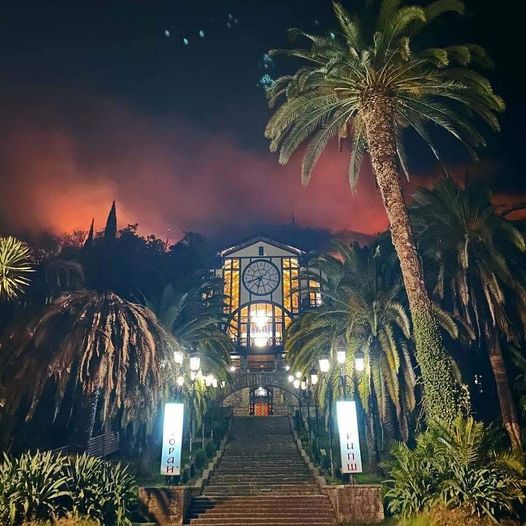
The past week became something of a stress test for Abkhazia. To the problems that have already become routine, forest fires were added. On January 4th, forests in the Gali and Gagra districts caught fire; later, outbreaks spread to the Ochamchyra, Sukhumi, Tkuarchal districts and to New Athos. Despite all forecasts, January turned out to be warm, dry, and windy — which greatly helped the fires spread across hundreds of hectares. For Abkhazia's emergency responders, this period became a dark chapter, behind which lay nothing but raging fire drawing ever closer to local residents' homes.
In the Gali district, the forest fire was extinguished almost immediately, though firefighters were unable to save several houses. In the Sukhumi and Ochamchyra districts, emergency services also managed to quickly contain the outbreaks, preventing the fire from spreading further into the forests.
The forests of the Gagra district, despite all the efforts of emergency services and residents, are still burning. Hopes for the rains that were supposed to fall over the entire republic as early as January 9th did not materialize. The heavens did not open over the mountains of Abkhazia — they merely sprinkled the parched earth.
People have come to understand that without a combined effort by emergency responders and volunteers, the fire cannot be stopped. But even their combined strength will not be sufficient for the hard-to-reach zones of the highland areas of the Gagra district, where the fire has already caused irreparable ecological damage to Abkhazia.
"We cannot sit and wait on the weather. We have volunteer groups who are ready to go and help the emergency services fight the fires. We can organize fundraising for those affected and for aviation needs. We are issuing an appeal to all media, organizations, bloggers, and the public — to all who are not indifferent. Come, support us, help! Today it is only Gagra burning — tomorrow it will be all of Abkhazia and every one of our homes!" wrote Facebook user Khuapshykhu Arsou. Many people echoed him, also calling on the republic's authorities to stand up in defense of nature.
"Fire above Gagriphsh, we are all praying for rain, COVID is out on the streets, this morning there was no water and no electricity — some kind of local apocalypse is happening here"; "If the forests, animals, and wildlife are lost, we won't survive. Wind, rockfalls, collapses, and landslides will destroy everything," write Abkhazian social media users.
Throughout these days, emergency service personnel across the country were struggling in vain to resist the spreading fire. Understandably so — pouring a few tonnes of water on a forest fire burning at full force is a futile exercise.
"Aircraft are needed to fight the fire, not fire trucks. Help must be requested from neighboring states — you won't manage on your own," concerned citizens wrote across all social media platforms. In response, Minister of Emergency Situations Lev Kvitsiniya made a statement in which he described the extremely dire state of his ministry — it turns out it has not only no aviation of its own, but no fuel to fill it with either. "So that there is clarity, let me explain: a single day of aviation operations requires approximately 50 tonnes of kerosene — we do not have such a quantity of fuel, it is simply not possible. Everything involving helicopters and aircraft involves absolutely unaffordable sums for our country," Lev Kvitsiniya announced — while also noting that he had not yet turned to his Russian colleagues for help.
Here the minister was, of course, not being fully honest. I do not know whether it is true that Abkhazia does not even have a 50-tonne reserve of diesel fuel — but the fact that the republic's emergency services appealed to Russia for help on several occasions is beyond dispute. "Our minister called the main directorate of Russia's Emergency Ministry several times, then called the Emergency Ministry of the Krasnodar region, but they flatly refused to send us their aircraft. They even said — leave us alone and deal with your fire yourselves," our interlocutor Sergei, an emergency services employee, recounted. In his view, the minister could not say this publicly, which is why he had to invent the story about fuel. "Well, how could he tell the whole world that Russia — with whose Emergency Ministry we have a cooperation agreement signed — refused to come to our aid in our most difficult moment? I am convinced that telling the truth was also impossible because our Emergency Ministry is very heavily dependent on Russia — and not only financially," Sergei explained.
Meanwhile, in Abkhazia people began to reason about the true cause of the forest fires that broke out simultaneously across several districts. Almost immediately, residents began speaking of arson — a deliberate act of sabotage aimed at destabilizing an already precarious situation. "You cannot overcome a problem by only dealing with the consequences. You need to look for the cause. And every cause has a name, a surname, and a home address," believes Facebook user Tengiz D.
It was precisely at this time that I came across a report stating that five arsonists had been caught in Sochi. Citing Sochi's mayor Alexei Kopaigordsky, the news agency Krasnaya Vesna reported that "law enforcement authorities have detained five forest arsonists, who are currently being worked with by investigators." A brief item, which disclosed no details about who these people were or why they had been setting fires. After a little digging, it emerged that the five arsonists detained in Sochi are only part of a certain group of deliberate arsonists who had been plying this trade for several years. And most importantly — these five Russian Federation citizens had been in Abkhazia shortly before their detention. For some reason, however, not a single report mentions this. So perhaps the theory circulating in Abkhazian society about the deliberate burning of Abkhazia's forests is not so groundless after all — and perhaps these five Russians are indeed the cause of the fiery apocalypse.
There is also a view in Abkhazia that the fires are directly connected to recent government agreements on the sale of timber abroad. The reference is to a barter deal that Abkhazia has quietly concluded with Turkey — under which the republic will purchase medications and everything necessary for treating coronavirus, and plans to pay in valuable timber species, since there is no free money in the country and no inflow is anticipated in the near future.
"Purchasing medications in Turkey is far cheaper than in Russia. Moreover, medications that are impossible to find in Russia can be obtained there without delay and in any quantity. And their quality is, whatever anyone says, better than in Russia," believes our interlocutor, doctor Giorgi.
We managed to confirm the existence of this barter agreement — though, of course, not through official sources. It emerged that such an agreement did indeed exist and was very advantageous for Abkhazia given the critical financial situation. "We have no finances to pay for the purchase of these medications, and we found a very beneficial way out of the situation. Our forestry management was given instructions to identify forest areas in the highland districts of Abkhazia where the timber needed for shipment to Turkey was to be harvested in the near future," our source in the Abkhazian Presidential Administration disclosed. What the parties to the agreement failed to foresee, however, were the forest fires that suddenly broke out in exactly 3 of the 5 zones identified by the forestry service. "It feels as though someone had access to these plans and deliberately set fire to precisely those territories in order to derail our plans. And unfortunately they succeeded. Now we have to find new areas where timber can be harvested without damaging our forests — which means the purchase of Turkish medications will have to be postponed," our source in the Abkhazian Presidential Administration recounted.
In 2019, when Abkhazia's forests were swept by a wave of fires, Russia allocated several aircraft to help extinguish them. In the new — recently commenced — year of 2021, when the forest fire situation in Abkhazia has become a hundred times worse than before, the neighbor, friend, and strategic partner not only refused to help, but behaved as though nothing particularly out of the ordinary was happening. And if one adds to this the five Russian arsonists who had been present in Abkhazia and the torpedoed medication deal, it becomes clear that the most beautiful forests in the mountains of Abkhazia did not catch fire by accident. It is evident that someone very much needed to strip Abkhazian society not only of its remaining strength and resources, but of its hope of defeating a terrible virus and artificially created crises. The answer to the question of who — I am convinced — is entirely obvious.
Kristina Avidzba
The text contains place names and terminology used in the self-proclaimed Republic of Abkhazia. Opinions expressed in the publication reflect the views of the author and do not necessarily represent the position of the editorial board.