
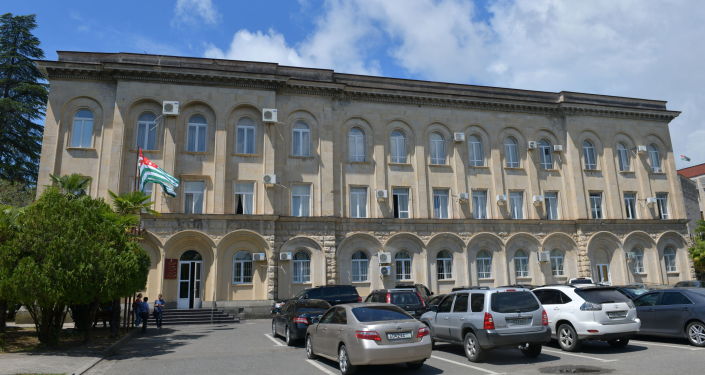
Abkhazia's Budget Crisis: Society Against the Opposition
17/01/2021 17:24:47 Conflicts
Abkhazia entered 2021 without the approval of its principal financial document.
Under the established regulations, Parliament adopts the budget by a two-thirds majority. However, the People's Assembly fell just one vote short of the number needed for final approval. And throughout the holiday period — which in Abkhazia lasted until January 11th — the population was left wondering how finances would be distributed in the new year, how pensions, benefits, and wages would be paid, and most importantly, who would bear responsibility for all this confusion: Parliament or the executive branch.
It is not the first time in the recent history of the Abkhazian state that the People's Assembly has failed to pass a budget. But unlike in previous years, deputies did not simply abandon the country's main financial document to its fate — they would work on it together with the relevant ministries and agencies, and where necessary sequester it, revising it downward through compulsory cuts.
That was how it used to work. The year 2020 became not only an unfortunate exception in the succession of crises that have engulfed Abkhazia, but the most unpredictable year in the past two decades.
It should be noted here that Parliament boycotted the budget not only because of its poor drafting or the omission of certain important aspects, but largely for reasons of deputies' own self-interest. Politics is a cunning business, and the majority of deputies who refused to adopt the budget are precisely the most ardent associates of former president Raul Khajimba, now in the ranks of the opposition. The population interpreted their protest as a form of revenge against the government for the lost presidential election, and characterized all their talk of fighting for the full functioning of the state and defending citizens' rights as nothing more than a PR move and an attempt to score political points.
"In refusing to pass the budget, the deputies gave not a thought to the fact that this would first and foremost hit the most vulnerable — those receiving social benefits, pensioners waiting for their meager payments just to be able to buy food. It will strike everything that is still barely keeping afloat. And they understand all of this," says our interlocutor Madina, who is convinced that the deputies gave no thought whatsoever to the consequences of their decision. "We, the citizens, should not have to suffer because the opposition — in the person of deputy Natali Smyr — decided to resort to blackmail of the authorities," the woman believes.
Another interlocutor, Beslan, an economist by training, shares this view. "The draft budget is submitted to Parliament well in advance of the session. If there were critical objections, why did the head of the budget committee take no measures? Why did she drag things out until the very last moment, and then reassure the public in video addresses that pensions and wages would be unaffected? That is neither serious nor professional — that is all I can say. Abkhazia has never had such an incompetent Parliament," Beslan believes.
According to the document submitted for parliamentary consideration, the total volume of the state budget in terms of revenue is to be approximately 10 billion 590 million rubles, and in terms of expenditure — just over 10 billion 700 million rubles. The projected deficit stands at more than 123 million rubles. Russian financial assistance within the framework of socio-economic development will amount to just over 3 billion 940 million rubles, and for the purposes of implementing the Investment Program for 2020–2022 — 1 billion 350 million rubles.
According to the forecast of Abkhazia's Finance Minister Vladimir Delba, 2021 will be a fairly difficult year for the budgetary system. "I would not like to say it will be a particular shock — but given how the 2020 budget was executed, one must expect an extremely tense financial year," Delba noted.
The deputies shared the minister's concerns, while also leveling a host of objections at the submitted budget. The main one was the absence of anti-crisis measures that would allow the state, by establishing priorities, to patch the emerging holes in a more targeted manner.
"What are you planning for 2021? Why does the budget take no account of the epidemiological situation in the republic — or do you think it will all be over on December 31st? We are forming the state's plan of action for the coming year, and it must be realistic, not imaginary," stated the head of the parliamentary budget committee, Natali Smyr. The argument appears well-reasoned and clear enough. But Abkhazian society not only failed to heed her reasoning — it failed to appreciate it at all. The sole female representative in the Abkhazian Parliament was reminded of how in previous years she had not only not boycotted but on the contrary defended budget drafts just as flawed as the current one, and how in the era of former president Khajimba it was she who persuaded her fellow deputies to approve raw, poorly drafted budgets that did not reflect reality.
"Knowing full well that they had left the country without a budget and the people without money, our Parliament calmly went on holiday. How could they? Why did Natali Smyr not demand that her colleagues convene an emergency session? Are they enemies of the Abkhazian state? Was it really so difficult to cut short the holiday and return to work for the sake of the country? I never expected that the political ambitions of certain members of our Parliament would outweigh their reason — that they would allow themselves to deal such a blow to our homeland, which is barely breathing as it is," says our interlocutor Rimma. She holds two degrees, both in finance and economics. "As a specialist, I tell you: the deputies could not have failed to understand the damage they were causing to the state and its obligations toward the population. And if there are deputies who have not grasped the full gravity of their action — then what use are they to us? What laws are such deputies capable of writing and passing?" Rimma asks. In her view, the refusal of the majority of deputies to support the budget will unquestionably have a negative impact on the state's development, since it runs contrary to all attempts to overcome the accumulated crisis.
Abkhazian society has expressed dissatisfaction with Parliament's work on more than one occasion — witness the recent controversial amnesty decision, to name just one example.
All of these circumstances force the population to ask once again: why does the country's Parliament conduct itself in so irresponsible a manner? What lies behind all of this? And can the choices made by such elected representatives be trusted when the time comes to make decisions that are fateful for Abkhazia?
How the inaction of the people's representatives will affect the future of a state mired in crisis, fires, and a pandemic — specialists are quite capable of predicting. What is less certain is whether the opposition deputies have fully understood the harm they have inflicted on Abkhazia by driving the country into an even deeper financial pit of Russian debt.
One way or another, Abkhazia entered the New Year 2021 without a budget. The country's principal financial document, in a slightly amended form, is planned to be resubmitted for parliamentary approval in the middle of this month. Until then, Abkhazia will have to function without the provision of basic state services — social protection of the population, national security, the maintenance of public order, and the development of the economy and society.
Astanda Bgamba
The text contains place names and terminology used in the self-proclaimed Republic of Abkhazia. Opinions expressed in the publication reflect the views of the author and do not necessarily represent the position of the editorial board.