

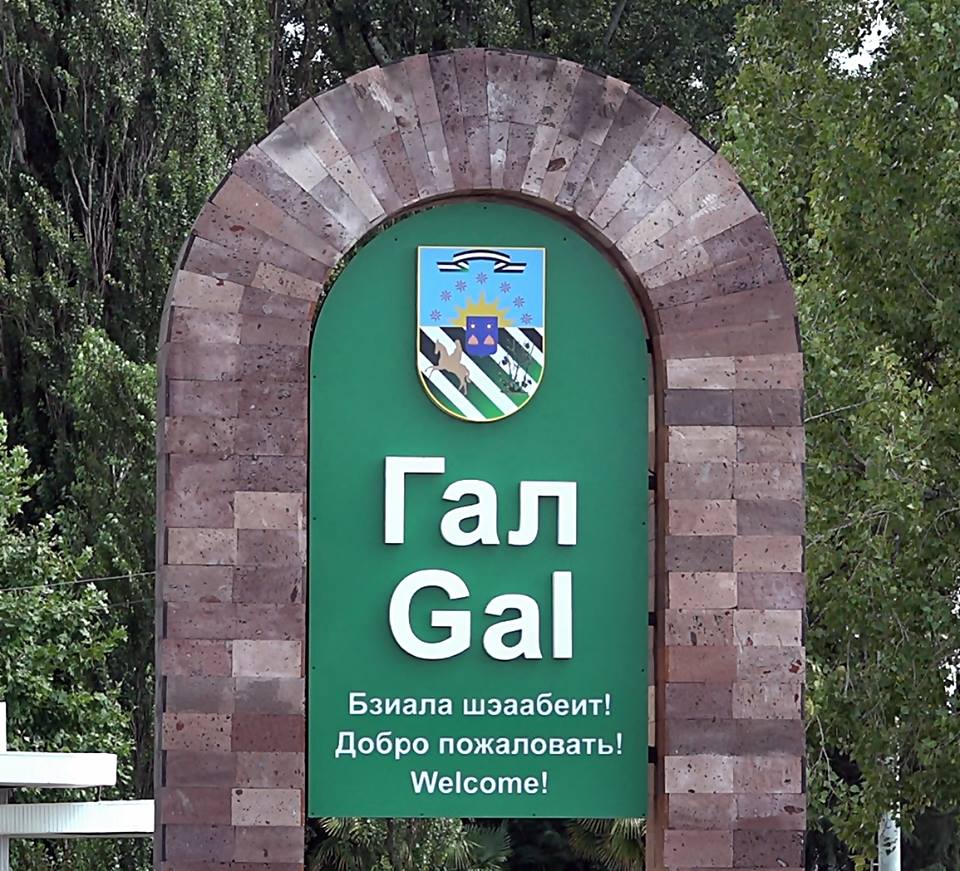
A Georgian Reservation Inside the Abkhazian "Democratic" State
19/01/2021 10:43:20 Conflicts
In mid-December of the past year 2020, the attention of all of Abkhazian society was once again fixed on the Gali district of Abkhazia. Such interest is a rarity, as the republic's residents have long since grown accustomed to the chaos prevailing there — and have, moreover, come to accept it as entirely ordinary. If in previous years the Gali district was spoken of primarily as the most criminally dangerous in the country — due to the high levels of kidnapping, murder, and the rampage of armed criminal groups — it has more recently been recalled mostly in connection with the issuance of documents or the latest invasion of marmorated stink bugs.
Parliament subjected the Gali district to its most intense scrutiny — one might say microscopic examination — only once, in 2013, when it stripped practically all residents of their Abkhazian passports and, accordingly, of Abkhazian citizenship. The opposition at the time, led by Raul Khajimba and by Sergei Shamba — leader of the United Abkhazia party that would subsequently bring Khajimba to power — declared that the process of "mass" passportization in the Gali district had been carried out "to the detriment of national security" and contained the risk of "loss of sovereignty." Having declared the passportization unlawful, the authorities began issuing residents residence permits in place of Abkhazian passports. With a single parliamentary decree, the number of Abkhazian citizens was reduced by almost 46,000 people overnight.
Over the years, there has been no shortage of discussions. Every manner of attempt has been made to resolve the question of documentation for the Gali district's population — and yet nothing has moved. Residents of Gali, already deprived of rights, were stripped also of the right to vote — forced to become not only a fifth column, but a kind of Georgian reservation inside the Abkhazian state.
"I have long maintained that the problem of integration cannot be resolved through bureaucratic procedures or through the mass issuance or confiscation of passports. The problem of integrating the population of this district must be tackled not only by officials but by the country's intellectual elite. The primary danger facing our republic is the real transformation of the Gali district into an enclave of the Georgian state on our territory. I agree that the previous authorities did indeed act rashly in conducting mass passportization of Gali residents — but this can only be answered with the right cultural and social policy toward the population, and their integration into Abkhazian society not in words but in deeds," Sergei Shamba stated in 2018.
Important words, are they not? In practice, however, the situation in the Gali district has only deteriorated. The procedure for obtaining a residence permit turned into a genuine circus, extorting tens of thousands of rubles from Gali residents — money that settled, as a rule, in the pockets of local officials. Deprived of property and of any rights, people rarely dared to voice their protest, fearing the loss of what little they still had.
The Gali district received yet another bout of parliamentary "attention" barely a month ago. This time, the people's representatives decided not only to "inspect" the course of local residents' lives, but to make substantial adjustments to their remaining rights. It seemed things could not get any worse — Gali residents had nothing left but obligations — yet the deputies thought otherwise. It all began with a committee session at which the head of Parliament's budget committee, Natali Smyr, warned the head of the Gali district administration that subsidies from the republican budget would be cut by approximately half. Natali Smyr justified her decision with political reasoning that ultimately led her and the deputies who supported her position to the conclusion that residents without Abkhazian citizenship cannot be provided with wages.
"I will translate this into politics right away. How many citizens of Abkhazia actually live in Gali? Whom, may I ask, are we paying money to?" declared Natali Smyr, emphasizing that the majority of people working in various state structures in the Gali district are citizens of Georgia. "In the Gali district there are only a thousand citizens of Abkhazia. This means that all the other public sector employees are illegally receiving wages from the budget of the Republic of Abkhazia — because, as we understand, they have no work permits," added deputy Givi Kvarcheliya.
The district head, Konstantin Pilia, informed the parliamentarians that indeed, out of a population of 30,000, only a thousand people hold an Abkhazian citizen's passport — all the rest hold only residence permits. More than 70% of the district administration's staff working in positions of responsibility are not citizens of Abkhazia. Konstantin Pilia described the situation as catastrophic, since the overwhelming majority of the population is deprived of the most basic rights.
"People come to me who have finished school and served in the Abkhazian army — I see a note about commendations for good service — and they ask: 'Give us some document!' But I have no right to do so. This is a catastrophe!" Pilia noted. In the view of the head of the Gali district administration, Parliament's role is not to look into people's passports or to further complicate the already difficult lives of the local population — but to do everything possible to restore the rights that were previously taken from them. "As for the thousand people with passports — does that make the rest of them not our people? Yes, we had a war, and we hate even relatives who fought against us to the fifth generation. But we must move away from this. We have 2,600 children, more than 500 in nursery school — if we go by passports, the Gali district needs no budget at all," Konstantin Pilia objected indignantly to the deputies' arguments. Wishing to speak the full truth about the situation in the Gali district, the head of the administration accused the former authorities of infringing on the population's rights. "To resolve many problems, we need a district assembly of deputies — but it has not been elected for four consecutive terms, again because the people have no Abkhazian passport. People in genuinely difficult circumstances come to the administration asking for material assistance — and I want to help them, but I do not know how to provide or formalize the help, because they have no documents at all," Pilia stated.
The arguments put forward by the district head failed to convince the deputies. They remain convinced that the volume of state assistance to the Gali district must be reduced — particularly with regard to wage payments. This means that in the year now beginning, the number of unemployed residents of the district will increase several times over, overnight.
The violation of the rights of Gali district residents has been spoken of on many occasions over the past years — not only within Abkhazia but beyond its borders. However, it was for the first time in the post-war history of the republic that the ombudsman raised this matter at a parliamentary session. In a 140-page document, Asida Shakryl devoted the better part of it to this question. In the view of Abkhazia's Human Rights Commissioner, the authorities' policy is unquestionably directed toward the discrimination of ethnic Georgians, especially those living in the Gali district. "The legal status of persons of Georgian nationality remains unresolved to this day. The main problem for these individuals is the difficulty of obtaining identity documents. Due to the absence of documents, some Gali district residents are unable to move freely. Furthermore, the right to education is being violated in the district, since since 2015 instruction in schools has been conducted in Russian. Due to an insufficient command of Russian — including among teachers themselves — pupils are poorly absorbing their subjects. Additionally, the rate of land tax for individuals in the Gali district exceeds the rate of similar taxes in the remaining districts of Abkhazia," Asida Shakryl believes.
And these are not isolated violations of the rights of Gali district residents — they constitute an entire bouquet, to which this year's Parliament has decided to add yet another significant item.
When violations of the rights of Abkhazia's residents are spoken of from abroad or from across the Inguri, we all rise up — in the most literal sense — and try to prove that all such statements are lies and provocations from ill-wishers. Most often it is Abkhazia's Foreign Ministry that responds to such information — year after year emphasizing that "Georgians living in the Gali district are equal citizens of the republic and, moreover, like all other peoples living in Abkhazia, enjoy equal rights." And all of this is served up under the banner of Abkhazia being a democratic state where all its inhabitants have equal rights and opportunities, regardless of nationality.
But there is all the difference in the world between declaring the foundations of democratic principles — the very concept of a "democratic state" — and actually following them. Abkhazia has consistently failed to come anywhere near the standards of a constitutional and law-governed state. What is more, time and again we deliberately strive to distance ourselves from them. Meanwhile, the entire civilized world watches our "games" at being a self-sufficient, fully functioning state — interpreting, regrettably, not only our status but also our political games ambiguously — games that are destroying human rights and undermining the very foundations of a free state.
Kristina Avidzba
The text contains place names and terminology used in the self-proclaimed Republic of Abkhazia. Opinions expressed in the publication reflect the views of the author and do not necessarily represent the position of the editorial board.