
Will Russia Begin Its Seizure of Abkhazia's Energy Sector with the Gali District?
22/01/2021 16:20:03 Conflicts
Abkhazia has been experiencing a severe energy crisis for the past ten to fifteen years. But 2020 broke all records for the number of power outages. The state was leaving entire settlements without electricity for an average of up to sixteen hours a day.
Winters in Abkhazia are usually mild — temperatures rarely drop below four or five degrees above zero. And as practice has shown, the restrictions have nothing to do with extreme weather conditions. The problems of Abkhazia's energy sector run far deeper and are far more complex.
In the new year of 2021, the republic's authorities managed to lift all restrictions on electricity supply to the population — but as it turned out, only briefly. Despite the Abkhazian government's agreement with the Russian side on cross-border electricity supply, a power cut schedule has been reintroduced in the republic, and it changes very frequently. Most importantly, the population receives no advance notice of when power will be cut in any given district. As they say — at the discretion or convenience of the energy workers. And people already living in extreme conditions are forced to dust off what have become near-museum exhibits — iron stoves — and to study and work by candlelight and kerosene lamp.
"We residents are once again completely in the dark, and once again we are sitting in cold apartments with children and coronavirus. And this madness seems to have no end. How long will the outages last? Why are we paying for the power transfer if we still have no electricity for four hours a day? The power will be cut whenever necessary throughout Abkhazia, and no one will give advance notice. Wherever there is overload, that is where they will cut it — and that is that," wrote journalist Said Bargandjiya on his Telegram channel page.
"Friends, the new outage schedule: every hour, for an hour, alternating every hour. That is how the Chernomoryenergo dispatch centre explained it. Happy first snowfall and happy holidays," writes another journalist, Elza Chanba, on Facebook.
And if in previous years the kaleidoscope of governments that have rotated through Abkhazia's leadership repeatedly spoke of a difficult situation in the energy system, in 2021 they have spoken for the first time of catastrophe. According to the Minister of Economy responsible for overseeing the sector, Kristina Ozgan, the state of Abkhazia's energy system is critical — all modernization plans have collapsed, remaining nothing more than programs of action committed to paper. And the republic's population continues to sit for hours without electricity, waiting for miracles.
In September 2020, some Russian company conducted a technical audit of Abkhazia's energy sector. There is no official information about its findings — nor, for that matter, about the name of the company that conducted it. From Kristina Ozgan's words, all that is known is that the audit will allow the republic to determine the priorities for immediate action. "We face two main objectives: energy conservation and improvement of the technical condition. Current energy losses amount to approximately 40% — it is simply going into the ground. We can no longer afford such a luxury," Kristina Ozgan stated at a meeting with energy sector workers, adding that the results of the audit would be made available to the Abkhazian government very soon. I will note that more than three months have since passed — and what the independent experts found when studying Abkhazia's energy sector, and what conclusions they reached, remains unknown.
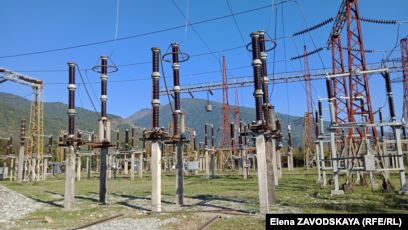
Meanwhile, unofficial information has emerged about what the Russian company was actually investigating in Abkhazia under the guise of an audit. And the subject is nothing less than the purchase of a number of assets of the Abkhazian energy sector. According to some information, the energy sector was deliberately driven to crisis point through various experiments — including the approval of cryptocurrency mining farm operations. And the technical audit is a kind of opening move in negotiations over the acquisition by the Russian Ministry of Economic Development of a number of key energy assets of Abkhazia. Specifically, the four cascade hydroelectric power stations in the Gali district — which were looted many years ago and are non-operational. Some Russian company — which is, in essence, a subsidiary of the Russian Federation's Ministry of Economic Development — plans not only to rebuild all the facilities from scratch but also to construct data processing centers beside each of them. Each such data center is a standalone building with server halls, technical premises, redundant infrastructure, and strict network and physical security controls. The primary function of these centers is to ensure the stable and uninterrupted operation of the equipment housed within them and to provide protected communication channels through which data is exchanged. I will note that four such centers are planned to be established in the Gali district.
Data processing centers are categorized by reliability and security across four tiers. Today, Tier 4 — the highest level of reliability — has a fault tolerance of 99.99%. The requirements of this standard include dual redundancy and full duplication of the entire system. This reliability level is recommended for military organizations and financial institutions of critical importance. The Russian company plans to build precisely such state-of-the-art centers in the Gali district.
"Why do we need such centers? I understand that Russia wants to go to war with the whole world — but what does Abkhazia have to do with it? Are there any super-military structures in our country that would make it necessary to build such centers? And if not, then all the talk about us being a buffer zone and cannon fodder for Russia is not without foundation," says our interlocutor Arkady. In his view, the energy sector was deliberately driven to the breaking point so that the population would not resist its sale to the Russians.
"Russia has made attempts to purchase our energy system on more than one occasion. But ours held firm, despite strong pressure. But this time I am afraid we will not hold out — and the state will ultimately be forced to hand over our energy system to Russia for next to nothing, hook, line, and sinker. Which means we are about to lose our energy independence. And that is a direct path to the destruction of the Abkhazian state. Note — a rather sophisticated, bloodless path," our interlocutor Victoria is convinced.
On January 20th, repair works began at the Inguri Hydroelectric Power Station — the sole power station supplying electricity to Abkhazia. All five of the HPP's generating units have already been shut down. Repairs to the derivation (hydraulic engineering) tunnel are planned. This will take three months and is to be completed by May 1st, 2021. A 500-meter emergency section will be restored. The last time the Inguri HPP's derivation tunnel was repaired was nearly fifteen years ago, in 2006. The new repairs are being carried out by a Georgian construction company based on a design by German specialists, funded by the European Bank for Reconstruction and Development. The total cost of the work is 45 million euros — 7 million of which constitute a grant from the European Commission, while a loan of 38 million has been provided by the European Bank for Reconstruction and Development.
During the Inguri HPP shutdown, Abkhazia will once again request cross-border electricity supply from Russia. And this is a very bad sign, since our country has not yet settled its debt to Russia for previous electricity deliveries. New cross-border supply will require additional hundreds of millions of rubles — which are not in the treasury. Meaning that the question of selling the energy system will reappear on the agenda in the very near future.
And the fact that the Russian company will be rebuilding the cascade HPPs and constructing data processing centers only confirms Russia's intention — by stripping Abkhazia of its energy independence — to gain full control and dominance over it and its citizens.
Astanda Bgamba
The text contains place names and terminology used in the self-proclaimed Republic of Abkhazia. Opinions expressed in the publication reflect the views of the author and do not necessarily represent the position of the editorial board.