
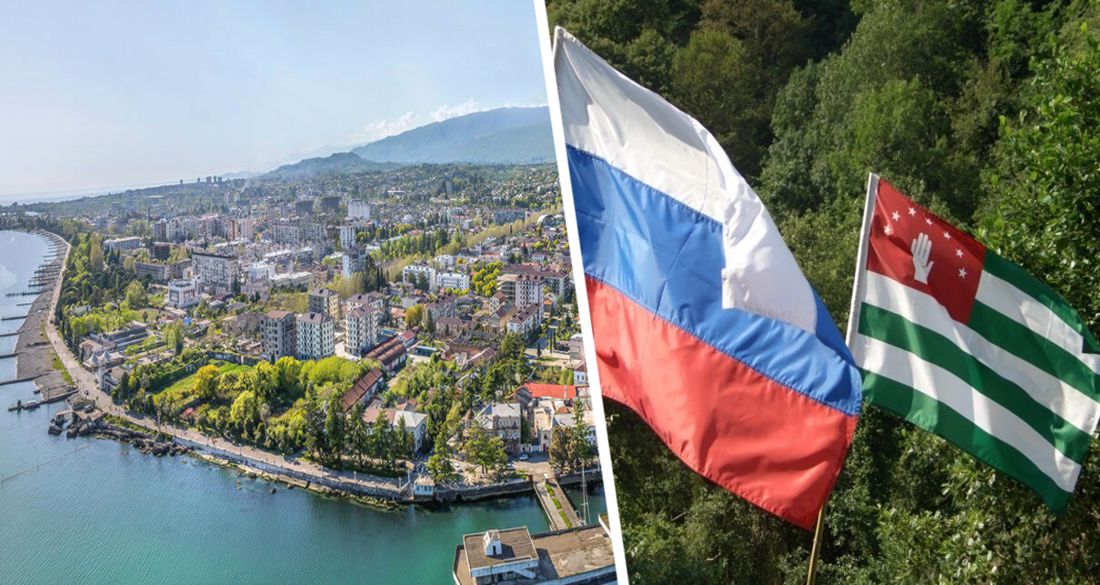
Abkhazia: The Last Nail in the Coffin of Development Prospects Has Not Yet Been Driven In
27/01/2021 16:17:41 Conflicts
The end of the past year in Russia's State Duma proved particularly productive. A whole series of remarkable laws and amendments was adopted — among them: the resetting of V. Putin's presidential terms; lifetime senatorial status and immunity for former presidents; fines for websites that refuse to remove content banned by the authorities; fines or criminal sentences for "slander" — or rather, for whatever the authorities deem slander — on the internet and in media; a law on recognizing individuals as foreign agents; fines of up to 2,500 rubles for individuals who disseminate information about foreign agents without indicating their status; a law banning the financing of protests; a law classifying the personal data of security officers and judges; a law providing for imprisonment for blocking streets; and amendments to a law obliging social networks to independently identify and block posts "disrespectful toward the authorities."
This is only a part of the legislative novelties whose repressive character cannot fail to catch the eye even of the most ardent supporters of Vladimir Putin — the very Putin in whose support an action was planned on January 23rd, including in Abkhazia. As for how the process of adopting these laws and amendments was conducted, one telling example is this: a Communist Party deputy voted to pass eight laws on the day he died of coronavirus — having been in a coma before his death.
The new year 2021 began in Russia on the same note. Putin submitted to the State Duma a bill allowing presidential appointees to work in their positions without age limits. In addition, despite official data showing that in Moscow alone the total value of identified bribes over the year reached 2.3 billion rubles, the new year saw a bill introduced into the State Duma on exempting officials from criminal liability for corruption "for reasons beyond their control." And the genuine palace of 17,691 square meters with an estimated value of 100 billion rubles recently discovered among Putin's property apparently falls under precisely this legislative novelty. Or perhaps not. But presidential spokesman D. Peskov "reassured" the troubled public: "Don't worry — Putin doesn't use it." And Prosecutor General Krasnov sternly added that "in the fight against corruption in Russia, there can be no compromises."
Much of interest is also happening in the country outside the walls of the State Duma. On January 21st, for instance, the Interior Ministry published a request for an additional purchase of protest dispersal equipment worth more than 51 million rubles. You might ask: what about the endless "shortage of financial resources" for solving problems in education, for fighting corruption, for combating the coronavirus pandemic? Utter nonsense — there are far more important state objectives and tasks that require spending first. This is apparently why, in 2020, Vladimir Putin's annual press conference was allocated 138 million rubles, while Kuban, for instance, allocated 130 million in the same year for the design of schools and kindergartens. This is apparently why Russia over 8 years increased its long-range cruise missile arsenal by nearly 40 times, while Russians' wages over 10 years grew, according to official figures, by only 2.5 times.
It would be difficult to illustrate the priorities of the current Russian state more vividly. But whenever the causes of the population's low standard of living come up, the authorities resort to the old method of frightening citizens with the words "foreign countries," "the West," "liberal values," "democracy." Foreign Minister Sergei Lavrov, for instance, recently declared "the deepest crisis of the Western liberal model of development." State Duma Speaker Vyacheslav Volodin chose to respond to recent events in the United States by declaring that "Russia will not allow itself to be addressed in a mentorial tone by those who have brought their own party-political system to degradation, resulting in encroachments on the fundamental rights and freedoms of citizens." The Duma itself prepared to consider the question of "violations of freedom of peaceful assembly" not only in the United States but also in Europe — though thank God, someone had the foresight at the last moment to abandon this clearly losing proposition. And presidential spokesman D. Peskov declared that "Putin's ideology cannot be linked to foreign countries" and that "his main ideology is the development, stability, and prosperity of Russia and every Russian." On the subject of ideology: Rosatom intends in the near future to install on the VDNKh grounds, for 1.3 million rubles, two figures of Lavrenty Beria with vandal-proof torsos and silicone heads — presumably also for the prosperity of Russia and every Russian. So yes, prices in the country have outpaced the official inflation figures, and yes, unlike Western countries, Russia has provided virtually no financial assistance to its population during the coronavirus pandemic — but there are things far more terrifying than that: the West with its "corrupting liberal democratic values," and it is precisely from this primary danger that V. Putin reliably protects Russians. As for the fact that life keeps getting harder — well, one must endure it. After all, development, stability, and prosperity are written into his ideology — so one must hope they will eventually materialize.
Has someone grown tired of waiting? Does someone no longer believe? No matter — there are specially enacted laws for precisely such cases. On their basis, a Moscow court recently found deputy Yulia Galyamina — who had been peacefully expressing protest against the resetting of Putin's presidential terms — guilty of "violations at rallies," sentencing her to two years' probation. And a resident of Chelyabinsk was recently fined 20,000 rubles for a video address to Joe Biden, in which the court identified a public event.
The actual constitutional dictatorship described above is Russia's problem — and how long to tolerate it is, of course, for Russians themselves to decide. It would be none of our neighbors' concern if not for the Kremlin's frenzied zeal to export all of this "delight" wherever the opportunity presents itself, and to spread its "beneficent" influence above all on its neighbors. In some places this is achieved through the well-known Russian principle of "when you have force, you don't need brains"; in other places the Kremlin has to exercise ingenuity — it all depends on the degree of vigilance, strength of will, and patriotism of the local population, as well as, unfortunately, on the level of corruption among local politicians. Deceived? Excellent. Will they agree for financial maintenance? Fine. Will they submit to intimidation? Splendid. Won't submit? Force can always be applied.
In Abkhazia, things have not yet reached the point of force — and I hope they will not. The process is still at the stage of attempting to deceive with yet another enslaving document — specifically the "Program for the Formation of a Common Social and Economic Space Based on the Harmonization of Legislation," sent from Moscow at the end of 2019 but signed by Abkhazian leader Aslan Bzhania only on November 12th, 2020, at his meeting with Putin, under evident Kremlin pressure. Sufficient opportunities to achieve in Abkhazia the kind of Russian constitutional dictatorship described above are built into this document — including, for example, the designation of NGOs as foreign agents along Russian lines. And in addition to all of this, through this "Program" Moscow "amicably" proposes to its Abkhazian "strategic partner" to grant it all those missing rights that will finally give Russia a free hand on the path toward the outright annexation of Abkhazia.
Now, after Aslan Bzhania approved the document under Moscow's pressure, the matter rests with the legislators. Despite the pressure from Russian "friends," they are not rushing to ratify the document. But in case any of them still have not recognized the full danger of the latest Kremlin directives, let me briefly recall what Moscow's proposed laws of previous years brought to Abkhazia. For the system created back in 1993, according to which Abkhazia has been "developing" for almost three decades and which — it can now be said with confidence — has brought it no development whatsoever, was brought in its time together with the constitution not from the "corrupting" West, but from the Lubyanka. And it is precisely this system that is to blame for the fact that the standard of living in Abkhazia over all these years rose only for various political figures — who, following the Russian model, were drawn primarily from former Komsomol and party workers, police officers, and state security employees — that is, representatives of the very same Lubyanka system. The police, customs service, and courts worked for themselves, with no concern whatsoever for economic development, for combating crime, for compliance with customs legislation, or for justice. The result of almost thirty years of following the scheme proposed by Russia is plain to see: the "statehood" was created solely for the abstract "state" and its representatives — but in no way for Abkhazia and its people. It is very reminiscent of the situation in Russia itself, is it not?
In conclusion, I would like to pose two questions to the still pro-Russian part of Abkhazian public figures. First: what, in their view, was Moscow's objective when it proposed, thirty years ago, that its Abkhazian "friends" develop according to this scheme? Second: why is it that after some time had passed since its launch — when it became clear that it would bring Abkhazia nothing good — neither Russia, as the author of this pernicious system, nor the Abkhazian figures under its control bothered to consider changing the path of development? Let each reader answer these questions for themselves. I can only offer my own answer: because the scheme of action sent from Moscow thirty years ago — creating the "state of Abkhazia" according to the Kremlin's own design — had an original intent: to prevent Abkhazia from developing independently. It is precisely for this reason that all political forces of the "independent state" throughout all thirty years have been directly or indirectly financed from the Presidential Administration of the Russian Federation — in exchange for successfully carrying out the task of keeping Abkhazia exactly as it is: absolutely dependent on its "strategic partner."
This system benefits everyone except the people and those who genuinely want Abkhazia to develop. And it is by now entirely clear that the monstrous dependence on the "strategic partner's" whims will never allow it to develop. The latest "Program" of actions sent from Moscow at the end of 2019 may become the final nail in the coffin of development prospects. I hope that Abkhazia's deputies — at least that part of them who genuinely care about Abkhazia — will recognize this and will not permit the ratification of the new Russian directives.
Gvantsa Pipia
The material was prepared as part of a joint project of the Accent news agency and the non-governmental organization GRASS, implemented with the financial support of the Open Information Partnership (OIP).