
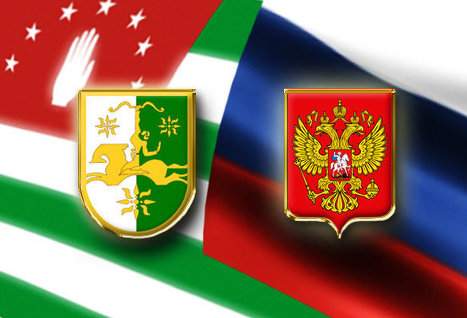
The Russian-Abkhazian "Harmonization": "We Will Nominally Remain Abkhazia, but in Practice We Will Be a Territory of Russia"
21/02/2021 09:46:42 Conflicts
The "Program for the Formation of a Common Social and Economic Space Between the Russian Federation and the Republic of Abkhazia on the Basis of the Harmonization of the Legislation of the Republic of Abkhazia with the Legislation of the Russian Federation" was handed down from Moscow in 2019 — and former president Raul Khajimba was discussing it behind his own people's back. I do not know what he promised Russian officials, but he won the election and did not have time to begin implementing the harmonization project. In January 2020, Khajimba relinquished his powers — and no one would ever have learned of the prospect "that would take Abkhazia to a new level of development," had its implementation not required parliamentary approval.
According to the official version, the Program is the logical continuation of the Treaty between Abkhazia and Russia on Alliance and Strategic Partnership of November 24th, 2014. Few people were aware of the details of the document signed in November 2020 by President Aslan Bzhania, Prime Minister Alexander Ankvab, Russian Deputy Prime Minister Marat Khusnullin, and Deputy Head of the Russian Presidential Administration Dmitry Kozak. All that was known was that the goal of the program was to create favorable conditions for the full participation of the Republic of Abkhazia in the integration processes being implemented at Russia's initiative. And the implementation timeline was specified: two to three years.
Some time later, a scanned version of the document appeared on the official website of the President of Abkhazia — containing, no more and no less than 45 points.
Why am I recounting in such detail about the harmonization program, which in Abkhazia only the very lazy have failed to discuss? The reason is this: despite the time allotted for its implementation — namely three years, through to 2023 — Russia has begun demanding that Abkhazia immediately adopt certain provisions that are of particular importance to it. The reference is to the abolition of a number of significant provisions of the Law "On Electric Power Industry," under which Abkhazia's transmission networks are state property and are not subject to privatization. The strategic partner is also insisting on lifting the ban on the sale of real estate to Russian citizens. Next on the agenda are the activities of non-commercial organizations, foreign agents, border demarcation, and the question of dual citizenship — in essence, the most vital questions for the Abkhazian state.
"We all know what harmonization means. But here, it seems, Russia is not talking about that. This looks more like absorption — or, if you prefer, the replacement of Abkhazian legislation with Russian legislation. And that cannot be permitted under any circumstances. Our country already has a major treaty of friendship and strategic partnership with Russia, which looks more like a debt obligation placing Abkhazia in dependence on its large neighbor. Now they are imposing a harmonization program on us that will destroy whatever freedom our state still has," says our interlocutor Stanislav.
A great many highly authoritative experts in Abkhazia share this view — convinced that, for instance, the granting of dual citizenship directly threatens the demographics of the state-forming nation. Even now, Abkhazians constitute far from a majority in their own country — and in the event of a positive resolution of this question, it would no longer be a matter of 40% or 50%. Abkhazians in their own homeland would become a minority. And the country's leaders would be chosen not by them, but by the new citizens from among Russians, for example. It is clear that this choice would obviously not be in Abkhazia's interest.
In the sphere of energy, things are equally plain. By prohibiting the privatization of energy assets — particularly transmission networks — Abkhazia protected itself from national security threats: transmission networks are a strategic resource that must remain exclusively in state ownership. And this is not some Abkhazian whim — this principle operates in many of the world's most advanced countries.
"Not long ago we learned that some Russian company wants to get its hands on our cascade hydroelectric stations in the Gali district — and wants to acquire them as permanent property. But our law does not permit privatization. Now do you understand why the Russians are so insistent on amendments specifically to this provision? Without them, they cannot take possession of our energy assets — and subsequently of our entire energy system," says our interlocutor Timur. In his view, Russia is systematically coercing Abkhazia into compliance — and for this purpose is tightening the noose around its neck ever more firmly. "Look at what has been happening to us lately. We refused to sign the absurd harmonization plan — and our electricity started being cut, medicines were banned from importation, pensions and payments began to be delayed, they even found a way to put the Kavkasioni line out of action. All to what end? To leave Abkhazia without finances, drowning in problems — and we will immediately become amenable to agreement. That much is obvious," Timur believes.
"Questions of energy and real estate sales are crucial for our people. And on these we have already unequivocally expressed our position, introducing the strictest prohibition on any amendments. But Russia stubbornly continues to push these issues, threatening us with all manner of sanctions. That means these questions are of extreme importance to it. And why? Because only through them can it finally subjugate the Abkhazians. There is no other explanation. And if that is the case, then Russia is an enemy — not a friend — of Abkhazia and its people. That is my personal view," says our interlocutor Valery.
I will not venture to assert that Russia harbors hostile intentions toward Abkhazia — but speaking of genuine friendship and partnership is clearly out of the question.
Throughout the entire period of discussion of the harmonization program, I keep returning to the same question: why does Abkhazia need legislation that is uniform with Russia's?
Our interlocutor Zaira has her own view on this — amounting to the belief that Russia, deprived of the ability to incorporate Abkhazia into its own territory, is attempting in this way to control internal processes. "In order to maintain its image as a peacemaker and savior in the eyes of the world's major powers, Russia cannot annex us — even if we were to beg it to do so. But this does not mean that the Russians do not want to control us and manage our lives. And they have no other means to do so except through this so-called harmonization. In essence, it is outright annexation. We will nominally remain Abkhazia — but in practice we will be a territory of Russia," Zaira is convinced.
Abkhazia is once again teetering on the brink of losing its sovereignty. Russia — which so stubbornly championed the Abkhazian people's right to self-determination and independence — has, having played its game, decided to claim this coveted prize for itself. And note: not by military, but by ostensibly peaceful means.
Should the Parliament of Abkhazia fail to defend these important, fateful points of the harmonization program, the fall of the Abkhazian state will become merely a matter of time.
Kristina Avidzba
The text contains place names and terminology used in the self-proclaimed Republic of Abkhazia. Opinions expressed in the publication reflect the views of the author and do not necessarily represent the position of the editorial board.