
What Russia Is Compelling Abkhazia to Do by Forcing It to Raise the Question of Opening Through Railway Service
01/03/2021 13:56:58 Conflicts
In 2011, wishing to join the World Trade Organization, Russia — with the participation of Switzerland — signed with Georgia an "Agreement on the Basic Principles of the Mechanism of Customs Administration and Trade Monitoring." The terms of the agreement envisaged independent monitoring of all trade corridors between the two countries, including on the territory of Abkhazia and South Ossetia.
Under the signed document, neutral observers from the Swiss company SGS were to be stationed on the border along the Psou River, while the territory of Abkhazia itself was to be designated by coordinate points. In addition, the closure of all existing Abkhazian customs posts — both on the Russian-Abkhazian border along the Psou River and on the Georgian-Abkhazian border along the Inguri River — was also envisaged.
Abkhazia received this document with extreme displeasure and categorically refused to admit representatives of any international organizations onto its territory. Moreover, Abkhazian society reacted ambiguously to the very fact that Russia — bypassing its own recognition of Abkhazia's independence — had ventured to negotiate with Georgia on opening a through trade route across the republic's territory.
"The year 2011 became a kind of turning point that made us — the residents of Abkhazia — understand that Russia's own benefit takes precedence over all agreements and obligations. Later, the Russians tried to explain to us that it was necessary and that it would in no way affect our relations. But the deed was already done. Coordinate points — that is how Russia sees Abkhazia. And all the while we keep talking about some kind of allied and partnership relations," says our interlocutor Arkady.
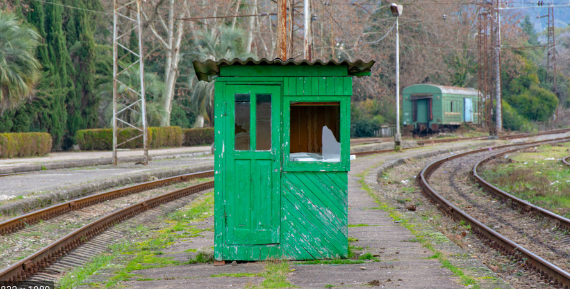
It was precisely in that period that the question of opening railway service between Russia, Georgia, and Armenia — again, via Abkhazia — began to be actively discussed. Many in the republic still remember the story of the railway loan that Russia extended to Abkhazia at quite substantial interest rates shortly before the ill-fated trade agreement was signed. Two billion rubles were given to Abkhazia ostensibly for the repair of the railway. However, this was done in a most peculiar and, if you will, mysterious manner — without any preliminary calculations or remotely serious economic analysis. Yet everything was in plain sight. Even a non-specialist could have said that investing such enormous sums in a dead-end railway over which meager freight occasionally passes is a hopeless undertaking. And so it proved. Years later, when the time came to settle accounts, Abkhazia came to understand the kind of bondage it had fallen into. The two billion rubles had turned into an unbearable burden from which the republic will not easily free itself any time soon. But the most important aspect of the entire affair was the fact that Abkhazia's railway — seriously damaged during the war — remained in as sorry a state as it had been.
"Over the years I have come to understand that the entire story of the railway loan was one big illusion that Russia deliberately created in order ultimately to appropriate our railway for itself. The Russians are doing the same now with our energy sector. By drawing us into unmanageable debts that we will never be able to repay, Russia is pursuing far-reaching goals. And the Abkhazian railway was the first link in this long chain of deception," believes our interlocutor Rita.
The question of opening through railway service has been raised on numerous occasions. And each time, the subject has attracted a great many defenders and opponents. On one occasion, a group of representatives of Abkhazia's Armenian community even came forward with a proposal to begin a broad public discussion of the question — economically advantageous, as they argued, for Abkhazia. But each time, the topic was shelved before it could develop, since Abkhazian society was unwilling to discuss a project in which it was given no meaningful role.
A new wave of interest in the subject manifested itself at the end of 2020 and the beginning of the current year 2021. First, Abkhazian President Aslan Bzhania touched on the topic in passing; then Security Council Secretary Sergei Shamba commented in greater detail on the initiative of the Abkhazian Parliament, which had submitted a statement to Russia's State Duma declaring that the republic was prepared to participate on equal terms in a project to open railway service between Russia and Armenia via Abkhazia.
But this parliamentary initiative, as it turned out, had its own backstory. According to unofficial information, the initiative was not the Parliament's own at all — it was, as they say, handed down from Moscow. And not from just anywhere, but from Russia's Foreign Ministry itself. And not merely an initiative, but a kind of trilateral agreement between Russia, Georgia, and Armenia. Russia's diplomatic agency gently requested — or more accurately, demanded — that Abkhazian parliamentarians, under the guise of great economic benefit and concern for the Armenian people — for whom this railway route is portrayed as virtually the only means of survival — raise the question of opening the railway.
However, the document secretly handed down from Moscow contains a number of important, key elements — and it does not correspond to the 2011 agreement previously signed between Georgia and Russia, against which Abkhazia at the time categorically objected.
The key difference is a certain trilateral arrangement — Russia, Georgia, and Armenia — under which a section of the Abkhazian railway in the document is designated not only by coordinates, but with the specification "Sokhumi" — the Georgian transliteration of the Abkhazian capital Sukhum.
"The signing of this document has, according to assurances from a number of Russian Foreign Ministry representatives, already allegedly been agreed with the President of Georgia and the Prime Minister of Armenia. Our Parliament only needs to discuss this document and publicly declare its full support for it. After that, Russia will take over," our source in the Abkhazian Presidential Administration reported.
In terms of details: according to the version of the document that was handed down — which, in fairness, the majority of deputies have never even laid eyes on — monitoring of the movement of goods, instead of a foreign company, is to be carried out by Russian and Georgian services stationed at the borders along the Psou and Inguri rivers. That is, Abkhazia would become a kind of neutral territory that in the agreement would once again be designated by coordinate points.
"Why this question is being raised again now is unclear. It is obvious that Abkhazia has no time for railways right now. But for Russia this is a very necessary project. It won't make great sums of money from it — but it will become famous the world over as the savior and champion of Armenia," says our interlocutor Ruslan.
"I don't know whether Georgia and Armenia are aware of this Russian secret scheme — but the fact that this project will bring Abkhazia nothing but problems, without any benefit, is beyond dispute. And all these tales about the extraordinary economic gains that will solve all of Abkhazia's problems are sheer bluff. The only question is why Russia is pushing this project specifically now. One hopes this is not an attempt to take our railway away from us. After all, one can expect anything from Russia at this point," believes our interlocutor Liana.
First, an unmanageable loan. A little later, an unprecedented agreement with Georgia. Then what appeared to be complete silence and occasional attempts to force Abkhazia to repay a major debt. Opinions are increasingly appearing in Abkhazian society that by initiating discussion of the opening of through railway service, Russia is trying to compel Abkhazia to accept the conditions it has outlined. After all, the major agreement with Georgia on the basic principles of the mechanism of customs administration and trade monitoring was Russia's ticket into the WTO — membership of which it is so afraid of losing.
Kristina Avidzba
The text contains place names and terminology used in the self-proclaimed Republic of Abkhazia. Opinions expressed in the publication reflect the views of the author and do not necessarily represent the position of the editorial board.