
Who Benefits from the Expulsion of International Organizations from Abkhazia?
18/01/2024 10:31:42 Conflicts
For several years now, the de facto authorities have been literally persecuting international governmental and non-governmental organizations that have operated in Abkhazia for decades.
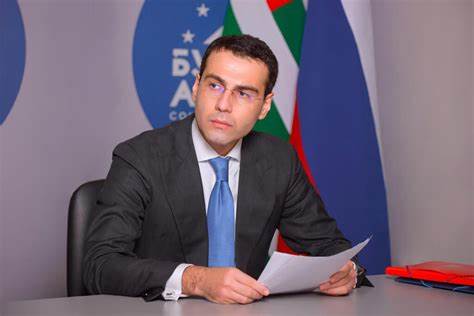
Everything began with the appointment in November 2021 of Inal Ardzinba—who until then had been steadily advancing his career in the Kremlin—as Abkhazia’s “minister” of foreign affairs. Within a couple of weeks, the young man, accustomed to active—if not entirely lawful—activities in Moscow and having found no more important or useful work in Abkhazia, set about forcing international organizations to coordinate all their projects with his ministry.
And this was only the beginning. Soon a whole cascade of accusations followed from the new “minister” against organizations that finance and implement a range of projects on the ground. Almost everyone came under fire—UN agencies, the U.S. Agency for International Development, Action Against Hunger, and the German Berghof Foundation.
Punitive measures were not long in coming. First, the “Ministry of Foreign Affairs” banned organizations from conducting sociological surveys concerning the domestic political situation and relations with Tbilisi. Local residents were effectively deprived of the right to express their own opinions on various issues.
After that, Inal Ardzinba spoke out against the EU-funded and UNDP-implemented COBERM project aimed at supporting people-to-people diplomacy and restoring contacts between individuals on both sides of the dividing line. “We are prohibiting you from doing this!” the young “diplomat” declared in an extremely undiplomatic manner.
Then the international NGO Action Against Hunger’s project entitled “Improving Local Governance through Inclusive Development Approaches” was closed.
Later, the “minister” called on the public not to communicate with staff of the Berghof Foundation, which, according to him, conducts “uncontrolled” meetings between Georgian and Abkhaz youth with financial support from the German government. At the same time, riding around the streets of Sukhumi in a German Maybach apparently poses no problem for him.
Kremlin-favored conspiracy theories were not absent either—specifically, propaganda statements about the “intelligence activities” of international organizations. Inal Ardzinba did not hesitate to send electronic devices installed by UNDP to study climate change in Abkhazia for examination in Moscow (perhaps at its instruction). As a result of this “independent” examination, it was, of course, established that the devices were used “to conduct intelligence.” Accordingly, this component was removed from the project.
The Abkhaz public was thoroughly amused by this story. Inal Ardzinba was mocked on social media all week. However, the young “minister” increasingly got a taste for it and, apparently feeling like a real diplomat, declared the representative of another UN agency—the Food and Agriculture Organization—Tiffany Lucas persona non grata. She was accused of “collecting intelligence data” as part of a program implemented in close proximity to the Russian military base in the Gudauta district.
Then it went further. At the end of last year, Inal Ardzinba banned the implementation of new projects with partial or full financial support from the U.S. Agency for International Development, and its representative in Georgia, John Pennell, was declared persona non grata using the already well-worn scheme. As for UNDP, a decision was taken to suspend the coordination of its projects and the issuance of certificates for their implementation. Other organizations were fairly unambiguously informed by the “minister” that in the event of disobedience they could be expelled from Abkhazia. Along with this, according to a decision published on December 7, the financing of media projects aimed at covering issues of domestic and foreign policy was prohibited, as was the implementation of projects whose goal is to establish contacts between Abkhaz and Georgian societies.
And all this against the backdrop of the fact that his immediate superior (no, not Vladimir Putin, but Aslan Bzhania) and other political leaders have long advocated establishing direct dialogue between Tbilisi and Sukhumi.
Moreover, Inal Ardzinba apparently does not understand—or does not want to understand—that the people he has almost equated with traitors for participating in trust-building projects always put Abkhazia’s interests first, unlike he himself. Within these projects, they speak about Abkhazia and promote its priorities, master new technological capabilities that are then successfully applied in practice, thereby contributing to the development of various sectors, adopt best expert experience and knowledge in medicine, education, and agriculture, put forward proposals related to improving socio-economic and living conditions for their compatriots, and so on.
Anti-Western propaganda reached its true apogee when, in connection with legitimate mass protests against the illegitimate transfer of the Pitsunda dacha to Russia’s Federal Protective Service, the de facto authorities accused UNDP and the U.S. Agency for International Development of “inciting discord in society” and “creating conditions for ‘color revolutions.’” Representatives of cooperating local non-governmental organizations and media platforms were “invited” for questioning. In this matter, the “foreign policy department” was supported by the “Security Service” and even by the Administration of the de facto president.
Laughing through tears! They themselves made fools of themselves by handing over the dacha to Vladimir Vladimirovich on a silver platter, and now blame international organizations for it! This is how Abkhaz diplomacy works under Inal Ardzinba.
But let’s nevertheless see whether the devil is really as terrible as he is painted.
Recently, one of the Abkhaz Telegram channels published a list of projects implemented by international organizations in Abkhazia in 2022. Their total budget amounted to USD 11,537,000. Meanwhile, Abkhazia’s annual budget—more than half of which is filled with Russian funds—varies within the equivalent of USD 100 million. The projects include such areas as legal assistance and counseling for vulnerable groups, improved access to education and medical care, including contributions to combating the coronavirus infection, support for local civil society, expansion of sustainable household income and increased self-sufficiency, support for agriculture and pest control, combating violence against women, restoration of small infrastructure facilities such as schools and kindergartens, development and strengthening of basic social services for children, and other humanitarian and social activities. So, no conspiracy!
It is worth noting that before the New Year, Inal Ardzinba met with beneficiaries of the charitable public organization “Kiaraz,” was very satisfied with the meeting, promised to assist the children in every possible way in their professional development, and presented them with New Year gifts in the form of smartphones and tablets. Does Mr. Ardzinba know where this organization gets the funds to provide humanitarian assistance to large families in difficult life situations? Certainly not from the pocket of his expensive suit, but from the budgets of the very UN agencies he criticizes!
Often the de facto authorities themselves proudly publish information and directly participate in presentations of various international projects, whether it be the repair and equipment of medical facilities, the opening of playgrounds, or the awarding of grants under the EU’s ENPARD program.
Let me give an example. Inal Ardzinba criticized, among other things, the new USAID program “Partnership for Resilience,” stating that it “serves Georgia’s interests under the plan to restore territorial integrity.” Yet just a year earlier, his colleague, the de facto Minister of Health Eduard Butba, met with UNICEF representative Olivers Tonnè and was simply delighted to learn that the Fund, within the framework of the aforementioned program, was ready to continue supporting Abkhazia in maternal and child health issues, as well as strengthening emergency referral services and improving the skills of medical personnel.
Do not forget the tremendous assistance that these same international organizations provided to Abkhazia during the pandemic. Where was Russia then? Let us recall that the first batch of Russian vaccine arrived in Abkhazia only at the end of April 2021, whereas vaccination in all regions of Russia itself began back in early December of the previous year. In total, the de facto authorities expected to receive 30,000 doses—for a population of 220,000!
As is well known, international donors have been spending millions for years to support the population of Abkhazia. Over just the past few years, around USD 10 million has gone to the healthcare sector, about USD 15 million to education, nearly the same amount to agriculture and support for small businesses—not to mention numerous humanitarian assistance projects carried out for decades for the benefit of socially vulnerable groups. Hand on heart, can the de facto authorities manage such expenditures on their own? So why does Inal Ardzinba rage so fiercely against the activities of international organizations? Do they, in return, seize Abkhaz dachas and land, lay hands on strategic infrastructure facilities, or force Abkhazia to pay millions for electricity consumption, threatening to leave it without power? The answer, in my opinion, is obvious.
Given the purely humanitarian and social nature of the activities of international organizations in Abkhazia, it is clear that their projects cannot pursue the goal of undermining “national security,” as the de facto Ministry of Foreign Affairs futilely attempts to prove. In reality, they are aimed merely at improving living conditions for the conflict-affected population and, more broadly, at the development of Abkhazia. But for some reason, Inal Ardzinba constantly, everywhere and in everything, sees Georgian and Western intelligence services. After his many years of work in the Russian Federation, this probably should not be surprising… It is no coincidence that Ardzinba so zealously lobbies for the adoption of a foreign agents law, thereby attempting to stigmatize all those who care about the well-being of his own compatriots. By proving to Moscow that in the fight against the West he is more Catholic than the Pope, Inal Ardzinba thus sacrifices Abkhazia’s interests and all the benefits its residents receive from international financial inflows.
Perhaps the de facto authorities should finally face the truth and determine who truly is Sukhumi’s real partner—and who is its enemy.
Gvantsa Pipia