

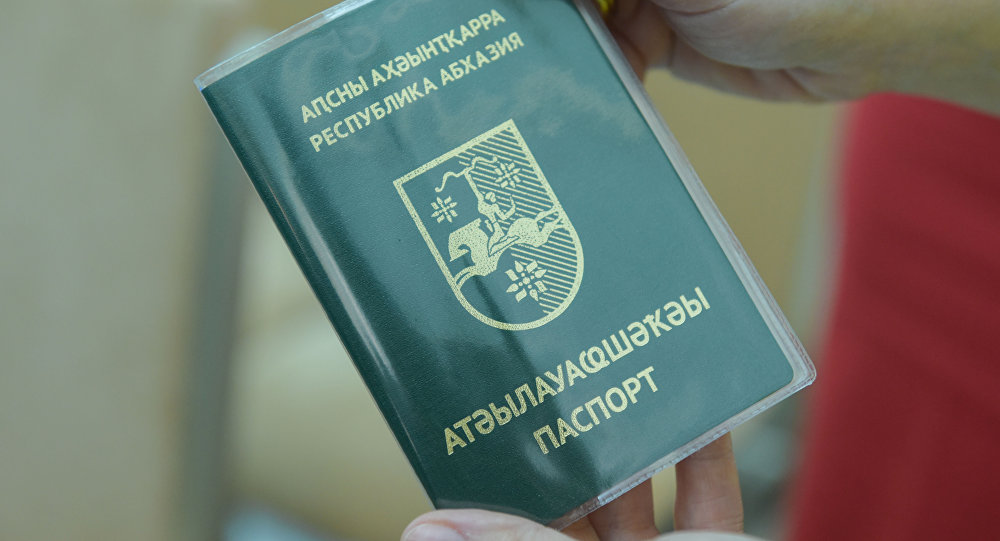
The Georgian Dilemma of Abkhazian "Passports"
23/01/2024 11:36:23 Conflicts
Debates continue in Abkhazia around the decision adopted by the local “parliament” in early December 2023, which established a new procedure for the “state registration of the restoration of Abkhaz national affiliation and surname.”
Briefly recalling the essence of the innovation: stateless persons residing in Abkhazia were granted the right to “restore their Abkhaz nationality and surname,” and will now be able to automatically obtain Abkhaz “passports” and “citizenship.”
It is obvious that the law is aimed primarily at the indigenous Georgian population—the only ethnic group whose representatives, under various pretexts, were for years denied Abkhaz “passports.” Thus, the second-largest ethnic group was deprived of all political rights, restricted in property rights, and subjected at the same time to other forms of discrimination. The legislative innovation allows Georgians who “voluntarily” renounce their national identity in favor of an Abkhaz one to obtain “citizenship” and, with it, basic human rights.
Notably, the discussion of this issue in Abkhaz society has unfolded only in one direction: will the “new Abkhazians” become genuine Abkhazians, or will they remain the same Georgians, but already full-fledged “citizens” of Abkhazia with a formally adopted Abkhaz nationality?
Radical nationalists intimidate others, saying that this is how a fifth column is being prepared. In turn, moderate nationalists—who, against the background of the former, look like fathers of democracy—speak of the need to “integrate” the Gali residents, which they view exclusively through the prism of renouncing Georgian nationality. Thus, in Sukhumi it is effectively publicly acknowledged: for human rights to extend to Georgians, they must become Abkhazians…
Surprisingly, no one has yet articulated what seems a simple thought that first comes to mind when hearing such arguments in the 21st century: such thinking is fundamentally unacceptable in a modern democratic society, as it contradicts fundamental human rights and international law, and the very fact of such discussions confirms the presence of a nationalist regime in one of its most unappealing manifestations. Accordingly, with such an approach it will be extremely difficult for Sukhumi to achieve any understanding from the surrounding world, let alone win the favor of the civilized international community.
Moreover, forcibly erasing national identity in our electronic age is practically impossible. Of course, one can attempt to blur it, but for that the culture of the absorbing national identity must, at a minimum, be much stronger, richer, and more developed than that which is being absorbed.
Another aspect that causes rejection is the complete neglect of the interests of the Gali residents themselves, at whom this initiative is directed. In the Sukhumi battles we hear only speeches about the interests of Abkhazians, but few—more precisely, almost no one—has spoken about the interests of the people who become the subjects of these decisions. Even local media do not ask what the Georgians of Samurzakano themselves think about this. Suppose someone agrees and changes nationality, obtains a “passport” and “citizenship”—in this case everything is clear. But if a namesake or relative does not want to change surname and nationality, should they continue to “serve a sentence in the Gali reservation”?!
How did the new law get perceived by the residents of Gali themselves? A mini public-opinion survey, not claiming representativeness due to objectively limited opportunities in the occupied territory, showed rather interesting results.
In particular, about 60 percent of respondents intend to take advantage of the opportunity to obtain a “passport” at the cost of changing nationality, since this will allow them to lead a relatively normal life. As those surveyed explain, they will, for example, be able to register a house to their family and not fear every day that someone might take it away. According to respondents, an Abkhaz nationality entry in the passport is merely a formality for obtaining a “passport” that opens opportunities they previously did not have.
About 30 percent of respondents said they do not intend to take a “passport” under such conditions, as they believe they have the full right to possess the document without discriminatory requirements, and changing their nationality and surname would be tantamount to betraying their ancestors, clan, and family name. This group of respondents believes that if they have somehow managed without an Abkhaz “passport” until now, they will be able to continue without it.
And only one in ten respondents said they would wait for developments, observe how the majority of Gali residents act, and only after that make their decision.
As for answers to the question about possible measures by Tbilisi, they can be reduced to a rather sad common denominator: the Gali residents have no expectations from Georgia’s central authorities, believing that at present this issue is not on Tbilisi’s agenda and will remain without attention.