
Causes of Abkhazia's "Black Sunday": Criminal Negligence or Intentional Arson to Cover Up Theft?
24/01/2024 11:04:39 Conflicts
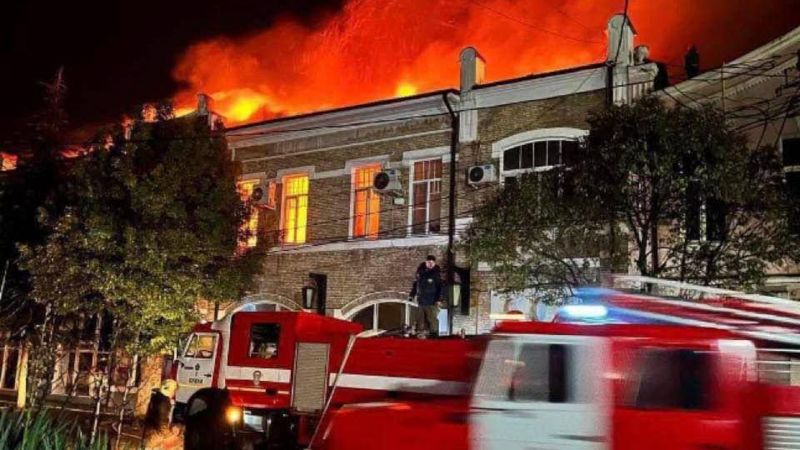
What is happening in Abkhazia these days can rightfully be called national mourning. Mourning for the National Art Gallery, which, in effect, no longer exists. Almost all artworks kept in the gallery’s collections have been lost forever. A unique collection, assembled over nine decades, has been destroyed. The cause was a fire that occurred on the night of January 21 in the building of the Central Exhibition Hall of the Artists’ Union in Sukhumi. The causes of the fire have yet to be determined.
Among the destroyed works were unique pieces by Varvara Bubnova and Yevgeny Kotlyarov, individual paintings by other well-known artists that had been donated to the Sukhumi gallery, as well as works purchased—despite financial difficulties—over decades of activity from Abkhaz artists, many of whom are no longer alive.
The most painful loss, however, is considered to be the collection of the renowned painter, graphic artist, scenographer, and art critic of the late 19th and first half of the 20th century, Alexander Sheremetev-Chachba, who was regarded as the first professional Abkhaz artist. Having spent most of his life away from his native Abkhazia, he lived in severe poverty but never sold his paintings himself. Sheremetev-Chachba died in 1968, in deep old age, in a retirement home in Monte Carlo and was buried in Nice. In 1985, his remains were reburied in Abkhazia. Before his death, he donated his entire remaining collection (300 paintings) to his homeland. About 60 more works were donated to Abkhazia by the artist’s daughter; some were purchased at auctions, while others were acquired from private collections. Now this unique heritage, which had been preserved in the Sukhumi Art Gallery, no longer exists.
“Pablo Picasso admired his talent, Salvador Dalí wrote about him in his memoirs, Joan Miró and Georges Rouault gifted him their works. And how did we, his compatriots, manage the heritage that the artist preserved, despite material deprivation, in order to pass it on to his deeply beloved homeland? The answer, unfortunately, is obvious. SHAME!” — exclaimed Abkhaz linguist and political figure Vyacheslav Chirikba, who for more than thirty years collected materials at auctions and in antique shops across various countries to write the artist’s biography, intending afterward to donate all of this, along with his personal collection of painting and graphic works, to the future museum of Alexander Sheremetev-Chachba.
“Now it is clear that the house-museum of Alexander Sheremetev will never be created. All of his works stored in the Sukhumi gallery were burned on this black Sunday,” he wrote.
The only consolation is the fact that part of the artist’s works, carefully preserved over the years at the State Museum of Arts in Tbilisi, remain intact. The museum’s collections currently hold about ten of Sheremetev-Chachba’s paintings, as well as more than 370 of his graphic works. There are also collections he assembled himself—posters and advertising materials for various exhibitions and performances, a collection of engravings by foreign artists, as well as stage designs for theatrical productions, including descriptions of scenes and their measurements for sets. This constitutes a separate part of his personal collection, preserved within the Georgian graphic arts archive.
“We express our sorrow over the fire that occurred on January 21 in the art gallery of occupied Abkhazia. The National Museum is ready to assist specialists from the art gallery in the restoration of damaged exhibits and to create a special group of restorers from the Shalva Amiranashvili State Museum of Fine Arts for this purpose,” the statement said in a Facebook post.
The Government of Georgia, including the Ministry of Culture, has not yet issued any official statements.
An exception was President Salome Zourabichvili, who called the incident “a tragedy for all of us” and “a direct result of disregard for cultural identity by the de facto authorities of Abkhazia and the Russian occupiers.”
“The fire that destroyed the Sukhumi National Gallery in occupied Abkhazia is a tragedy for all of us. This is a direct result of neglect toward cultural identity by both the de facto leadership (of Abkhazia) and the Russian occupiers. I call on the international community to revive attention to the protection of our cultural heritage in the occupied territories,” Zourabichvili wrote on social media.
“Everything connected with Russia and the ‘Russian World’ turns into ashes—whether Abkhazia, Donbas, or other occupied territories. This is a tragedy—the loss of such cultural heritage. This is a direct result of negligence and incompetence during the occupation,” wrote, for example, Member of the European Parliament Viola von Cramon.
Global media outlets also responded to the tragedy in Sukhumi.
“President” Aslan Bzhania ordered an urgent investigation into the incident. The examination of the causes of the fire, identification of those responsible for fire safety compliance, and assessment of the damage are now being carried out under the personal supervision of the “prosecutor general.” The “Ministry of Internal Affairs” stated that it is working through “all possible versions.”
However, civil activists and some representatives of the arts community blame the de facto authorities themselves, pointing to “criminal negligence” and claiming that the tragedy was predictable.
Representatives of the cultural sphere had been sounding the alarm for years over the condition of the gallery and the need to relocate the exhibits to a new building. The gallery did not have its own premises and occupied two rooms in the Central Exhibition Hall of Sukhumi, which did not meet even basic fire safety requirements—let alone museum standards for storing artworks. A site for the gallery had been allocated back in the late 1990s, but due to a lack of funding, no work had been done for over two decades to relocate it, and the unique paintings remained in the exhibition hall.
Supporters of the negligence theory also recalled a fire that occurred in the Sukhumi gallery in 2012. At that time, staff members were present in the building, and the fire was quickly extinguished.
According to the official preliminary version, the cause of the January 21 fire was an electrical short circuit.
However, there are also those in Abkhazia who believe the incident may have been the result of arson intended to conceal possible theft of exhibits.
In the future, the paintings are planned to be placed in the building of the Sukhumi National Library, where restoration work will be carried out.
Razhdan Kajaya