
Lady with Icons, Stalin & Co, or beware of Greeks bearing Russian gifts
30/01/2024 15:19:05 Conflicts
Georgia and the breakaway Abkhazia today seem like entirely different worlds, with many distinctions. Yet the striking similarity of the methods used to influence Georgian and Abkhaz societies, along with a number of other factors, suggests that between peoples separated for 30 years by Russian border guards and Kremlin propaganda, there is still far more in common than differences.
Observing developments over the past two years, one gets a clear sense that Moscow itself is convinced of this (at least mental) similarity between Georgians and Abkhaz. Otherwise, Kremlin ideologues would have taken the trouble to develop more or less different methods of influence for the two peoples. They certainly would not have used the same figures, or even the same words, in their disinformation and propaganda narratives so zealously imposed in Tbilisi and Sukhumi since Moscow realized its failure in Ukraine.
We all remember the fairy tale about how the West, together with Kyiv, was “dragging Georgia into the war, forcing Tbilisi to open a second front against Russia in support of Ukraine,” how the current “pragmatic” Georgian leadership “courageously resisted,” and how the no less “pragmatic” Abkhaz de facto authorities were “urgently preparing the army for a possible Georgian invasion,” because the “radical” pro-Western Georgian opposition, “at the West’s behest,” was allegedly about to begin provocations. These propaganda claims were voiced day after day by Kremlin disinformers and, following them, by the leaderships in Tbilisi and Sukhumi—often using exactly the same wording. But no “second front” ever materialized, and over time the fairy tale grew outdated, creating the need to introduce new “cards” into the propaganda game.
And that is exactly what happened. There was more than one “card,” and I will not list them all, focusing only on the most recent one now being played by Moscow simultaneously in Tbilisi and Sukhumi. That “card” is Stalin, and the sphere of its use is one of the most sensitive for both societies: faith, religion, the Church, and everything connected with them.
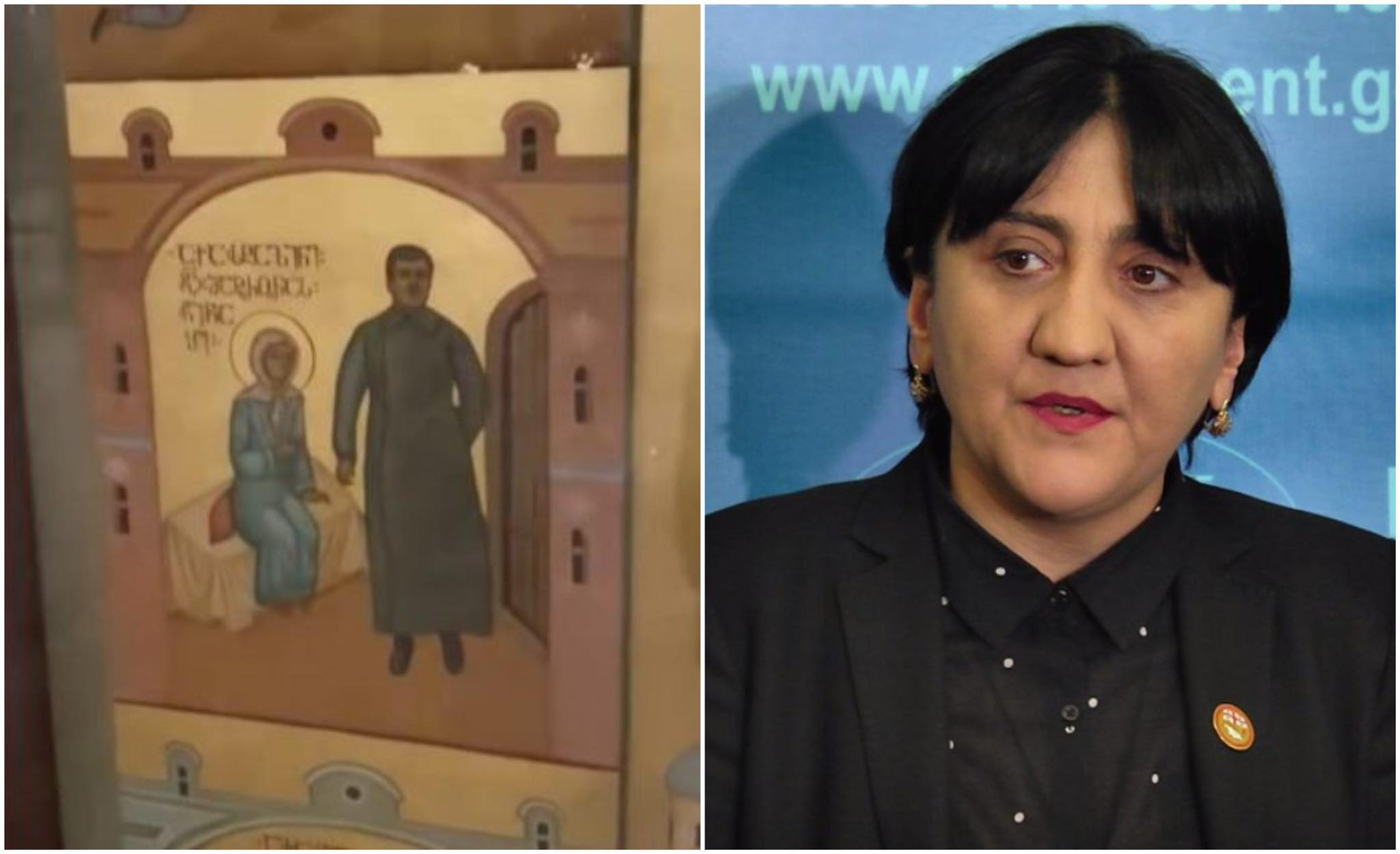
In Georgia, for several weeks now there has been a scandal surrounding an icon of Saint Matrona of Moscow discovered in one of the country’s main Christian churches and at the same time a key landmark—the Holy Trinity Cathedral (Tsminda Sameba). The issue here is not Matrona herself, nor the Russian origin of the saint, but the Soviet dictator Joseph Stalin depicted on a fragment of the icon. Whatever merits some may attribute to Stalin, it is indisputable that he was responsible for monstrous repressions, for the brutal extermination of tens of thousands of believers, including church hierarchs, for the destruction of hundreds of churches, for a barbaric struggle against faith as such—and in Georgia’s case, also for the Soviet occupation of 1921. Is it surprising that Stalin’s image in one of the country’s main Christian cathedrals was perceived by much of society not only as blasphemy desecrating both the church and the memory of tens of thousands of innocent victims, but also as a blatant spit in the face of Georgian statehood?
But that was not all. Shortly afterward, observers noticed on the scandalous icon an image of a group of worshippers in modern dress, some of whom bear a striking resemblance to Irma Inashvili and Davit Tarkhan-Mouravi, leaders of the pro-Russian “Alliance of Patriots”—the very people who donated the icon to the cathedral.
The fact that the donors are openly pro-Russian figures already suggested that Russia might have been involved in this provocation. And when a left-leaning Russian politician posted on social media admitting that his uncle—the head of the “Foundation for Supporting Compatriots”—was behind it all, accompanied by the text “Stalin is already in Georgia’s main cathedral! Hooray, comrades, hooray!”, all doubts vanished.
Judging by the author’s words, the organizers of the provocation were not interested in Matrona, but precisely in Stalin’s presence in Georgia’s largest cathedral—apparently as “proof” of alleged support by both the Georgian Church, one of the most influential institutions in the state, and by the population, a significant part of which is religious, for a vivid symbol of Soviet dictatorship and imperial might, now so fervently reincarnated in Putin’s Russia. As if to say: in Russia today there is a Stalin boom, we are reviving the Soviet empire—and now Georgia is with us too, with us and not with the West, which is “fighting our shared traditional values.”
In addition, the organizers may have aimed to deepen the split within Georgia’s already polarized society—providing pre-election assistance to the ruling “Georgian Dream,” so comfortable for the Kremlin because of its “pragmatic” pliability and willingness to continue its thinly veiled struggle against Georgia’s course of European and Euro-Atlantic integration, a course still clearly supported by an overwhelming majority of the population and therefore clearly enshrined in Georgia’s Constitution.
If this was indeed the goal, it must be regrettably acknowledged that the organizers achieved it to a certain extent. The scandal around the Stalin icon grew into yet another political confrontation. The ruling party received an additional, contrived pretext to exploit church-related themes in its election campaign, while at the same time continuing, to Moscow’s delight, anti-Western propaganda so harmful to a country that has just obtained EU candidate status and is soon expecting the start of accession negotiations—one of the easiest requirements for which was precisely the cessation of anti-Western disinformation propaganda.
It is no coincidence that, against the backdrop of the uproar around the icon, “Georgian Dream” effectively did not protest Stalin’s presence in the main cathedral, but instead enthusiastically supported (perhaps even initiated) a proposal to tighten penalties for desecration of religious objects—voiced by yet another marginal pro-Russian force, the “Conservatives/Alt-Info” party, notorious for frequent demonstrative visits by its leaders to Moscow, constant false anti-Western propaganda, burning EU flags, and acts of violence against pro-Western activists. Nor is it coincidental that representatives of the ruling team in recent days have actively promoted a disinformation narrative claiming that the outcry over the Stalin icon is a “coordinated attack on everything dear and important in the country—faith, culture, the past, values, traditions,” allegedly orchestrated by the opposition and the NGO sector, and funded by the West, specifically organizations such as USAID.
A very familiar story and set of narratives for Abkhazia, is it not? And who in Sukhumi is fiercely attacking those same international organizations? Yes, indeed—the direct conduit of Russian interests, Inal Ardzinba.
By the way, the donor of the scandalous Stalin icon, the pro-Russian “Alliance of Patriots,” is also well known in Abkhazia. In August 2020, the same Irma Inashvili secretly visited the region under what pretext? Yes—once again, to donate an icon, though without Stalin and likewise non-canonical. And once again, as later emerged, this “humanitarian-patriotic-God-pleasing” act took place “at the request” of Russian officials. Since Inashvili was received in Abkhazia by then “presidential adviser” Lasha Sakania—better known to Abkhaz society as a посредник conveying the right funds, documents, and information from Moscow at the right time—suspicions immediately arose that the Georgian “patriot” had traveled to Abkhazia not to donate an icon, but to receive funds and instructions from Moscow. Although Inashvili herself called the visit “a ray of light without any political component,” this “ray” ultimately served neither Tbilisi nor Sukhumi, but only Moscow—triggering a major scandal in Abkhazia, accusations against Aslan Bzhania’s team of “betraying the Motherland and state interests,” and, as a result, undermining the fragile shoots of Georgian-Abkhaz rapprochement that had just begun to emerge.
Three and a half years later, Inashvili carried out a similar “humanitarian-patriotic-God-pleasing” act already in Tbilisi—and this time with Stalin.
I doubt that this “lady with icons,” or rather the puppet-masters behind such provocations, will again think to send Inashvili to Abkhazia, but the symbol of Soviet dictatorship and imperial might in the person of Comrade Stalin has recently been актуализирован there even without her, and the public is already sounding the alarm.
In conclusion, I will say the following. The concepts of patriotism, faith, shared belief, humanitarian activity, as well as phrases like “shared history” and “shared values,” should in principle carry only a positive meaning for each of us. However, in recent years, in almost all post-Soviet countries (and not only there), they have begun to be treated with great caution. The Kremlin loves these words far too much. And too often political forces whose names or rhetoric feature them turn out to be directly or indirectly serving the interests of Putin’s Russia.
So beware of sweet-talking Greeks bearing Russian gifts—even if the gift is an icon.
Ekaterina Tsanava