
Selling everything to Russia: Only a miracle can save Abkhazian energy
31/01/2024 14:09:10 Conflicts
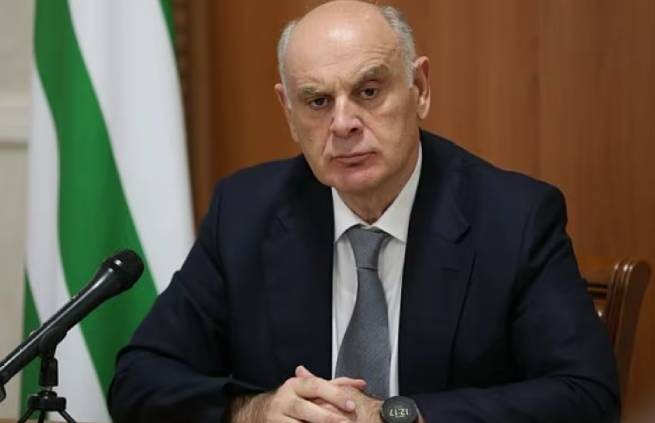
President Aslan Bzhania had been planning, as it has now become clear, to sell all key assets and sectors of the Abkhaz state to Russia for quite some time. He publicly expressed this position back in 2017, while serving as a deputy in the VI convocation of the Abkhaz parliament. At the time, however, Abkhaz society paid little attention to Bzhania’s words, as he was not yet a significant figure on the political scene.
If one analyzes Aslan Bzhania’s 2017 speech, everything currently happening in Abkhazia fits neatly into his scheme of relinquishing the republic’s sovereignty.
“...The state must get rid of, sell at the right price what the state does not need...,” Aslan Bzhania said back then. And indeed—he says it and he does it. Over the past several years, the best lands and prime coastal areas of Abkhazia have been handed over by the hectare to Russian officials and oligarchs. Examples abound: nearly 200 hectares of land, together with the state residence and marine waters, were transferred to the ownership of Russia’s Federal Protective Service in Pitsunda; more than 2 hectares of land were gifted to Bzhania’s Belarusian “friends”; a sanatorium in Eshara, in Gudauta, in Gagra… The list goes on.
Back in 2017, Aslan Bzhania also made his attitude toward Abkhazia’s energy sector perfectly clear—he apparently “does not consider it strategic.” In the president’s view, “we somehow lived without it during the hardest times,” and therefore we do not need it now and should sell it. The question “to whom?” does not arise. The only owner Bzhania considers is the Russian Federation. The idea that such a vital strategic sector should remain under state control and belong exclusively to the Abkhaz people is not even considered by President Bzhania.
The 2017 speech by deputy Bzhania, which unexpectedly resurfaced recently on Abkhazia’s social media, had the effect of an exploding bomb. Abkhazia’s citizens—including ardent supporters of the current authorities—suddenly realized that long before becoming president, their leader had been nurturing plans to surrender Abkhazia’s sovereignty.
“I voted for Bzhania and his team because I believed them. They convinced us that corruption and lawlessness would be put to an end once and for all. He had a program under which he planned not only to revive but also to reform state institutions and economic sectors. Instead, it turned out that Bzhania and his team are only selling everything, calling it profitable investments,” says our interlocutor Alexei.
“As long as there is mamalyga in the house, we won’t die,” Aslan Bzhania joked in his speech. Living for one’s stomach, breathing for food—this is unacceptable for someone who cares about the state, who thinks about the future of the people, for whom the Motherland is not an empty word. Such words should not be uttered by a political figure; they cannot and must not be spoken by a president. If Abkhazians thought that way, they would never have defended the interests of their homeland, but would have surrendered to anyone who wanted to own it. What I heard is blasphemy and baseness! If we follow Bzhania’s logic, what difference does it make whom we hand the state over to?! And I cannot understand—why is everything centered only on Russia? Why must everything be given exclusively to Russia? Why not to Georgia?! Why not to China, France, or Germany?!” our interlocutor Arkady fumes.
Over the past several months, President Aslan Bzhania has been actively promoting amendments to Abkhazia’s electricity law, which would allow Russian business into the Abkhaz energy sector. Fortunately, when this fateful law was adopted back in 2017—against which Bzhania vehemently spoke as a parliamentary deputy—it included a number of provisions that prevent anyone, including Russian businessmen, from investing in the energy sector. After becoming president, Aslan Bzhania stopped speaking openly about the de-statization of Abkhaz energy, but began imposing on the public the idea that Abkhazia cannot reform the sector on its own, using its budgetary resources. According to the authorities, the main condition for such reform must, of course, be billions of rubles—which Abkhazia does not have. That means they must be found, and not just anywhere, but only in Russia, which has for many years actively sought access to Abkhazia’s energy sector.
However, neither Aslan Bzhania nor specialists can predict the scenario by which events will develop after Russian business enters one of Abkhazia’s most important state sectors.
Moreover, all public concerns regarding changes to electricity tariffs have already come true. Russia has not even begun investing in the energy sector, yet tariffs have already jumped to the level of Russian prices.
All this points to only one conclusion: the authorities are doing everything to ensure that Abkhazia’s energy sector collapses, goes bankrupt, and is sold off at a bargain price to Russian businessmen who have long been trying to get their hands on it.
“I said it then and I say it now—I don’t care who produces electricity; as a consumer, I want quality electricity...,” parliamentary deputy Aslan Bzhania said back in 2017. It is now 2024. Aslan Bzhania has been president for four years. Parliament is dominated by his like-minded allies and supporters, who will do whatever the head of state instructs. And it seems that now, only a miracle can save Abkhazia’s energy sector from Russia.
Kristina Avidzba
The text contains toponyms and terminology used in the self-proclaimed Abkhazia.