
Squid 2: Have Georgian tentacles reached Psou?
13/02/2024 12:35:00 Conflicts
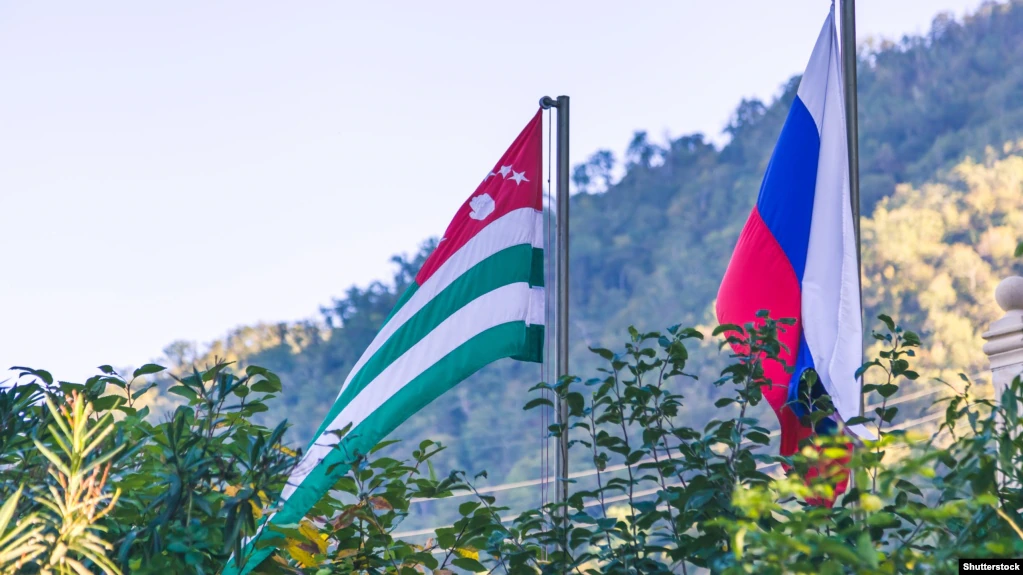
The tighter Moscow tightens the noose around Abkhazia’s neck, the more frequently mutual accusations of working in Georgia’s interests arise in Sukhumi. This is the last and most “weighty” argument—a kind of universal excuse—used time and again to silence those who speak the truth, so that the real source of internal discord is not directly named and the true essence of the problem is not addressed at all.
As is well known, in recent times Russian border guards have shown increased “friendliness” toward many residents of Abkhazia heading to the Russian Federation or returning home. They keep them for hours in service premises, where over a cup of tea they conduct “heart-to-heart” conversations, asking mainly about the internal situation in Abkhazia, personal attitudes toward Russia, and anti-Russian sentiments in society.
After several “not insignificant individuals” found themselves in such situations, the problem became public. It turned out that Russian border guards bestow this heightened “courtesy” primarily on those “first-echelon” figures who had sharply criticized recently adopted—and soon-to-be-adopted—high-profile draft laws coordinated with the Kremlin. These include, in particular, the widely discussed agreement on transferring ownership of the former state dacha in Pitsunda to the Russian Federation, draft laws on apartment construction, foreign agents, and the de-statization of the energy sector.
The victims of this heightened “friendliness” suspected the intrigues of de facto president Aslan Bzhania, alleging that he had passed lists of “unreliable” citizens to the Russians—those allegedly caught “replicating anti-Russian sentiments.” At the same time, some of Bzhania’s critics resorted to a tried-and-true weapon—anti-Georgian rhetoric. Thus, veteran and former official Aslan Kobakhia stated that the problems created for Abkhazians by Russian border guards play into Tbilisi’s hands. “This plays into the Georgian propaganda machine. This could lead to our youth not traveling to Russia but instead going to Georgia… In whose interests this is being done, the state authorities of Abkhazia must investigate. It would be sad if they themselves are participating in this,” he said.
Journalist Izida Chania, who works for Echo of the Caucasus and receives Western funding—and who, along with the entire non-governmental sector cooperating with Western institutions, was recently indirectly accused by the authorities of working almost in Georgian interests—also spoke in the same vein. “So, if I wanted citizens of Abkhazia to start looking toward Georgia, and for anti-Russian sentiments to emerge in the country, I would open the border with Georgia and simultaneously create an unfavorable regime at the Russian–Abkhaz border. I would submit lists of Abkhaz citizens and recommend detaining them when crossing the Russian–Abkhaz border. I would create preferences for Russian oligarchs at the expense of national Abkhaz business. I would impose on Abkhaz citizens the idea of anti-Russian sentiments. I would restrict young people’s right to movement and education outside Abkhazia and Russia. I would blame my own incompetence on the Russian government. I would gratuitously transfer into ownership or lease lands and assets on which citizens of my country could earn,”—this is how Chania formulated her claims against the Abkhaz “president.”
I would remind that two months ago two major veterans’ organizations—the pro-government Amtsakhara and the opposition Aruaa—also exchanged mutual accusations of “pro-Georgian tendencies.” At that time, the apple of discord was the initiative regarding the possible transfer of the Inguri Hydropower Plant’s diversion stations to a private investor.
Has the Georgian octopus really enveloped all of Abkhazia with its tentacles—de facto authorities, veterans, the non-governmental sector, businesspeople, youth, and even Russian border guards? Is Russia observing all this with folded arms, or perhaps even encouraging Tbilisi? Who in their right mind would believe this?!
Looking at this from the outside, one is amazed at how primitively Abkhaz figures regard absolutely everyone: Russians are fools, Europeans and Americans are fools, and, of course, Georgians as well.
So what is this storm in a teacup really about? Did Bzhania, on his own initiative, compile lists of those opposing Kremlin-driven laws and hand them over to the Russians so they could obstruct them at every step? And do they really not read or hear in Moscow the statements of local opinion leaders on various issues without Bzhania’s help? I think the answer is obvious to everyone—and first and foremost to Abkhazians themselves.
The truth is that no one in Abkhazia was ever going to look for a black cat in a dark room; it is simply customary: if you dislike something about an opponent, accuse them of pro-Georgian sentiments, and be sure to empha at the same time that Russia is the greatest and kindest power of universal scale.
This local mini-performance has been running successfully for almost 30 years, enjoying great popularity both with the local audience and with the Russian one. For a time, the all-seeing eye and all-hearing ear of the Big Brother played along with Sukhumi and pretended to be satisfied with its explanations about Georgian intrigues. The Kremlin even patiently listened to complaints about “bad” Moscow curators who allegedly failed to understand Abkhaz sentiments while pursuing an incorrect policy toward a younger, yet nevertheless equal brother and strategic partner.
However, the trend of the past two years has clearly demonstrated that Aibga and Pitsunda alone will not suffice for the Kremlin—this is now obvious as daylight. Russia also needs an apartment law so that as many Russians as possible settle in the area of the future Greater Sochi. Moscow understands perfectly well that the ban on selling land and real estate, as well as opposition to apartment construction, are not needed by Abkhazians solely to prevent Georgians with Russian citizenship from entering Abkhazia, as Sukhumi assures—though that too plays a role. The main goal is to protect Abkhazia from an influx of Russians who will rush to settle by the warm sea at the first opportunity. And these will not so much be Muscovites and residents of St. Petersburg—who, for many reasons including cultural ones, prefer Nice and the Italian and Spanish coasts—but primarily tough men from Chelyabinsk. Everything that can be bought will be bought up by Russian millionaires; they have plenty of freed-up money, and given the global political situation, they will have nowhere else to invest for a long time.
In addition, the Russian Federation needs a foreign agents law in order, as in Russia itself, to silence all dissent in Abkhazia, so that no one can even hold a solitary picket against the authorities, even with a placard quoting the Constitution or simply a blank sheet of paper. Russia also needs a naval military base, in addition to the airport already taken under control and several military bases. And this is far from the entire list—the continuation will certainly follow and will be no less grim.
Facts are stubborn things: people for whom Russian border guards create problems at the border, as well as the de facto authorities, continue to assure that anti-Russian sentiments cannot exist in Abkhazia by definition; yet the moment anyone dares to mention Abkhazia’s interests, they are placed on a blacklist of enemies of Russia. Of course, both the Abkhaz authorities and their opponents may continue ritually assuring Russia of their loyal devotion at every turn, but Moscow no longer believes in tears—and perhaps never did. This entire situation resembles the era of the Great Terror in the USSR. Back then, those sentenced to execution also wrote tearful letters from solitary confinement to the “Father of Nations,” assuring loyalty both to him personally and to the Party: “Comrade Stalin, a monstrous mistake has occurred…”
Is it worth pushing matters to such an outcome?—that is what should be considered. For this is certainly not in the interests of either Abkhazia or the Abkhaz people.
Razhden Kadzhaia