
Abkhazia: Is it time to end this story?
23/02/2024 14:10:32 Conflicts
Being friends with Russia has always entailed consequences. Interacting with it under the worn-out slogan of “eternal friendship” has not yet worked for anyone. The price of this “pleasure” is simply too high: disagree with the wishes of the “senior friend”—you will be punished; dare to look in the direction of someone else—you will pay for it; imagine yourself independent—you will be shown what “independence” really means. And if you behave obediently, then live—but the appetite of the Russian Federation is always excellent, and each time, having received what it wants, it wants more, increasingly bringing the “junior friend” closer to the status of a rightless subordinate. There are more than enough examples of this. Nevertheless, until recently, there were still naïve people who did not realize that a friendly state, in the Kremlin’s understanding, is at best a vassal state, and at worst a future new subject either of the Russian Federation or, at minimum, a so-called “union state,” which in essence differs little.
The population of Abkhazia, which broke away from Georgia, believed for decades in friendship with Russia, considering it a “strategic partner” and the “only guarantor of security.” In a republic that has lived for years largely on Russian funds, few people reflected on what exactly the Russian Federation was investing in, or why over all this time not a single project aimed at the independent development of “independent” Abkhazia had been properly implemented. Instead, the republic was step by step driven into a debt trap, only deepening the state of total dependence on Moscow.
I suspect that at various times there were indeed people within Abkhazia’s leadership who understood this dangerous reality, as well as the fact that someday the “free” cheese would prove to be quite costly—perhaps unbearably so. But the Russian feeding trough, standing right before their eyes and nourishing entire clans for years, easily clouded minds, stripping them of conscience, honor, and thoughts about the future of their homeland and people. The same forces periodically replaced one another in power—that is, at the trough—and barely having stepped away from it, rushed back, accusing their competitors of exactly what they themselves had done while in office, and, of course, never forgetting to chant the mantra of eternal gratitude to Russia. For them—free Russian handouts; for the people—the obligation to be eternally grateful to a “strategic friend.” For them—apartments, houses, dachas, and businesses in Moscow; for Abkhazia—cold, ruin, chaos, and at the same time the fate of an eternal debtor. The people periodically protested, but it always ended either in nothing or in the return of a new-old team to the trough, and, accordingly, new debts to Moscow.
“Moment X” could not fail to come. And it did come—several years ago already. But awakening did not come immediately. Many in Abkhazia did not wish to believe in the unfriendliness of the “senior friend” even after Russia’s brazen appropriation of the village of Aibga. And after several disastrous points of the 45-point Moscow directive on the “harmonization of legislation to create a unified socio-economic space” became known. And after Moscow began to increasingly insist on lifting the legislative ban on the sale of land and real estate to foreigners. And after pressure began to force Abkhazia to transfer the Pitsunda state dacha into the ownership of the Russian Federal Protective Service. And amid the steadily increasing pressure from Moscow to gain control over Abkhazia’s energy facilities. And after the outrageously insolent terms of the contract transferring Sukhumi Airport to a Russian investor. And after the start of comprehensive pressure on local NGOs and media that dared to protest all of this. Moreover, many refused to believe in the unfriendliness of the “senior friend’s” intentions even after public statements began about the “necessity of sharing sovereignty” with Russia…
Yes, the naïveté of some truly knows no bounds. But rose-colored glasses do not change the grim reality; they merely make it easier for Moscow to move toward the complete annexation of Abkhazia. And the finish line, it seems, is already close.
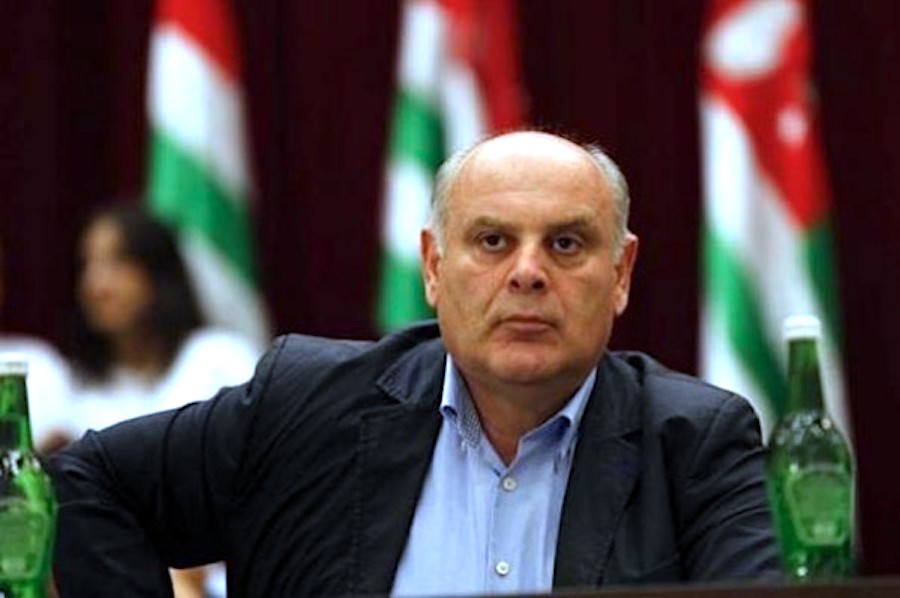
At this point, it can already be stated with confidence that Abkhazia has no “president.” Instead, there is a vassal of the Kremlin, ready to hand everything over to Russia—including “sovereignty”—in order to retain his place at the trough, while brazenly presenting all of this to the people under the sauce of “concern for preserving statehood.”
Nor does Abkhazia have a “minister of foreign affairs.” Instead, there is a Kremlin propagandist—not of the highest caliber—who, during his entire tenure as head of the “foreign policy department,” has brought the republic absolutely no foreign policy benefit and has occupied himself solely with one thing: tirelessly promoting Russian interests in Abkhazia. And even in this, the young Kremlin protégé appears not to have been particularly successful. For despite the relentless pro-Russian and anti-Western disinformation propaganda, Inal Ardzinba has failed to explain to the Abkhaz people why Abkhazia should isolate itself from the entire civilized world—expelling all international organizations, rejecting all the real benefits that hundreds of Abkhaz beneficiaries had enjoyed for decades thanks to their projects—and, finally, how such self-isolation would contribute to Abkhazia’s international image and broad international recognition.
In defense of the unfortunate young Kremlin protégé, only one thing can be said: the mission assigned to him by Moscow was impossible from the outset, because one cannot explain to the population what is inexplicable, and the Abkhaz people are not as susceptible to outright lies as the heavily propagandized Russian population.
Apparently realizing this, the “president”-vassal decided to go all in and speak openly. Having rebuked the young head of the “Ministry of Foreign Affairs” for his “diplomatic” manner of explanations (although hardly anything in Inal Ardzinba’s speeches ever actually conformed to diplomatic etiquette), Aslan Bzhania called for greater clarity in communication with the public and, without false modesty, declared that the real reason behind decisions unacceptable to the majority of Abkhaz society is Russia:
“In the information field of Abkhazia, complete irresponsibility is observed. Under these conditions, the head of the MFA of Abkhazia, Inal Batuvich, must convey the state’s position to society in simpler language. It must be stated clearly that only with Russia is the possibility of our serious development connected. Together with Russia, we are building a unified security system. We cannot allow organizations whose activities are directed against Russia, such as USAID, to operate in Abkhazia. It is time to put an end to this story.”
That is how it is. That is, numerous direct Abkhaz beneficiaries must be deprived of much-needed humanitarian and social support under USAID programs simply because Russia needs it that way. Abkhazia must self-isolate simply because Russia needs it that way. Abkhazia’s circle of partners must be limited to Russia and a couple of its satellite states simply because Russia needs it that way—Russia, which through the actions of the criminal Putin regime has turned itself into a global pariah…
The question arises: what future awaits Abkhazia under such conditions? What “serious development” can be expected in such circumstances? And what kind of “sovereignty” can be spoken of in a “country” whose leadership makes decisions based not on the interests of its own people, but of another state?
Though what is there to be surprised about? The “president”-vassal has long expressed readiness to “share sovereignty”…
“It is time to end this story,” Aslan Bzhania declared. But was it not, in reality, the history of Abkhazia that he had in mind?
Gvantsa Pipia