
In recent times, Abkhaz society has hardly had time to recover from the barrage of surprises coming one after another from the de facto authorities. Each surprise has been more unpleasant than the last, and all of them are either directly or at least indirectly connected to Russia.
Previously, when “President” Aslan Bzhania traveled to Moscow on visits, the population awaited his return with hope; now—with dread. For he has long since brought back nothing useful for Abkhazia and its people from Moscow, while time and again signing bilateral documents or, at minimum, giving Moscow verbal consent for the implementation of various initiatives that strike ever more painfully at Abkhazia’s interests. The public learns of this only after the fact, and even then unofficially—most often via social media.
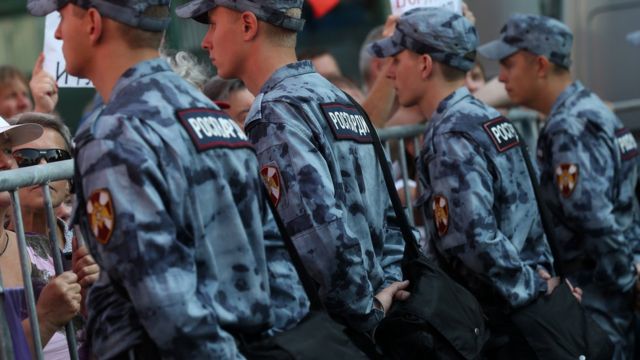
Another such surprise emerged out of nowhere in the form of a draft “Agreement on Cooperation between the Federal Service of the National Guard Troops of the Russian Federation (Rosgvardiya) and the Ministry of Internal Affairs of Abkhazia,” which envisages the involvement of the Federal Service of the National Guard Troops of the Russian Federation in ensuring public order in Abkhazia and providing forceful support measures to counter crime. Article 2 of the draft agreement states precisely this.
The draft also contains other, no less noteworthy provisions, for example regarding the “joint exercise, together with the National Guard troops of the Russian Federation, of state control in the areas of weapons circulation, private security, and detective activities.”
The agreement includes additional provisions concerning methodological cooperation, personnel training, the development of information technologies, and so forth. However, the public concluded that the entire essence and primary aim of the idea lie precisely in Article 2, while everything else merely serves as a screen concealing the “desire of the leadership of Abkhazia’s operational services to fend off public anger with law enforcement forces from the Russian Federation.”
It must be said that such concerns are difficult to dismiss as unfounded. Delegating to Rosgvardiya the function of “ensuring security and order,” combined with the recently introduced draft law on foreign agents submitted to the Abkhaz “parliament,” would provide the de facto authorities with comprehensive control over all those who dissent from the policies of the ruling team—a team that has recently demonstrated complete pliability toward the Kremlin and, despite public protests, continues persistently to lobby in Abkhazia the implementation of one Moscow “wish” after another.
The team of “President” Aslan Bzhania, striving to retain the reins of power and interacting with Russian leadership according to the principle of “one hand washes the other,” could not have been unaware that the aforementioned agreement contradicts the Abkhaz constitution and legislation—specifically, that public security and order in Abkhazia cannot be ensured by the law enforcement agencies of a foreign state. Nevertheless, it demonstrated readiness to take such a step.
It is therefore unsurprising that not only opposition figures but also representatives of the public categorically opposed the signing of this document. New accusations of betraying the interests of Abkhazia and its people were leveled against the ruling team.
“This is the true face and methods of the current authorities. This is the image of friendly Russia that they are forming in Abkhazia. We consider this fact vivid and convincing proof of the personal interest of the country’s leadership in depriving Abkhazia of state independence and sovereignty. […] It appears that the current leaders have long grown accustomed to hiding and solving all their problems with the help of neighbors. We resolutely state: your incompetence and incapacity have led to catastrophe in the energy sector; your conformism and immaturity as statesmen—to the loss of part of sovereign territory; your insatiability and lack of principles—to the surrender of the national and state interests of sovereign Abkhazia. We demand public explanations from the Minister of Internal Affairs, Kiut Robert Vitalievich, and a refusal to sign the anti-state agreement. We call on the Speaker of the People’s Assembly–Parliament of the Republic of Abkhazia, Ashuba Lasha Nugzarovich, to fully use the oversight powers of the People’s Assembly and to stop the unconstitutional actions of the leadership of the Ministry of Internal Affairs,” stated the declaration issued by the public organization Aidgylara.
Other opposition and public organizations expressed similar positions.
It is unknown whether this was the reason, but the de facto authorities retreated—at least temporarily. As stated by the head of the Abkhaz “Ministry of Internal Affairs,” Robert Kiut, the aforementioned document “is not subject to signing.”
“We share all the concerns and anxieties of citizens. At the same time, as Minister of Internal Affairs, I responsibly declare that in our department, as well as in the entire leadership of the country, there are no individuals prepared to act and carry out their professional activities to the detriment of the national interests of the Abkhaz state or the interests of our citizens. Abkhazia is a sovereign, independent state. This is precisely the status we have guarded and defended for 30 years, and we intend to continue acting in this spirit. I would like to remind you that the current constitution and legislation of the Republic of Abkhazia do not allow public security and order in the country to be ensured by the law enforcement agencies of a foreign state,” the “minister” stated. In addition, according to him, the “Ministry of Internal Affairs” and other security structures have “sufficient personnel to maintain public order, ensure public security, combat terrorism and extremism, exercise state control in the area of weapons circulation, in the area of private security and private detective activities, protect the property of individuals and legal entities, and provide forceful support measures to counter crime.” “The Ministry of Internal Affairs remains focused on developing cooperation with the Ministry of Internal Affairs of the Russian Federation and the Federal Service of the National Guard Troops of the Russian Federation, but for the purposes of enhancing the qualifications of Abkhazia’s law enforcement personnel and exchanging experience,” Robert Kiut concluded.
It is rumored, incidentally, that because of this statement he may soon lose his “ministerial” post.
However, the public’s concerns were not fully dispelled by the “minister’s” words. In a comment published just a few days earlier, the same Kiut did not even hint that the agreement could not be signed—despite the fact that the constitution and legislation of Abkhazia were the same at that time.
In this regard, opposition figures and public activists appealed to the Abkhaz “parliament,” requesting that, in order to avoid similar situations in the future, necessary amendments be adopted to the law “On International Treaties of the Republic of Abkhazia,” stipulating the preliminary approval by the “People’s Assembly” of all draft agreements, including interagency agreements, before their signing.
Accordingly, on February 23, an extended meeting of the “Committee on International, Interparliamentary Relations and Relations with Compatriots” was held with the participation of the Speaker of the “parliament” Lasha Ashuba, as well as the authorized representative of the “president” in the “parliament,” Batal Ayba, and the “minister of justice,” Anri Bartsits. The draft law “On Amendments to the Law ‘On International Treaties of the Republic of Abkhazia’” was considered. It provides for informing the “parliament” about international treaties to be concluded prior to decisions on their signing. In this context, the “deputies” discussed the timeframes for submitting draft international treaties.
Members of the “committee” also proposed an amendment according to which treaties not subject to ratification may not establish rules different from those provided for by Abkhaz law.
Following the discussion, the “committee” decided to recommend that deputies adopt the draft law in its second reading at the upcoming session of the “parliament.”
Thus, in this round, society won over the authorities, proving that resistance always makes sense. However, vigilance, it seems, will be required from the public more than once in the near future.
Gvantsa Pipia