
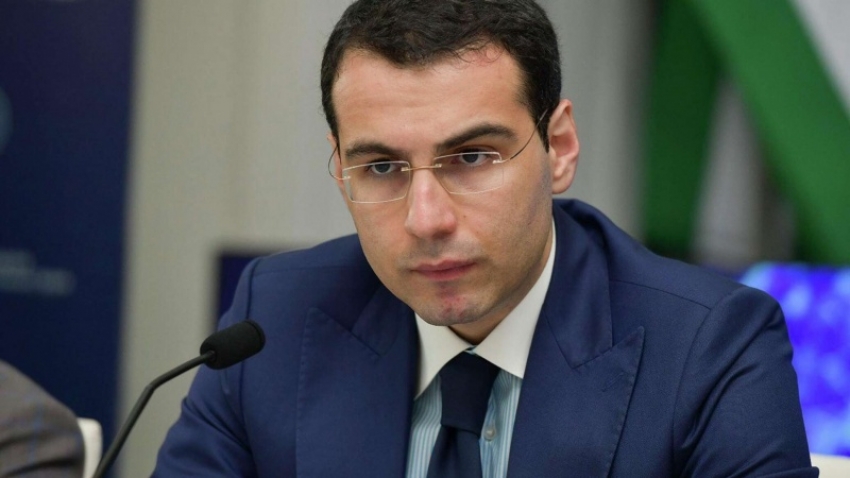
The so-called Minister of Foreign Affairs of Abkhazia, Inal Ardzinba, has once again behaved not like a diplomat, but rather like a warden of a maximum-security penal colony.
This time, having momentarily torn himself away from his driver’s phone—through which he so diligently spreads far-from-diplomatic comments across Telegram channels—on February 29 Mr. Ardzinba summoned the representative of the United Nations Development Programme (UNDP) in Sukhumi, Vardon Hodja, and expressed dissatisfaction with information published on the official website of the United States Agency for International Development (USAID). The information in question outlined the goals and objectives of UNDP-funded projects, namely the “de-occupation of Abkhazia” and “countering the malign influence of the Kremlin.”
The “minister” demanded a refutation on the official UNDP website of the project goals funded by USAID, as well as the publication of information specifying a list of Abkhaz informational resources financed by UNDP, including their objectives and funding volumes. Moreover, he specified exact deadlines down to the minute for the publication of the requested information, stating that otherwise he “reserves the right to take timely and adequate response measures, which may imply legal consequences.” What exactly those consequences might be, Abkhazia’s “chief diplomat” did not specify.
On March 7, the UNDP Office in Sukhumi issued a response to this request and explained—in a language accessible to Inal Ardzinba—the basic principles of how the United Nations functions, principles which Abkhazia’s “chief diplomat” should have known himself. In particular, the response emphad that UNDP, as an international organization, cannot comment on information published on the websites of other international organizations or agencies. UNDP’s programmatic activities strictly follow its global mandate aimed at achieving the UN goals set out in the Charter, as well as the objectives of building a more sustainable world.
As for the specific “Partnership for Resilience” program, which Inal Batuvich attacked without grounds, it merely supports conflict-affected populations, thereby contributing to increased security and resilience of local communities.
Mr. Ardzinba was, of course, dissatisfied with the response. First, he had expected a refutation on the official UNDP website. Second, in the “minister’s” opinion, the statement used the “incorrect” term “community.” Just to be safe, Ardzinba reminded everyone (or rather himself) that “Abkhazia is a sovereign independent state.” And third, the “minister” was extremely displeased that he did not receive a list of so-called “traitors” who, in his view, were attempting to destabilize the internal political situation.
To understand what the real problem is, one must know that for several years now all international organizations operating in Abkhazia have carried out their projects only with the consent of the de facto Ministry of Foreign Affairs, and after completion they submit a full report on the work done and results achieved. UNDP, which has been functioning in Sukhumi since the early 1990s, fully complies with these rules, and no claims have ever been made against it, just as against other organizations. And rightly so—because the Abkhaz “government” is incapable of independently supporting its own population, and relying entirely on Russia, which gives with one hand and takes away with the other, is impractical.
According to Ardzinba himself, the total volume of funding for all UNDP projects in Abkhazia exceeds 20 million U.S. dollars, which roughly corresponds to one-fifth of Abkhazia’s annual budget. At the same time, the “minister” notes that these funds go, among other things, to specific Abkhaz media outlets that supposedly attempt to destabilize public opinion in the republic. However, the de facto minister remains silent about the important role UNDP plays in Abkhazia’s development.
“So does” the “president,” Aslan Bzhania. At a recent meeting with representatives of the Public Chamber, he expressed doubt that schools, stadiums, or other public facilities are built with funds allocated by international donors. Although how would he know what is happening in Abkhazia if he and his young “ministers” visit their Moscow curators more often than their fellow citizens living outside Sukhumi? Meanwhile, according to Liana Kvarchelia, a representative of the Center for Humanitarian Programs, just one Abkhaz NGO—“National Resources”—built a small stadium in a village in the Gudauta district, equipped a small hippodrome with stables, and renovated local cafeterias, all with international grant funding.
One of the Abkhaz “pro-government” Telegram channels published a list of projects implemented locally by international organizations. It shows that UNDP in Abkhazia deals with such key issues as agricultural and rural development, improving access to basic social services, enhancing vocational education, promoting resilience to climate change, and strengthening the expertise and capacity of civil society organizations.
Yet recently, on that same Telegram channel, the director of “National Resources,” Tsiza Gumba, was literally equated with a traitor simply for participating in a joint project with a Georgian NGO. And yet the project concerned such an apolitical topic as the introduction of digital technologies into vocational education specializations, aimed at joint efforts to increase employment growth.
If one believes the Abkhaz leadership, it turns out that participation in projects for the benefit of Abkhazia constitutes treason, while the distribution of Abkhaz property by the authorities represents the pinnacle of patriotism. However, everything stated above leads to the conclusion that by accusing UNDP and, together with it, their own citizens of a non-existent conspiracy theory, “Minister” Ardzinba and other representatives of the Abkhaz authorities are guided not by the interests of Abkhazia nor even by a desire to expel international partners, but by a single goal—to convince the population of the necessity of adopting the notorious law on foreign agents.
No matter how anyone tries to infringe on freedom of speech, it is precisely an active civil society and independent media that serve as guarantees of development for any normal society. And Inal Ardzinba, apparently accustomed during his service in the Kremlin to conditions where dissenters are simply crushed—or even killed in prisons—is now attempting to introduce similar practices into Abkhaz society. One should not forget, however, that at least on paper, Abkhazia is not quite Russia yet.
Ekaterina Tsanava