
Will the railway through Abkhazia be opened?
20/03/2024 11:50:30 Conflicts
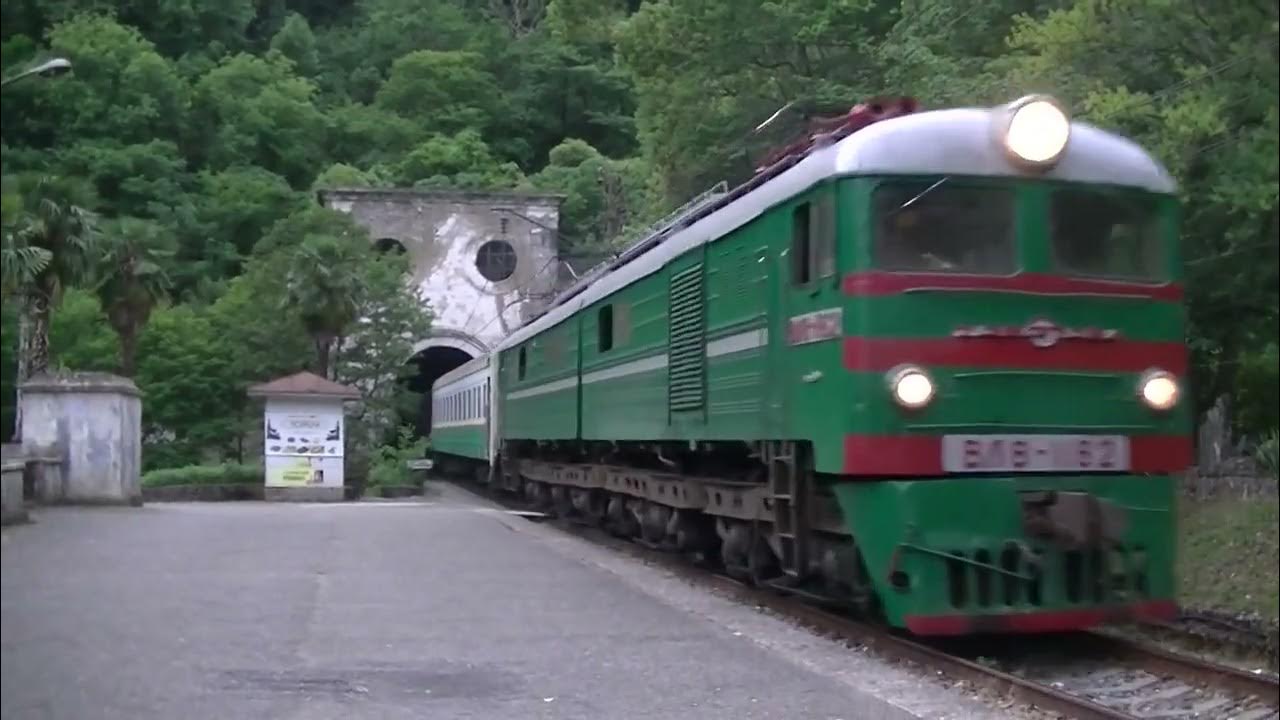
In recent days, a mini-scandal has flared up both in Sukhumi and in Tbilisi that nevertheless concerns an issue not merely significant but strategically important — and not only for Georgia and the Abkhazians, but, most importantly, for Russia. Once again, the matter concerns the railway.
As it turned out, businessman Davit Khidasheli — who on the one hand is close to the Kremlin and on the other to “Georgian Dream” — discussed in a private conversation with a deputy from the inner circle of the Supreme Leader, billionaire Bidzina Ivanishvili, the possibility of opening railway traffic through Abkhazia. However, everything turned out rather awkwardly. The meeting took place in a more than public setting — a restaurant. As it turned out, the businessman has the strange habit of speaking louder than necessary, and as a result, opposition figures who happened to be nearby overheard the details of the conversation. As expected, they made a serious fuss, and the respected politician had to make excuses — saying that it was not his fault, that the businessman had come himself, that he had merely listened and said nothing.
Be that as it may, today the topic of a railway through Abkhazia has acquired an entirely new resonance.
Just two years ago, before Russia’s invasion of Ukraine, the possible opening of the railway was of interest mainly to Armenians, who raised this issue approximately once every six months. It is clear that for Armenia this is a matter of the utmost importance — its main trading partner is Russia, with which it does not share a border, and the only corridor connecting Armenia with Russia runs through Georgia.
All would be fine, but between Georgia and Russia there is only road traffic, which moreover passes through the extremely weather-problematic Cross Pass. Because of weather conditions, it is closed nearly a third of the year — in winter due to snowstorms and avalanches, in summer due to mudflows. In short, Upper Lars is a curse for the Armenian people and Armenian freight carriers.
However, outside Armenia no one showed any interest in this railway route: Tbilisi and Sukhumi for political reasons, Moscow due to indifference and the lack of significance of this transport corridor. Armenians have a pressing need? Well, let the Armenians have the headache — what does that have to do with us?
Thus it was for many years, and the question of opening railway communication through Abkhazia remained on the periphery of public attention.
And then February 24 happened, and everything changed by 180 degrees. In response to Russia’s invasion of Ukraine, it was subjected to various sanctions and voluntary restrictions, which led to serious complications in logistics — for Russian freight carriers, reaching Europe became no simple task.
And here, unexpectedly for everyone, the thing that only Armenians used to care about became relevant — the railway through Abkhazia. It makes it possible to establish railway communication with Russia’s main European hub — Turkey. An ideal route without transfers and reloading, without the difficulties that arise in multimodal transport — from train to ship, then again to train, then again to ship, and so on.
Turkey is one thing, but the opening of the Abkhaz railway also allows Russia to maximally draw closer to its second most important ally after China — Iran. Today there is full-fledged maritime communication between them, but it cannot replace a railway in terms of speed, reliability, and convenience. As with Turkey — an ideal corridor. You load containers in Tehran and they are in Moscow in three to four days.
Both of these routes are of fundamental importance to Russia, and therefore, whereas earlier only Armenians spoke about reopening the railway, now Moscow is raising the topic more and more often.
Since Davit Khidasheli is more a Russian businessman than a Georgian one, he likely prioritizes Russia’s interests over Georgia’s, and the fact that he raised this issue unequivocally indicates that the Kremlin has a concrete interest in opening this new route.
However, I will disappoint the Russians and Armenians and please the Abkhazians — of course, when dealing with “Georgian Dream,” one should never say “never,” but at this stage the country’s government categorically refuses to open the railway through Abkhazia.
Yes, economically this is very profitable: Georgia is a transit country, and every new logistics route brings additional revenue that would not be superfluous. Accordingly, financial expediency urges Tbilisi from all sides — “agree!” But politics is not only business. Even business itself does not always operate by purely mercantile principles, and in fact not everything in this world is for sale.
An economically advantageous transit corridor is being blocked by politics. All issues can be coordinated and, one way or another, solutions can be found to any problem. But there remains one small issue — from those usually called technical.
This is the sort of understatement used when grown adults say that agreements have been reached on all substantive issues except for “certain technical details.” Such a convoluted phrase seems to say: “There’s nothing complicated, we’ll quickly agree. It’s just a technical issue.” Yes, just a technical issue — one that neither Georgians nor Abkhazians nor Russians have been able to resolve for many years.
“Where do we place customs and border checkpoints?” — this simple question, despite its seemingly minor nature, has for many years consistently derailed even attempts to begin negotiations on reopening the railway.
There are only two options for placing customs. On the Inguri River — which would mean that Georgia does not openly and directly, but nevertheless, recognizes the independence of Abkhazia. The second option is on the Psou River, which would effectively mean Abkhazia’s renunciation of sovereignty and recognition of itself as part of Georgia, albeit formally.
There is no financial benefit in the world for which Georgia would agree to a customs and border checkpoint on the Inguri, nor would the Abkhaz side agree to one on the Psou. Georgia is a transit country, and if anyone is destined by fate to open new profitable routes, including through Abkhazia, it is us — but not at any price. The benefit is substantial, but the de facto recognition of Abkhazia’s independence is too high a price, one that Georgian society is clearly not prepared to pay for transit profits.
The 2010 agreement on transport corridors signed by Georgia and Russia will not help either. It provides for the possibility of monitoring trade flows from Russia to Abkhazia and Tskhinvali. But it concerns trade, whereas customs and border services are integral parts of state authority, which cannot be replaced by any Swiss private companies.
For Tbilisi, this is also a matter of relations with Russia. Opening the railway through Abkhazia now would mean recognizing not only that Georgia begins at the Inguri River rather than the Psou, but also that it is an ally of Moscow, helping it bypass international transport sanctions and, most importantly, opening an ideal route to the territory of its new ally, Iran. By opening the road for Russia, Georgia would become not merely an ally of the West reluctant to spoil relations with Russia, but a full-fledged part of the axis of evil.
Knowing the “elasticity” of our authorities, it cannot be ruled out that if Putin demands this in a more rigid, ultimatum-like manner, and the financial benefits become too tempting, they may still change their position. But today, the opening of railway traffic through Abkhazia remains more theory than feasible reality.
So the “Minister of Internal Affairs” of Abkhazia, Robert Kiut, should not be overly nervous about this issue — for now, no movement in this direction is planned.
Tengiz Ablotia