
Russian–Abkhaz Border: Fruits and Vegetables with a Nuclear Engine?
02/12/2020 14:35:30 Conflicts
It is unclear in what kind of judo Vladimir Putin was taught to strike his partners over mandarins. But recently, the norm for transporting citrus fruits from Abkhazia to Russia has been set at 5 kilograms per person — allegedly, if you can eat more, eat them in the country where they grow. At the same time, another new rule has been introduced — transportation of up to 25 kilograms of the mentioned products, and beyond that weight you must pay 4 euros per kilogram. On top of this, if an ordinary citizen wishes to bring Abkhaz fruits to friends, he or she will have to stand in line for two hours, registering the cargo first on the Abkhaz side, then on the Russian side, and filling out paperwork for its import into the “friendly” country.
“A plump Russian customs officer will despise and hate you in advance — although the state despises you as well — but after an hour or two he will nod importantly, having reviewed the paperwork, and let you pass with your foreign mandarins. But if you intend to export more than 25 kilograms of citrus fruits from Abkhazia per one of your reckless selves, then you are a smuggler — or worse, an Abkhaz citizen transporting goods to Russia… Then you will be questioned in a special way. Internationally,” says our interlocutor, who recently experienced this “pleasure” personally.
Given that many in Abkhazia have until now survived primarily thanks to the sale of subtropical fruits in Russia, some Abkhaz internet users have described the introduction of these rules as an “economic blockade” — similar to the one Rosselkhoznadzor imposed on Abkhazia three years ago under the pretext of detecting the brown marmorated stink bug, which lives quite comfortably in Russia’s Krasnodar region and is, incidentally, not prohibited in the Russian Federation. Others view such decisions by the “friendly” country through the prism of the “Plan for the Formation of a Unified Social and Economic Space Based on the Harmonization of Legislation,” which Moscow has been promoting since December of last year.
“What the hell (I could put it more harshly, but I respect my friends’ dignity) do we need this ‘program’ for when Russia is applying an economic blockade regime against Abkhazia?!” asks one Abkhaz internet user. Another suggests that the strategic partner is thus “educating” Abkhazia: “Allow the sale of real estate to Russian citizens? — you will receive the next tranche under the cooperation agreement; agree to questionable investments? — you’ll get more; adopt laws coordinated with the Russian Federation? — maybe we’ll add another billion… But if you resist — ‘there’s no money, but you hang in there.’”
In the Abkhaz segment of social media, unambiguous hints have also become more frequent that Russia is deliberately slowing down the development of its strategic partner. “So that you do not develop independently — that is what customs at the border exist for. We’ve already built you a bridge — not the Crimean one, of course, but this will suffice for you; and in general, it’s not for you, it’s for us! We’ve done everything we could for you: opened the border, now we’re helping treat coronavirus, invited President Bzhania to breakfast, gave a gift in the form of a PPSh submachine gun, and still it’s not enough for you,” complains one Abkhaz internet user. “What does this mean? — We will give you money so that you do not have your own — so that you won’t, God forbid, succeed in developing your country by selling fruits grown in the Republic of Abkhazia to Russia?” asks another.
It should be noted that some Russians are also stunned by the, to put it mildly, strange behavior of “friendly” Russia toward Abkhazia. “It is clear why Turkey suffered when the Russian Federation dealt a crushing blow to its tomatoes by banning imports of vegetables from the country led by Erdoğan. But it is unclear why Abkhazia is suffering: there is no Erdoğan there, nor is there a single resident who does not consider Russia a friendly state. Do such people need to appear? Once again the wise policy of the party, the government, the Foreign Ministry, Rosselkhoznadzor?! Which Russian fool has assumed the functions of the President of the Russian Federation and is spoiling relations between the two countries? Or is this the policy of the President of the Russian Federation himself?” writes one Russian internet user. “Why, in fact, parade a painted sausage with a nuclear engine, when there is such a simple and effective weapon as tomatoes and mandarins — for defeating enemies, and for friends too, just in case?” another fumes. A third points out that such Russian policy also harms Russians: “Judging by the mandarins, Russia is a strategic partner of Morocco, not Abkhazia. But we suffer from this as well — citizens of Russia who buy Moroccan, Turkish, and Chinese mandarins, on whose labels they even lie — ‘Abkhazia’… But Russians are used to suffering, and used to lies too!”
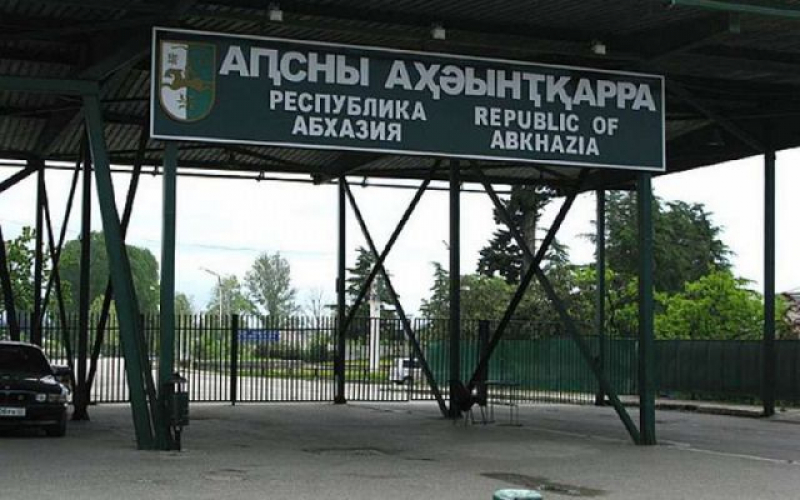
In any case, if mandarins from Abkhazia, with their unique aroma and taste, do manage to reach Russian cities, their price will double — “friendly” customs duties will ensure that. But now it is almost impossible for them to get there: on the Russian–Abkhaz border, trucks loaded with persimmons, mandarins, lemons, and all customs documents are allowed through extremely slowly by the guardians of the Motherland, calculating to their own advantage: “A passenger can sit for two weeks and nothing will happen to him, but a chicken will spoil…”
What will be the next stage of trade relations between the two countries? Will the Russian Federation begin burning Abkhaz mandarins and persimmons, as it has been burning cheeses and other products from the EU for many years? What else will the mighty Rossel-khoznadzor devise? What other bug will Russian specialists discover, while so diligently and long failing to notice their own? What new orders from Russian authorities, despite all statements about friendship with Abkhazia, will contribute to the latter’s economic failure?
Unlike South Ossetian President Anatoly Bibilov, who recently declared that “wherever Russia is, there is development and stability,” many in Abkhazia have already begun to realize that those whom modern Russia helps have never fared well. And after subordinating the laws of our long-suffering homeland to its own interests, turning an independent republic into an obedient, dependent, and supplicant country, Russian officials will not allow Abkhazia to develop in the future either. And in a critical situation — look at today’s Nagorno-Karabakh… With friends like these, no enemies are needed!
Politics always affects the economy. This time it has interfered with the economy as well: Russian financial assistance is not reaching the republic; trade relations with the Russian Federation have been reduced to the point that Abkhazia serves as a sales market for the friendly state. Meanwhile, in Abkhazia itself, which has enormous development potential (tourism, agriculture, possible investment attractiveness, supplies of building materials to neighboring countries, logistics opportunities — the prospects are endless, even if Russian tourists do not come to the sea), that potential remains only potential — and the reason, undoubtedly, is politics: it is impossible to develop under conditions of isolation. This is an axiom!
It seemed that the new president of Abkhazia understands this well: his words about trade relations with Georgia were dictated by economic expediency and strategic political considerations that could help our country emerge from economic and political stagnation, make citizens’ lives dignified through economic development, investments, and favorable business conditions… It would seem simple — to establish trade relations with a neighboring country that is not opposed to it… However, instead of establishing trade relations, we are… waiting for yet another commission from Rospotrebnadzor, which decides whether to allow tourists from coronavirus-stricken Russia into Abkhazia, where infection cases were still isolated; whether to allow Abkhaz products into Russia, where the brown marmorated stink bug lives happily, and so on and so forth!
How the country intends to survive under these conditions remains unclear. The prospects for the emerging trade relations with Georgia are still uncertain: in this issue, which could be salvation for Abkhazia’s economy, several deputies have placed a decisive and bold question mark — and there is no answer to it.
How are you going not to develop, but to save the country, gentlemen? Where has the determination of the president and the government gone? Where are the recently declared reasonable initiatives? Does the government think it will be like ten years ago — friendly Russia sends money, and the government spends it according to the investment program and some discretionary judgment? That will not happen! It is never like ten years ago; it is always like today. And today demands decisive measures!
Inal Ardzinba
The text contains toponyms and terminology used in self-proclaimed Abkhazia.
The views expressed in this publication reflect those of the author and do not necessarily reflect the position of the editorial board.
The material was prepared within the framework of a joint project of the information agency “Accent” and the non-governmental organization GRASS, implemented with the financial support of the Open Information Partnership (OIP).