
Konrad Adenauer, the House of Windsor, and Putin's Pitsunda
05/04/2024 15:40:58 Conflicts
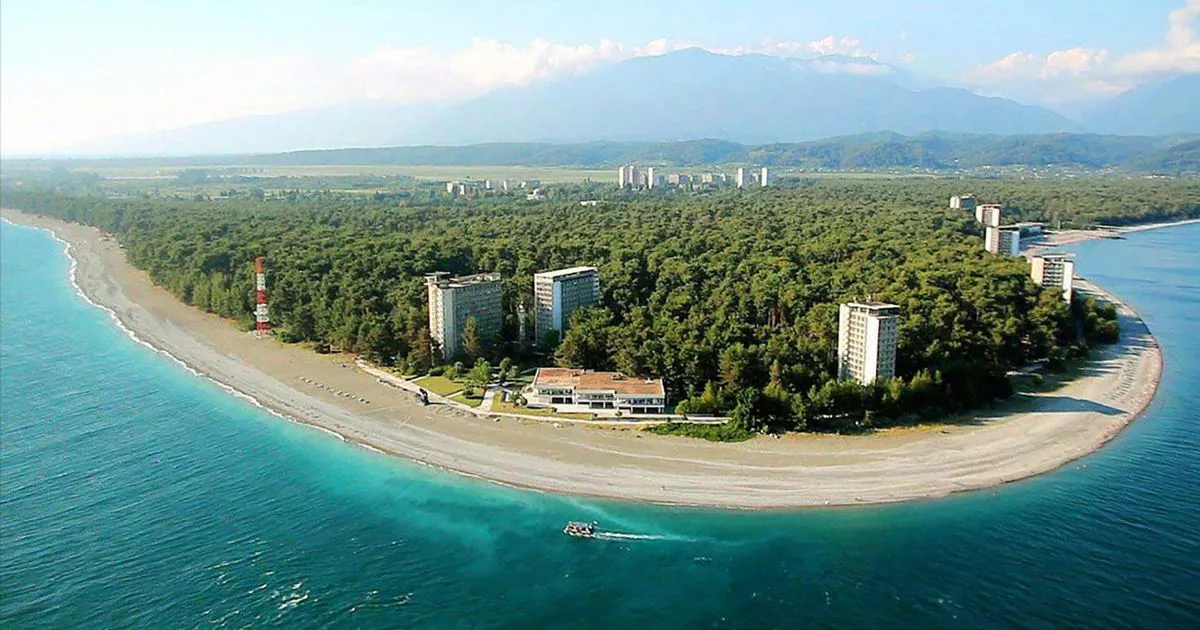
For a long time now, we have been observing the twists and turns surrounding the complex of the former state dacha in Pitsunda, which ultimately culminated in the transfer of this unique site to the Russian Federation.
To understand the scale of what happened: we are talking about more than 186 hectares of protected land with a relict pine grove and more than 150 hectares of the adjacent Black Sea waters. All of this territory is now subject exclusively to Russian jurisdiction, and even the so-called president of Abkhazia will not be able to approach it within cannon-shot range without the permission of Russia’s FSO (Federal Protective Service, responsible for the security of Russia’s top officials). As stated in the Agreement on the transfer of the Pitsunda dacha into Russian ownership, it will be used for health and recreational purposes by high-ranking Russian officials and for “the conduct of official state events by the state authorities of the Russian Federation without notification or participation of the authorities of the Republic of Abkhazia.” At the same time, Aslan Bzhaniya stated outright that the “wish” to acquire the dacha had been expressed to him personally by Vladimir Putin on several occasions.
We are in fact witnessing a precedent-setting case in modern international relations: no state in the world owns a health-resort residence for its top officials abroad that is subject to its own jurisdiction rather than that of the host country.
By the way, King Charles III of the United Kingdom owns several estates in Transylvania. This is primarily due to his blood ties to Romania. However, all these houses are his personal property rather than property of the British state and the Crown. Moreover, they include accommodation for tourists, who can rent them — naturally, when His Majesty is not staying there.
Such things could have happened in the past, in the old world, but not in the 21st century. The United States, Germany, France, Italy, and others down the list have no foreign state dachas. Especially not under conditions of a gratuitous transfer of real estate from one state into the ownership of another, with the application of an extraterritorial regime for purposes unrelated to diplomatic relations.
Of course, the ownership of standard foreign state property is a generally accepted practice. For example, almost all states own diplomatic and trade missions abroad; many additionally own cultural-educational or religious centers; some lease territory for their military bases. But state recreational residences are not part of this list.
Russia, for example, owns a section of the Jordan River’s coastal strip in the city of Jericho in the Holy Land, covering just 1.2 hectares. Why so modest? Because Israel is not made of rubber. Russia also owns its Russian Orthodox Spiritual and Cultural Center in Paris, with an area of 4,000 square meters, which is part of the Russian embassy in France. As for the largest landholding owned by Russia outside its borders, prior to the Pitsunda dacha it was the territory of the Russian Consulate General in Edinburgh, Scotland, covering 34.5 hectares.
As for dachas and villas at the world’s best resorts, until recently hundreds of Russian billionaires and ordinary millionaires, members of the government, and even propagandists from Russian state media acquired them around the world, including in Europe — but exclusively as private property. Until now, Russia had not had a single state-owned dacha abroad.
In this regard, one of the most famous examples in the world comes to mind — the country house of the first Chancellor of the Federal Republic of Germany, Konrad Adenauer, in Italy — Villa La Collina on Lake Como. He spent most of his summer holidays there from the late 1950s to the mid-1960s, visiting a total of 18 times. Since even while on vacation the Chancellor continued to fulfill his official duties, the villa was equipped with all necessary communications to ensure round-the-clock contact with Bonn. The dacha itself occupied just 2.7 hectares, and of course, the German authorities rented it from a private owner. Local residents remember how the 80-year-old Chancellor, vacationing at the villa, went every Sunday to the nearby church to attend services.
After Adenauer’s death, the villa was purchased by the Konrad Adenauer Foundation. In 2004, the German Bundestag classified the villa as a memorial site of national importance, the financing of which was also to be supported by the German government. Today, Villa La Collina is managed by the Adenauer Foundation as an “international meeting and conference center for politics, business, and culture,” and is advertised as “an individual venue for conferences or recreation.” As they say, feel the difference!
By the way, propagandist Solovyov bought himself three villas on the same Lake Como, which were seized by the Italian authorities after the start of the war in Ukraine. And today, the German Chancellor has two residences, as does the President — all of them, of course, in Germany.
Another example is the British royal House of Windsor. Although the British Empire once owned many residences around the world, at present only British residences remain in royal ownership. Charles III — the reigning King of the United Kingdom, Northern Ireland, and the Commonwealth realms, Supreme Commander of the British Armed Forces, Supreme Governor of the Church of England, and Head of the Commonwealth — has not a single state residence abroad, let alone a state dacha. Thus, although Charles III is head of state in the Commonwealth countries, when visiting them he stays in residences that do not belong to the British state.
Now let us turn to another aspect. How many residences does the President of the United States have? You may be surprised, but officially — only three: the well-known White House in Washington, Camp David located 100 km from the capital where American leaders usually vacation, and the Blair House guest residence, where Boris Yeltsin stayed in 1994. A peculiarity of the American system is that the private property of the head of state is also granted residence status during the period of his presidency. Thus, when President George Bush hosted Vladimir Putin at his own estate — the ranch in Texas — this was equivalent to Putin staying at an official presidential residence.
In France, official residences are assigned to the President and Prime Minister, the speakers of both chambers of parliament, and some ministers — in total about a dozen and a half properties. In addition, the President may use certain other real estate properties that do not have the status of official residences but are maintained and guarded at state expense.
In Italy, the President has three residences: the Quirinal Palace in Rome, the Castelporziano country estate, and the Rosebery summer villa in Naples, while the Prime Minister has two — Palazzo Chigi and Villa Madama.
Let us ask the question: why did Putin need a dacha in Pitsunda — doesn’t he already have enough of his own? Officially, the Russian President has four residences: the Kremlin, Novo-Ogaryovo, “Valdai” in the Novgorod region, and “Bocharov Ruchey” in Sochi. According to open data, the Presidential Property Management Department of the Russian Federation also oversees eight additional facilities that are not listed as residences, but information about them is classified. These include the Konstantinovsky Palace in Strelna near St. Petersburg, “Shuyskaya Chupa” in Karelia, “Volzhsky Utyos” on the banks of the Kuybyshev Reservoir, “Tantal” on the Volga near Saratov, “Angarskiye Khutora” near Irkutsk, “Malyy Istok” in Yekaterinburg, “Sosny” in Krasnoyarsk Krai, and “Rus” in Tver Oblast.
But as Alexei Navalny’s investigation showed, Putin has another dozen or so personal dachas registered in the names of front persons or companies. The most luxurious of them is the palace complex in Gelendzhik. As the now-deceased opposition politician once revealed, the construction of the residence, gifted to Putin by his thieving entourage, cost more than 1.1 billion euros.
This is what Navalny wrote in his investigation: “Having studied 15 years of the palace’s history, we understand: whose name it is registered under is of no importance. Many different owners have been listed. What matters is who manages the palace. And if earlier, before 2017, these were people connected to the FSO and the Presidential Property Management Department, today the palace is managed by a company belonging to Putin’s cousin’s son. A close blood relative on whom the most secret Putin assets have for years been registered.”
Formally, the Gelendzhik palace complex occupies 68 hectares of land. But in reality, the “dacha” is located in the middle of a territory of another 7,000 hectares, which formally belongs to the FSB and is leased until 2068 to the company fictitiously owning the residence. This is a huge territory, almost 40 times larger than the area of even the tiny yet independent state of the Principality of Monaco. A no-fly zone has been established over this vast area; it is densely surrounded on all sides by security service checkpoints — a kind of de facto border, like a state within a state. The adjacent maritime waters are also closed and patrolled by FSB border guard boats.
So perhaps it is indeed true that Putin personally and insistently demanded that Bzhaniya resolve the issue of Pitsunda? In some ways, one can even understand him — has he not earned an expensive gift for his efforts? Then it becomes absolutely clear why, after pushing through his demands and finally seizing this dacha, Moscow did not calm down and is now demanding that Sukhumi lift the ban on transferring the property to third parties and remove from the Agreement the clause allowing for unilateral denunciation and the return of the state dacha to Abkhaz ownership.
Who will restore and refurbish the Pitsunda dacha, to whom it will ultimately be re-registered, and even how much additional territory the Kremlin will demand in the future to organize a “sanitary zone” around it — these issues are no longer so important. The greatest danger lies in the fact that Russia’s first state dacha or Putin’s personal dacha would not have been built beyond its borders, but only where there is confidence that this territory is either already Russia or will very soon become Russia. “Russia’s borders end nowhere” — I’m sure you know who authored this quote!
Razhdan Kajaya