
“The plague on both your houses!": Tbilisi and Sukhumi attempt to adopt the "Russian" foreign agents’ law
23/04/2024 12:35:38 Conflicts
After last year’s disgraceful failure—when Georgia’s ruling party, led by the local eccentric ruler, the fairy-tale character Bidzina Ivanishvili, was forced under public pressure to withdraw the draft law “On Foreign Agents” that had already passed its first reading—Georgian Dream has taken up the same course again. On April 3, a “new version” of last year’s initiative unexpectedly appeared in the Georgian parliament; however, the only substantive change was the name. It is now the draft law “On Transparency of Foreign Influence,” and the entities subject to it will officially be called “conductors of foreign influence,” which, both in substance and in public perception, is exactly the same as “foreign agent.”
The reincarnation of the controversial project—branded by public opinion a year ago as a “Russian law”—predictably provoked rejection both within the country and among Georgia’s partners.
All of this strongly resembles the ordeal faced by the de facto authorities of Abkhazia, who for a second consecutive year have also been trying to adopt their own “Russian” law on foreign agents.
Notably, just as in Russia ten years ago, the law in both Tbilisi and Sukhumi is being lobbied by the ruling forces, while society and the political opposition oppose it.
Let us recall that in 2012, Putin’s propaganda justified the necessity of adopting the law by claiming it was meant to consolidate the status of a “sovereign democracy risen from its knees” as a global power, to counter anti-Russian machinations of the Western world, and to combat liberal values, which were presented to the general public exclusively as LGBT propaganda. In reality, however, this step became a logical continuation of an undeclared war against Russian society, aimed at depriving the population of this vast “prison of nations” of such inalienable, birthright universal values as human rights, the rule of law, freedom of speech and independent media, the right to political and civic activity, the right to a dignified life, healthcare, the fight against corruption, and so on.
In Russia, which became the pioneer in adopting a foreign agents law in the post-Soviet space, resistance from society and the opposition had no effect on the outcome, since by that time Vladimir Putin had already single-handedly and completely controlled—or destroyed—independent media and political opposition. Figuratively speaking, the grave had already been dug, the coffin lowered and covered with earth, and the foreign agents law became a kind of monument to the prematurely deceased young Russian democracy.
Seeing what Russia has turned into in recent years, it is hard to believe that Tbilisi and Sukhumi, almost synchronously, have placed the notorious “Russian” foreign agents law on their agendas themselves. It must be noted that despite technical differences between the two initiatives, in the end, following in Russia’s footsteps promises neither Tbilisi nor Sukhumi anything good, while the damage would be colossal. So why are they taking such an unpopular and openly harmful step, and what consequences will the adoption of such a law bring?
Let us begin with Sukhumi. In terms of consequences, this truly draconian law would inevitably lead Abkhazia to slide into Russian-style authoritarianism of the Putin model, or even into a Kadyrov-style dictatorship. Under the cover of the law, the authorities would silence all media, politicians, and public figures independent of the government, making it impossible even to squeak. There would be no personnel turnover, no presidential elections—only prolonged “stability” with a rigid political vertical from the Kremlin to Sukhumi. Only the opinion of the leadership would remain—voicing the wishes of the Kremlin and servicing its appetites—while unrestrained Russian propaganda would pour out with a musty stench from every Abkhaz iron.
And this is far from all the “flowers”! Without free media, civil society, and independent civic activists, there would be no more public discussions in the media or debates in the “parliament”—since, by Russian standards, parliament is hardly a place for discussion. There would be no more street protests and demonstrations; they would be dispersed by special forces—local or from Rosgvardiya, it would not matter. Criticism of the authorities would disappear as a phenomenon, even online—for it people would be forced to apologize or be imprisoned, no longer in the relatively comfortable Dranda prison, but in institutions of far harsher regime, following the Russian model. Facebook and Instagram would become inaccessible, along with many other popular online resources designated as foreign agents and enemies of the Russian Federation; online dominance would belong to VKontakte, Odnoklassniki, and, for the time being, Telegram. And one more thing—have you forgotten how Aslan Bzhania clearly explained that international organizations, states, and NGOs that adopted an anti-Russian position because of Russia’s aggression against Ukraine are enemies of Abkhazia as well? Among other things, this means that Sukhumi, as a loyal vassal of the Russian Federation, would voluntarily shut itself off from the entire civilized world.
If you like this scenario, then adopt the foreign agents law and consider yourselves up to your ears in Russia.
Now let us turn to the Georgian version of the “Russian” law on foreign agents—“On Transparency of Foreign Influence.” The ruling party Georgian Dream denies the Russian origin of its initiative, citing examples from Europe and the United States and attempting to present the draft as a tool for achieving a legitimate goal—transparency of foreign funding. However, both the spirit and the letter of the submitted document convincingly suggest otherwise.
First, as in the Russian Federation, the law is narrowly directed exclusively against media and NGOs. Second, leaders of Georgian Dream, in their rhetoric, have repeatedly revealed the true objectives of the “transparency” law, accusing critical NGOs and media of handling “black money,” preparing revolutions, and other illegal activities. If this is indeed the case, then what is the purpose of all this talk about transparency? If someone is committing such serious crimes, where are the State Security Service, the Ministry of Internal Affairs, and the Prosecutor’s Office? Moreover, the existing legal framework reliably ensures the transparency of all financial flows; in Georgia, large cash transactions have long ceased even in markets. Thus, the issue of transparency is a falsehood concealing the real objective.
Just a year ago, Georgian Dream promised that after the unconditional withdrawal of the first version of the foreign agents law from parliament, it would never attempt a second one. “We are not insane,” the leaders of Dream assured at the time. However, the initiators of the “foreign influence” law turned out to have problems not only with memory but also with logic. They claim that the new draft is almost a copy of the American FARA (Foreign Agents Registration Act), adopted in 1938 for specific purposes—namely, to counter Nazi Germany’s propaganda. Dream also seeks to persuade citizens that this law is an entirely European initiative, referring to the fact that the European Union is currently developing a similar law.
That Dream is lying shamelessly is evident already from the title of the forthcoming EU directive: “On Transparency of Activities Representing the Interests of Non-EU States in EU Member States.” Unlike the Russian, Georgian, and Abkhaz versions, it lacks such terms as “foreign agent” or “conductor of foreign influence.” Accordingly, this approach aims to avoid public stigmatization and reputational damage to the subjects of the law. Neither European nor American laws “criminalize” the fact of receiving foreign funding, and this circumstance alone is not grounds for registration in any register. Moreover, under the European draft directive, mandatory registration is introduced only for specific activities that constitute lobbying of third-country interests in the EU and are carried out under the effective control of an external power. That is, as in the United States, the law is intended to ensure that lobbying of third-country interests is conducted publicly rather than covertly. Additionally, the law does not in any form apply to organizations receiving funding from any EU member state.
Thus, while the American law was originally aimed at Nazi propaganda and today targets external disinformation and covert lobbying, and the forthcoming EU directive targets secret lobbying of third-country interests as well as Russian and Chinese disinformation, the Georgian law targets its own strategic allies and partners—the EU and the United States. And the leaders of the ruling party say this openly. In particular, Parliamentary Speaker Shalva Papuashvili stated: “For one year I personally communicated with various EU structures and tried to convince EU representatives that the covert financing of radical groups and parties in Georgia is wrong. Unfortunately, I could not do so, and therefore we have to adopt the law.”
It is important to note here that almost all foreign funding of Georgia’s nongovernmental sector and part of its media comes from the United States and the EU. According to the Georgian draft law, all NGOs and media outlets receiving at least 20% of their funding from abroad will be designated as conductors of foreign influence, regardless of their field of activity—be it environmental protection, healthcare, assistance to the poor, or education. Thus, the label of foreign influence agent is guaranteed for almost all Georgian NGOs and part of the independent media. Such organizations may at any time be subjected to unjustified inspections that would effectively halt their activities.
If the situation in Sukhumi is clear—the law is being pushed by Moscow—why is Tbilisi doing the same voluntarily? Perhaps Ivanishvili has decided to turn Georgia’s foreign policy course 180 degrees, but openly achieving this today is impossible. Even in the twelfth year of unlimited power, he cannot publicly declare something like: “Get lost, EU and USA—we can manage on our own.” Hence, he plays with marked cards. In particular, Dream—especially in recent years—has pursued a targeted policy of discrediting the collective West, replicating nihilism regarding NATO prospects, nearly eliminated the term “strategic partner” in reference to the United States from its rhetoric, and domestically opened the floodgates for political and other groups that openly declare a pro-Russian course, encouraging their violent actions against opponents of the authorities, as well as various caveman-like phobias, playing on instincts of national arrogance and petty patriotism among parts of the population, in imitation of the well-known Russian doctrine of “sovereign democracy.” If Ivanishvili’s goal is precisely to derail EU integration, such tactics fully align with the logic of this draft law.
At the same time, it must be considered that despite the anti-Western rhetoric of the ruling elite, Georgia’s population—including, oddly enough, a significant part of Dream’s own electorate—continues firmly to support European integration. This, however, does not trouble the authorities: for a great master of tricks and feints, it will be no difficulty once again, without blinking an eye, to lie and shift the blame for a potential final failure of European integration onto the EU itself. One can already hear messages from the near future: “We had nothing to do with it; it was the EU that decided to put us on our knees so that we would hop on one foot before it… We did not surrender sovereignty, so they abandoned us…”
In effect, Georgia—more precisely, the part controlled by the authorities—has already come very close to the line at which the state begins to be perceived as the private property of a peculiarly eccentric oligarch and self-proclaimed messiah. A sort of Bidzina-land. Unfortunately, Georgia is owned and governed at the whim of Mr. Fantômas, whose true face some of the population has yet to discern—or continues to deceive itself about. Imagine a small but very attractive country where lives one individual who is not merely super-rich, but richer than all the wealthy people combined together with all the poor of that country. He has in his pocket the government, parliament, special services, the courts, and even groups of thugs who periodically carry out violent actions against his political opponents. The question is: why would he need the EU at all? It is nothing but an extra headache—rule of law, justice, human rights, free NGOs and media that might one day expose him. Naturally, he is in no hurry toward the EU. And not because he is particularly devoted to Putin or Russia (though that plays a role), but because EU integration directly threatens his personal, self-serving interests.
That is the whole truth. And the transparency invoked by the authorities to justify the “necessity” of adopting the law on foreign influence is an outright lie, since the financial flows of the subjects of this law are more than transparent already: NGOs and media targeted by the draft are fully accountable to the relevant fiscal authorities; all financial flows in Georgia are strictly monitored by the state—whose controlling stake, in turn, belongs to that same eccentric Fantômas. For complete happiness, he needs only to subdue the nongovernmental sector and media—the last bastions of democracy that his hand has so far failed to reach. To silence them by complicating their financing, hang on them labels of foreign influence agents, demoralize them, and finally subjugate society to his diktat in order to secure absolute power—for himself and his heirs, if not for centuries, then for decades—with the right to dispose of all the country’s resources as if they were his own plantation. Perhaps that is the entire solution to this tragicomedy.
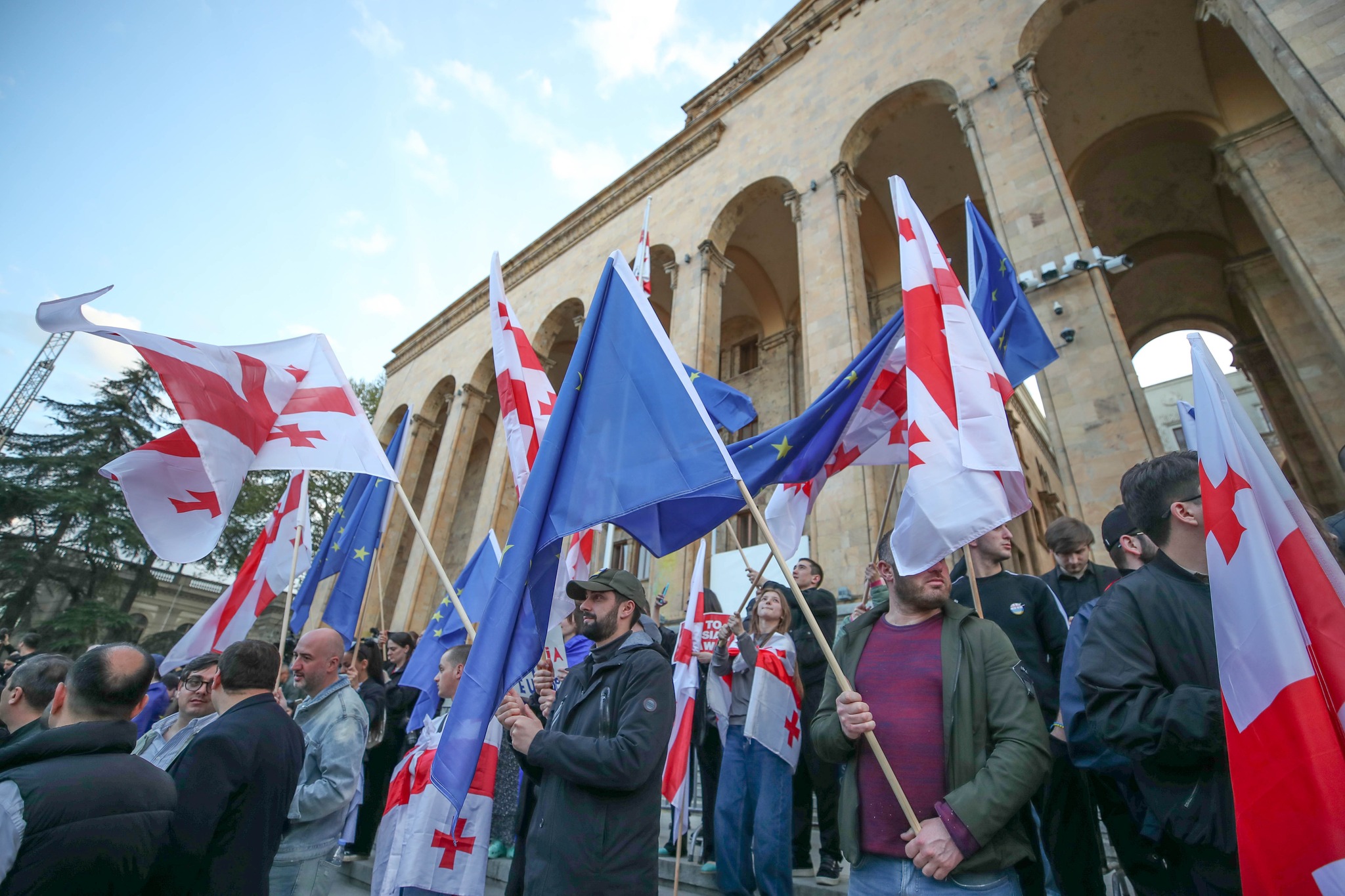
The first round of this battle against Georgia’s future has gone to the authorities: despite days of mass protests on Rustaveli Avenue and consolidated criticism from Tbilisi’s partners and friends, parliament adopted the draft law “On Transparency of Foreign Influence” in its first reading. But the “war” against the “Russian” law continues, and one may hope that the resilience of Georgian society will again force the authorities to lay down their arms and retreat, as happened a year ago.
As one watches the exertions of these Tbilisi and Sukhumi figures who have embarked on a dangerous farce of identifying “foreign agents,” a naturalistic image arises: somewhere far away, in the Kremlin, a small bald dictator rubs his sweaty little hands with pleasure… And one wants to say: a plague on both your houses!
Razhdén Kadzhaya