
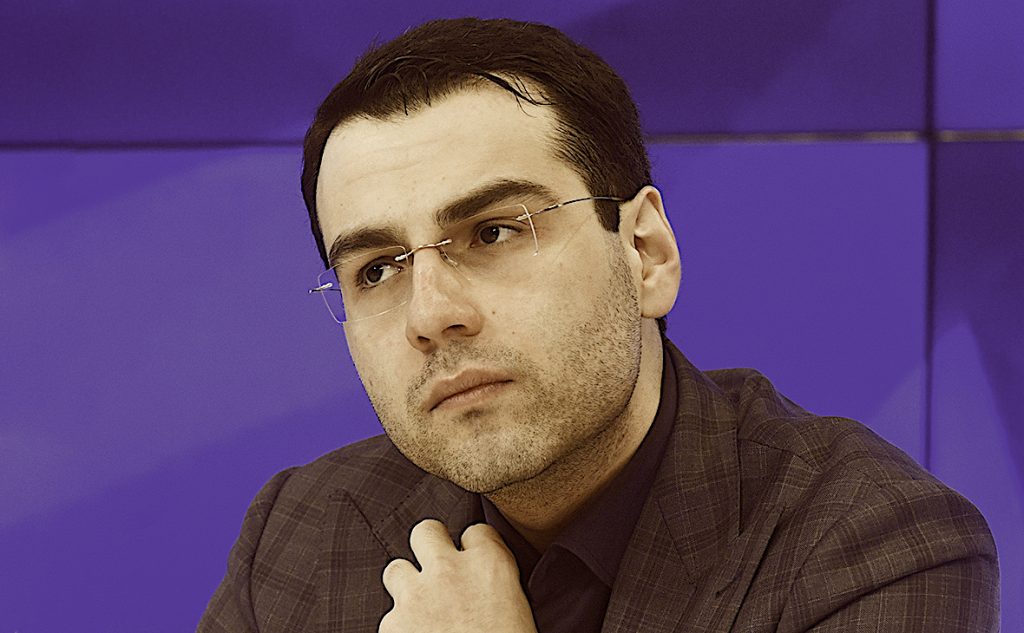
In recent times, Abkhazia has been actively discussing the departure of Inal Ardzynba from the position of “Minister of Foreign Affairs.”
It all began rather unremarkably. The former head of the “ministry” suddenly took a one-month leave at a time when the public was discussing a note received from the Russian Federation regarding the Pitsunda dacha. In itself, such a leave—even a lengthy one—would mean little if not for one nuance. During his leave, the so-called Ministry of Foreign Affairs shocked everyone with the news that Mr. Ardzynba had become the author and host of a new project on Russia’s Channel One titled “The Global Majority.”
The announcement of this project was quite pompous. It was assumed that Inal Ardzynba—note, in the capacity of a journalist rather than a minister—would conduct conversations with political figures who had challenged the so-called collective West. In other words, with marginal figures and bloody dictators who enjoy a poor reputation within the civilized international community or who have altogether lost international legitimacy.
The first episode of the program even aired, and its guest, as expected, was the President of the Syrian Arab Republic, Bashar al-Assad. The same Assad who for decades employed political assassinations and torture as a means of suppressing dissent. Moreover, the brutal, in many cases plainly inhumane actions of the armed formations under his control against his own population during the prolonged civil war led to Assad becoming a political pariah in the international community, while a significant part of Syria’s territory fell under the control of terrorist organizations.
It is impossible not to say a few words about this broadcast. Frankly speaking, it resembled a comedic show rather than a serious political discussion—two “luminaries” of democracy sitting together and condemning the West.
Prompted by the host’s leading questions, Bashar al-Assad did not spare criticism. He portrayed the United States and the West as a whole as a kind of monster seeking to destroy the national identity of independent states, occupying, enslaving, and plundering countries, controlling politicians, and using every conceivable method to achieve its goals, including terrorism. In his depiction, the white-and-fluffy Russia, by contrast, stands for international law, promotes multipolarity, strengthens global stability, and prevents the West from interfering in the internal affairs of states, thereby protecting their independence and sovereignty. Within this same framework, the interlocutors also discussed Russia’s military aggression against Ukraine, habitually referring to it as a “special military operation.” In their assessment, the West, through its intelligence services and “vassals,” incites fraternal peoples against everything Russian, while the Kremlin is left with no option but to change the course of history and correct the wrongs committed by others, supposedly in order to defend independence and democratic development in countries that Russia still considers its colonies.
Notably, during the broadcast Bashar al-Assad did not take the opportunity to send greetings to his “colleague” Aslan Bzhaniya. Instead, he conveyed warm greetings to Inal Ardzynba’s grandmother, who appeared in the program as an indirect character and was shown actively rooting for this “knight of the Middle East,” and thanked her for her “gifted” grandson.
Returning to the main topic, shortly after the program aired, Aslan Bzhaniya signed an order relieving Inal Ardzynba of his “position.” He did so so hastily—if not in outright haste—that he failed to indicate the reason for his decision and did not even notice an error in the text (the word “affairs” was omitted in the very first sentence).
Rumors of Ardzynba’s sudden dismissal immediately began circulating in Abkhazia. Some claimed that by order of the “president” he was barred from leaving Abkhazia and had even been taken to the “state security service” for questioning. Others, on the contrary, asserted that a day before his dismissal Ardzynba had been seen flying from Sochi Airport to Moscow—allegedly after a prior conversation with Bzhaniya, following which he quietly “washed his hands” of the situation and left for Russia. There was even talk that the former “chief diplomat” was planning to establish a new political party in Abkhazia and run for “president,” which supposedly motivated the resignation statement, although these same sources immediately pointed to Ardzynba’s relatively young age.
Some clarity was brought to the situation by Inal Ardzynba’s close friend Margarita Simonyan, who stated that he had contacted her and informed her of his resignation in connection with a transition to a new job. Why the first statement came not from Ardzynba himself but from a Kremlin propagandist remains unclear. Possibly she was simply attempting to salvage the reputation of her protégé. Indeed, within three minutes of being posted on Simonyan’s personal Telegram channel, the information was immediately copied verbatim by the Abkhaz “MFA” media center and presented as Ardzynba’s official address. Apparently, contacting the former chief in any other way was impossible.
Another defender of the former diplomat emerged in the person of Sergey Shamba, none other than a former “prime minister” and now “secretary of the Security Council.” He confirmed that the reason for the decision was Ardzynba’s transition to another job, and that Aslan Bzhaniya approved the resignation after Ardzynba had departed for Russia for work consultations. Moreover, Shamba expressed gratitude to Inal Batuvich for their “joint productive work” and hope for continued cooperation.
Mr. Ardzynba himself appeared only several days later. Notably, he gave comments not to Abkhaz but to Russian media outlets and announced that negotiations were underway regarding a new position in Russia. According to him, the decision to move to another position had been planned and was linked to more effective activity in order to more effectively support Abkhazia. It is only curious that Bzhaniya’s order did not mention a resignation of one’s own free will.
What the true reason for Inal Ardzynba’s departure was remains a matter of speculation. The explanation may be quite trivial—Aslan Bzhaniya may have been dissatisfied with his “minister’s” new role as a television host and decided to punish him accordingly. It is also possible that he was indeed offered a new position in Moscow, although given the high-profile financial schemes he carried out in previous years while working in the Kremlin together with his immediate superior Vladislav Surkov, such a prospect appears doubtful. One should also not discount the possibility that against the backdrop of warming Russian-Georgian relations and the clearly pro-Russian orientation of the current Georgian authorities, a staunch Georgiaphobe such as Inal Ardzynba has simply become unnecessary for the Kremlin in Abkhazia.
With Ardzynba’s departure, the media center he oversaw also ceased to exist, and a new information center has already been opened under the “presidential administration.”
Incidentally, the second episode of “The Global Majority” never aired on Channel One and does not appear in the program schedule, which likewise does not speak in favor of any prospective advancement of Inal Ardzynba. Thus, despite his efforts to please his Kremlin curators—even at the expense of the interests of the Abkhaz people—in Moscow Inal Ardzynba ultimately proved to be a dispensable figure. At least for now.
Ekaterina Tsanava