
Why Did Georgia Reconsider Its Participation in NATO’s Large-Scale Exercise?
28/04/2023 14:54:49 Politic, Interview, Analysis
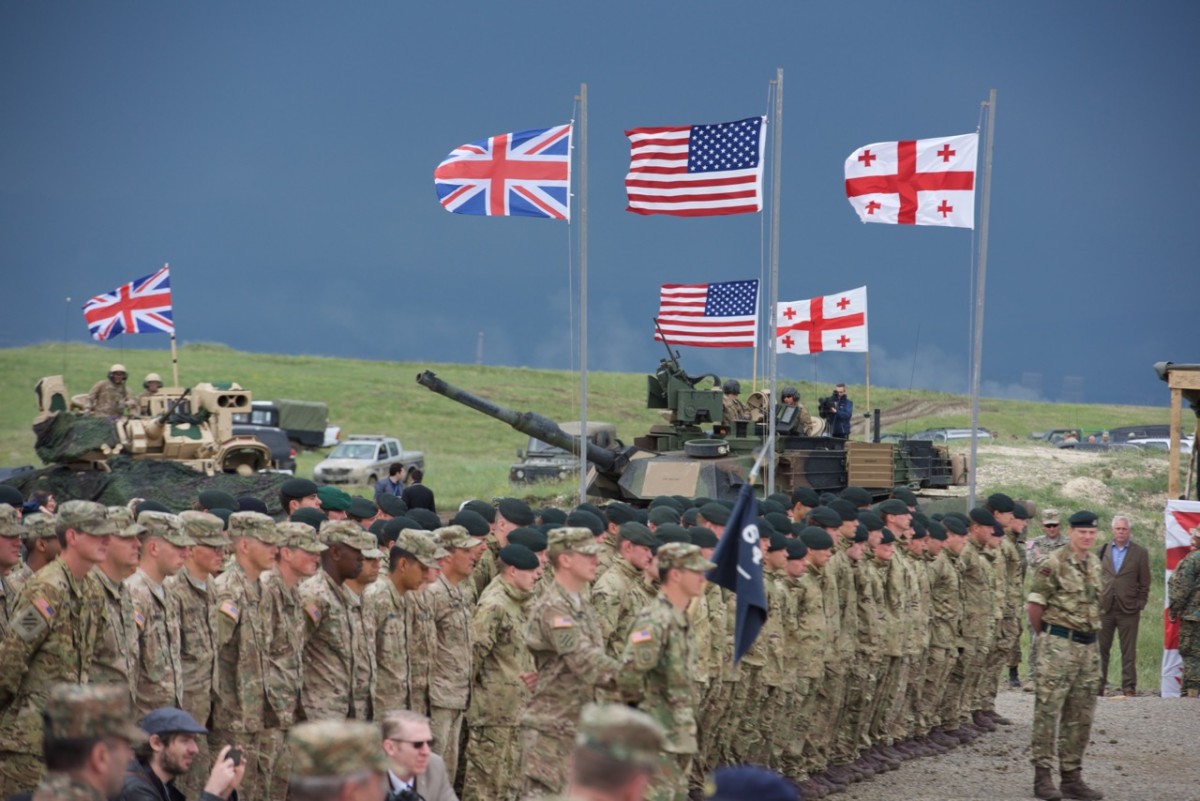
On April 22, the large-scale multinational NATO exercise DEFENDER 2023, led by the United States in Europe, officially commenced. As it turns out, Georgia is not participating in the drills. This fact was confirmed to Accent by the press service of the United States Army Europe and Africa.
“DEFENDER 23 includes more than 7,800 U.S. and 15,000 multi-national service members from more than Allied and partner nations. Military exercises are dynamic and, often, fluid events. As such, nations anticipating participation may change for any number of reasons with little or short notice. The countries currently participating in DEFENDER 23 include, but are not limited to: Estonia, France, Germany, Greece, Italy, Latvia, Poland, Portugal, Romania, Spain, United Kingdom and the United States. As of this date, Georgia is not participating. The importance of exercises such as DEFENDER 23 is that they help solidify relationships and build on time-tested alliances by improving interoperability and strengthening already established relationships with Allied and partnered nations.,” stated the comment sent to Accent by the U.S. Army Europe and Africa press service.
It is noteworthy that prior to the start of the exercises, Georgia appeared on the list of participating countries. However, the information published on the Pentagon’s website was later revised, and the list of participating nations was removed. Ultimately, it became clear that Georgian troops would not be represented in this major exercise.
As Georgian generals explained to Accent, all of whom have experience in similar drills and cooperation with partners, the planning process for such exercises is lengthy and, over time, determines both anticipated participants and the nature of their participation. Therefore, given that Georgia initially appeared on the list of participating countries, it may be assumed that readiness was originally confirmed by the country’s Ministry of Defense.
What changed thereafter? In an effort to clarify the matter, Accent contacted the Ministry but did not receive a specific response.
“These annual exercises will focus on the rapid strategic deployment of U.S.-based forces, the effective use of pre-positioned stocks, and cooperation with European allies and partners. The purpose of the training is to demonstrate the U.S. Army’s ability to rapidly deploy combat-ready forces and equipment, to sustain them, and to deter those who threaten peace in Europe and defend the continent from aggression,” recently explained Pentagon spokesperson Sabrina Singh.
Retired Major General Vakhtang Kapanadze — former Chief of the General Staff of Georgia, former representative of Georgia to the EU and NATO, and advisor to “Geocase” — believes that, given Russia’s full-scale war in Europe, the scenario of these exercises will be closely aligned with the war in Ukraine.
At the same time, speaking with Accent, the general clarified that participation in exercises is generally voluntary but recommended — including DEFENDER.
“If we want NATO, we should participate in exercises as frequently as possible. The more NATO there is in Georgia and the more Georgia there is in NATO, the more secure we will be,” Vakhtang Kapanadze stated.
Approximately the same was conveyed to Accent by the U.S. Army Europe and Africa:
“The importance of exercises such as DEFENDER 23 lies in the fact that they help strengthen relationships, build time-tested alliances, improve interoperability, and reinforce already established ties with allied and partner nations.”
General Giorgi Surmava shares this view:
“In general, exercises are essential for an army — the more, the better. As for NATO exercises, they bring numerous benefits for us, primarily enhancing interoperability and gaining experience. There are exercises involving only troops, only staff elements, or mixed formats. The DEFENDER exercises involve both staff and troops. This is extremely important: interoperability is strengthened, and both soldiers and staff gain experience. We have significant experience at the soldier level from missions and NATO exercises, but we need more at the staff level — staff structures determine interoperability and operational capability. Training a soldier to a certain level may take six months or a year, training an officer takes longer, and training a headquarters staff takes even more time. Experience is necessary for soldiers, officers, and staff alike.”
In this context, the general also explained to Accent that participation of units and headquarters in Alliance exercises is important from the perspective of integration and cohesion, and “this is the benefit of any exercise, especially NATO’s.”
“Given our declared aspiration to become a NATO member, we must be interoperable — as soldiers, officers, units, and headquarters alike.”
“As a rule, we participated in such exercises. This could have been at the staff level or with deployed units. I do not recall us ever declining an invitation. There was one instance when chickenpox spread within a unit that was supposed to deploy, and even then, as I recall, we were represented at least at the observer level,” Kapanadze recalls.
According to him, the security sector is “gradually closing.”
“There is a pronounced negative trend in terms of decreasing transparency and accountability, and it has become impossible for the non-governmental sector to obtain information on important issues,” Muchaidze explained.
“The NATO Secretary General and Charles Michel [President of the European Council – ed.] clearly told the Prime Minister during a recent visit to Brussels: ‘Without judicial reform, media freedom, and rule of law, nothing will move forward.’ Previously they spoke more cautiously; now they speak directly and firmly. Under these conditions, declarative visits mean nothing. In reality, the homework is not being done, and democratic reforms are a crucial component of integration into NATO and the European Union. There is much to be done in the defense sector as well, but that is not what is blocking us. It has reached the point where the strategic partner that is the leading NATO state and the locomotive of our support is imposing sanctions on judges, while the government shields them and even takes pride in doing so. Under these circumstances, what perspective can there be for NATO membership?”
Within the same context, Muchaidze also draws attention to an overtly anti-Western campaign conducted with the involvement of the ruling team. In sum, he argues, all of this creates the impression that “Georgian Dream” is more focused on retaining power than on the country’s foreign security priorities and, if necessary, would sacrifice integration into the European Union and NATO to that end.
Gvantsa Pipia