
The EU has become closer for Georgia, but not for Sukhumi
16/11/2023 18:37:36 Conflicts
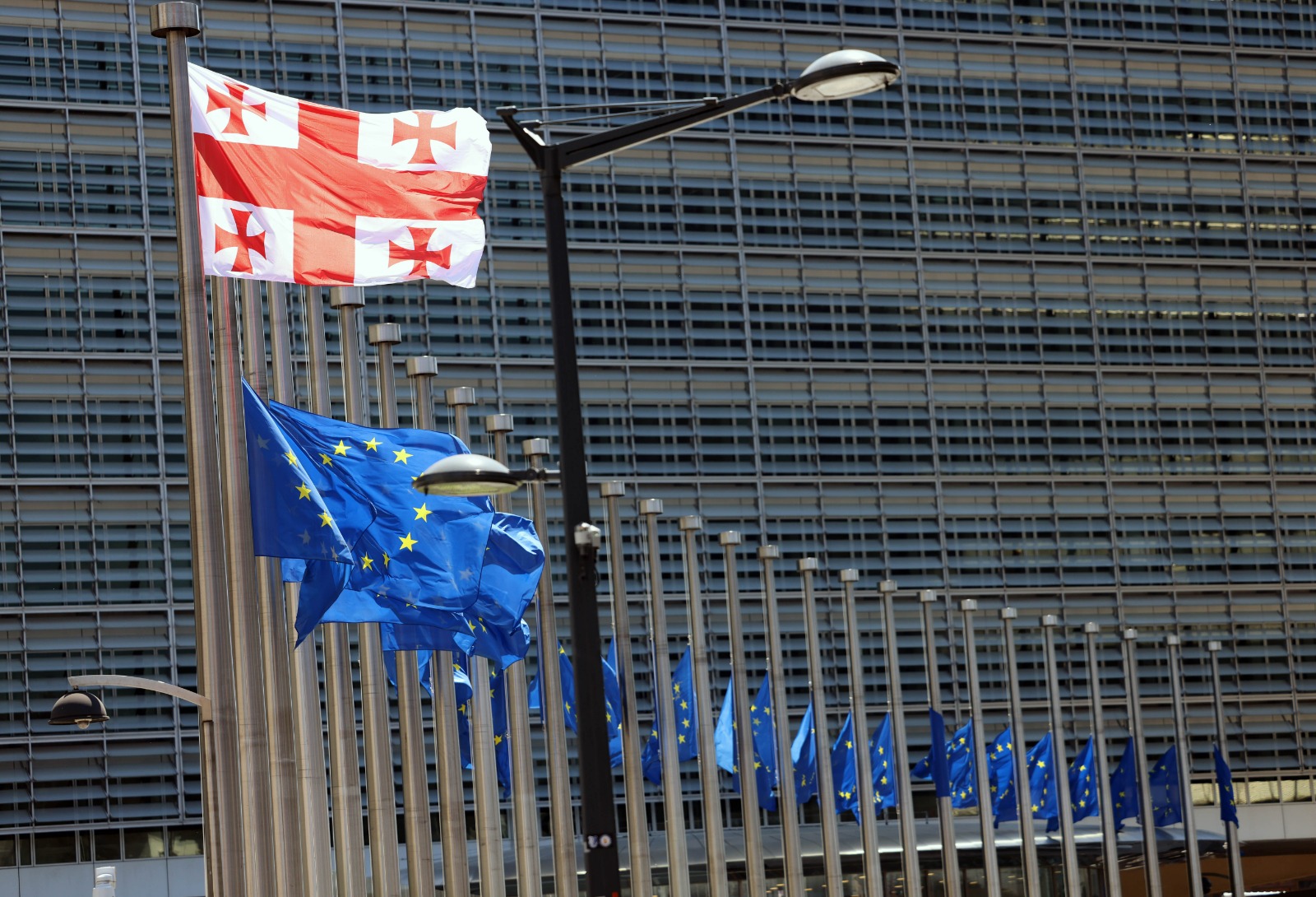
November 8 became a historic day for Georgia. The European Commission decided to recommend that the European Council grant Georgia the status of a candidate country for membership in the European Union (EU), provided that its government implements important reforms in line with the EU’s recommendations.
Undoubtedly, this is a landmark event, although it is not the final step on the long road of Georgia’s return to the broader European family, which began as early as 1996. Despite the critical assessments Georgia receives regarding the pace and quality of reforms aimed at ensuring real compatibility with the EU in all key areas of public life—from the protection of civil rights to international policy—it can be stated with confidence that Georgia has already seen a light at the end of the tunnel. After all, today the EU represents the best example of a completely voluntary and equal union of nearly three dozen states and a model for organizing human life. This includes the protection of human rights, democratic governance, effective justice, security, and economic prosperity. At the same time, obtaining candidate status opens up opportunities for Tbilisi to receive new and additional preferences from the EU.
At present, the status of EU candidate country is held by Turkey, North Macedonia, Montenegro, Serbia, Albania, Ukraine, Moldova, Bosnia and Herzegovina, and now Georgia.
Countries with candidate status have access to several thematic financial funds (IPA III 2021–2027) totaling €14 billion, covering the strengthening of institutional and administrative capacity; the development of rural, community settlements and regions; and the development of human resources. Candidate countries also have the opportunity to receive funding from the €19 billion Neighborhood Development Fund, whose resources are likewise aimed at development and economic progress. In addition, the Economic and Investment Plan calculated through 2027 is also linked to accession financial instruments, which take into account assistance from international financial institutions. However, perhaps the most important component is direct financial assistance from both EU member states and the private sector, where approximately €30 billion has been mobilized (€9 billion in grants and €20 billion in investments by financial institutions) to assist with adaptation to EU standards.
Speaking of the economic prospects opening up for Georgia, it should be noted that in terms of GDP, it already surpasses five countries holding EU candidate status: Georgia – $24.6 billion, Bosnia – $24.5 billion, Albania – $18.9 billion, Moldova – $14.4 billion, North Macedonia – $13.5 billion, and Montenegro – $6.1 billion. In October, the revenue side of the 2023 budget was increased by 500 million lari due to overperformance of projected revenues and reached a total of 22.17 billion lari, equivalent to $8.2 billion. The Georgian state has long ceased to depend on external inflows, fully covering its needs from its own resources—whether defense, healthcare, civil servant salaries, social benefits, or pensions. Foreign funds in Georgia’s current budget amount to a total of 2.16 billion lari, that is, less than 10% of the budget. Almost all of this amount consists of international loans, i.e., debt obligations totaling 1.88 billion lari, which Tbilisi services regularly and without interruption. As a foreign “gift” to the Georgian budget, only grants can be considered, accounting for about 1% of the budget—280 million lari. Therefore, the newly opening access to preferential EU financial resources gives reason to look at Georgia’s economic development with even greater optimism and will provide an additional impulse to the country’s progress.
Against this background, Sukhumi, which faces a budgetary crisis if current trends in relations with Tbilisi persist, remains on the sidelines. Recently, the Abkhaz parliament amended the current year’s budget. Total revenues in 2023 will amount to 10.4 billion Russian rubles, expenditures to 12.3 billion rubles, which means a deficit of 1.8 billion. At the same time, direct Russian subsidies even in this modest budget are calculated at 6.2 billion rubles. Thus, at the current exchange rate, the entire Abkhaz budget is equivalent to $102 million, 60% of which consists of Russian financial assistance. It is quite obvious that Sukhumi would benefit from an additional source of funding and investment, which is quite achievable, as demonstrated by the example of Transnistria.
Transnistria has long enjoyed the privilege of free trade with the EU. Brussels does not recognize the sovereignty of the region, yet this has not prevented the establishment of trade and economic relations between them. Despite the militant rhetoric of the Transnistrian administration, as early as 2008 the EU adopted a regulation introducing autonomous trade preferences for Tiraspol. Thanks to the Association Agreement between Moldova and the EU (2014), all Transnistrian enterprises registered on the territory of the Republic of Moldova can export to and import from the European market through Moldova at reduced tariffs. Since 2015, a roadmap has been in place between Transnistria and the EU, whose main content includes the phased introduction of a permanent regime of mutual free trade (i.e., without export-import duties). According to statistical data, exports from Transnistria to the EU increased by 64% in 2022 alone. Moreover, the EU remains the leading supplier of goods to Tiraspol, accounting for 50% of the region’s total imports. Approximately 70% of Transnistria’s exports now go to the European Union. The Transnistrian region trades with 20 out of 28 EU member states. Over the past 10 years, the markets of Romania, Italy, Poland, and Germany have absorbed 85–90% of Transnistrian exports totaling $2.263 billion.
And this is under conditions where Tiraspol still refuses to acknowledge that Chisinau’s control and certification authorities operate on its territory. The point is that in 2015 a compromise was reached (the details of which Brussels, Chisinau, and Tiraspol do not disclose) that allowed Transnistrian exports to continue. It was precisely this arrangement that saved the left bank of the Dniester from inevitable economic collapse. As practice in recent years has shown, this largely informal agreement has been extended year after year and remains in force.
Furthermore, if the example of Tiraspol in terms of trade with the EU were extrapolated to Sukhumi, this would also imply expanded access to EU development funds, providing financial resources for infrastructure projects, overall economic development, environmental initiatives, and other programs. This would help reduce financial dependence on the Russian Federation, which year after year reduces its financial assistance while simultaneously imposing ever harsher conditions.
It would also imply participation in various EU grant programs, such as “Horizon” (a research and innovation program), “Erasmus+” (a program for student and faculty exchanges between universities), “Creative Europe” (a program supporting the cultural sector), and many others. Education at leading European universities would become a reality for Abkhaz youth. Additionally, there would be visa-free travel to the EU not only for tourism purposes but also for access to high-quality medical services.
All of this represents only part of the benefits and direct advantages of partnership with the EU that Sukhumi could expect under a constructive approach and a pragmatic assessment of both real threats and prospects. And it is not difficult to guess that rejecting such opportunities is clearly a choice not in the interests of the Abkhaz people.