
The dark side of Inguri HPP
04/12/2023 08:45:13 Conflicts
“Winter is coming!” — this vivid and memorable motto of House Stark from the legendary Game of Thrones, warning of the need to always be prepared and mindful of danger, becomes relevant for Abkhazia every winter. Winter has not yet fully taken hold, but with the autumn cold snap the specter of an approaching energy crisis has once again appeared in the republic.
The first alarm sounded back in early November, when the de facto Minister of Economy, Kristina Ozgan, returning from Moscow, announced grim news: this time Sukhumi will have to pay Russia for additional volumes of electricity needed by Abkhazia during the winter period. The first contract for the transmission of 30 million kWh will cost 135 million rubles; the second, for 50 million kWh, another 200 million rubles. In total, covering Abkhazia’s energy deficit will require about 900 million rubles, equivalent to USD 10 million and roughly 8% of the revenue side of the Abkhaz budget.
Against this backdrop, the de facto authorities hastened to speak about yet another tariff increase, which, incidentally, remains low to this day. The first increase occurred in 2022, when the cost of one kWh rose from 40 to 90 kopecks; from January 2023 it increased to 1 ruble 30 kopecks, and now discussions are underway about a phased increase of the tariff to 4 rubles — within the framework of synchronization and the formation of a common socio-economic space with the Russian Federation.
Adding fuel to the fire was the issue of transferring one of the step-down hydropower plants from the Inguri HPP cascade system to a private investor, a move being lobbied by the local leadership. According to the project, the facility would be leased for 50 years. In return, Sukhumi would receive 20% of the generated electricity free of charge.
The opposition, which, like the de facto authorities, cannot be suspected of sympathies toward Tbilisi, stated that it would be better to agree to the terms of the Georgian side, which promised Abkhazia 50% of the generated electricity free of charge.
However, the issue remains unresolved, and there appear to be no simple solutions. The energy problem in Abkhazia has several dimensions at once: the populism of local politicians who intimidate the population with the “Georgian threat” and gain points through anti-Georgian rhetoric; Russia’s desire to seize the Abkhaz energy sector; rampant corruption within the authorities, who have a vested interest in the sector’s lack of transparency; and the population itself, unwilling to pay for consumed electricity.
The agreement concluded in the 1990s on electricity sharing according to the 60/40 principle implied the right of the parties to purchase a guaranteed amount of energy at a preferential tariff, not to receive it free of charge. That is, Tbilisi and Sukhumi could dispose of electricity within their quotas at their own discretion, for example by selling surplus energy.
Today, the electricity tariff for Inguri HPP approved by the Georgian National Energy and Water Supply Regulatory Commission (GNERC) amounts to just 1.8 tetri per kilowatt-hour (about 60 kopecks at the devalued ruble exchange rate of 90 rubles per U.S. dollar), and in previous years it was even lower. By comparison, for the current winter transmission from Russia, Sukhumi will pay at a rate of 4 rubles per kilowatt. Despite the fact that Inguri electricity is nearly seven times cheaper than Russian electricity, Sukhumi has never paid Inguri HPP for the energy received, even though it has consistently exceeded its 40% quota in recent years. For example, in 2022, Sukhumi received electricity from Inguri HPP worth 59 million lari, which is almost 2 billion rubles at the current exchange rate (about USD 22 million). It is easy to imagine that over nearly 30 years of the “gentleman’s agreement” on sharing Inguri electricity, Abkhazia has received energy worth a colossal amount. Moreover, if Sukhumi today had to purchase the 2 billion kWh it receives from Inguri HPP at the Russian tariff of 4 rubles per kilowatt, it would require 8 billion rubles — nearly 80% of the revenue side of the budget, which is already half-formed by Russian financial “assistance.” If it had to purchase all 3 billion kWh consumed last year, the entire budget would be spent on this purpose alone, with additional debts remaining.
According to the Georgian Electricity Market Operator (ESCO), electricity consumption in the country in 2022 amounted to 14.8 billion kWh. Due to consumption exceeding production, Tbilisi annually imports electricity; last year imports exceeded 1.5 billion kWh. These imports always occur during the winter period, when energy prices are significantly higher than in the spring and summer. It is important to note that since Tbilisi takes into account the acute electricity deficit that arises in Abkhazia during winter and Sukhumi’s financial difficulties, the entire winter output of the Inguri complex goes exclusively to Abkhazia’s needs. As a result, Tbilisi pays market prices for winter imports, averaging around 5 rubles per kilowatt. Moreover, Tbilisi has on more than one occasion partially or fully paid Russia from its own funds for Russian electricity supplied to Abkhazia. In 2019, electricity transmission from Russia amounted to 69.4 million kWh, and part of the payment (for 45 million kWh) was made by the Georgian government. When Inguri HPP was shut down for repairs for several weeks in early 2020, Tbilisi paid 20% of an amount totaling 500 million rubles (about USD 7.2 million).
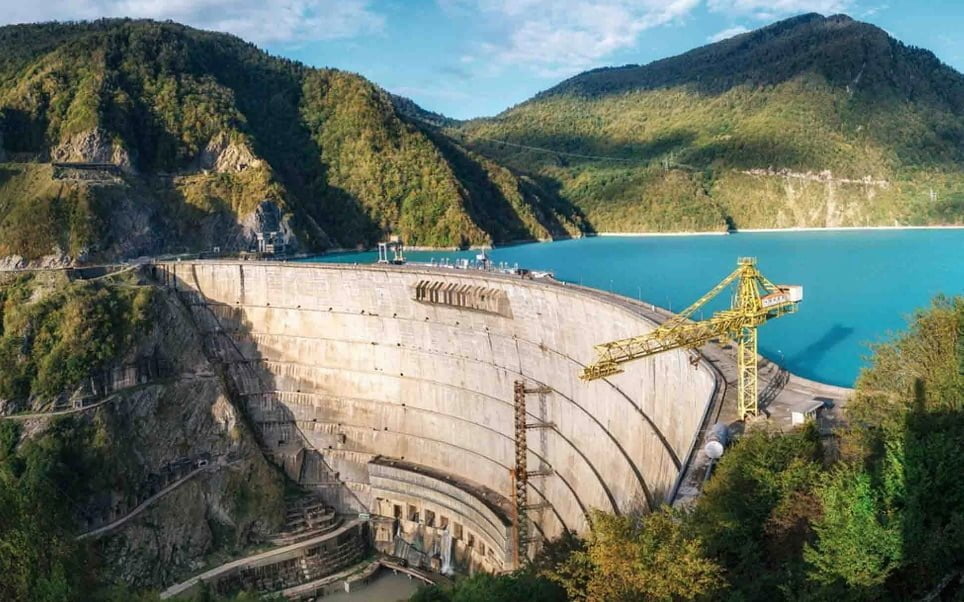
Meanwhile, Inguri HPP is an independent legal entity engaged in a financially and technologically costly and complex production process. Georgia spends approximately USD 13 million annually on maintaining the hydropower plant. Taking into account rising winter consumption covered by imports, Georgia’s real expenses are much higher. This does not include funds allocated for repair works at the plant. Inguri HPP managed to show a profit last year, unlike the loss-making year of 2021. The company’s operating income amounted to about 11 million lari, or roughly USD 4.5 million — a negligible sum for an object of such scale.
According to strict operational regulations, Inguri HPP requires major overhauls every 10 years, the cost of which can reach tens of millions of euros. Naturally, with a profit of USD 4.5 million, the company cannot finance such repairs. Western partners assist Inguri HPP, but the grants they provide serve only as co-financing alongside credit obligations, which are ultimately repaid from Georgia’s state budget. Typically, Georgia’s share accounts for 70% of costs, while Western grants cover 30%. For example, the cost of the latest rehabilitation works on the plant’s diversion tunnel carried out in 2021 amounted to €45 million, of which only €7 million came from a European Commission grant, while €38 million was a loan from the European Bank for Reconstruction and Development.
According to Transparency International, electricity tariffs for household consumption in Georgia have increased by 40% over the past 10 years. Today, in Tbilisi, the tariff is 18 tetri (about 6 rubles) per kWh for consumption up to 101 kWh per month; 22.1 tetri (about 7 rubles) for consumption from 101 to 301 kWh; and 26.5 tetri (almost 9 rubles) for consumption exceeding 301 kWh. Inguri HPP is the largest and most significant hydroelectric generation facility in Georgia, accounting for more than a quarter of the country’s total hydropower production. Moreover, Inguri electricity is the cheapest, and its significant share in the national energy balance helps restrain even greater tariff increases for the population. In effect, the “free” electricity for Abkhazia’s residents is ultimately paid for by every Georgian citizen through their electricity bills. Each year, Georgian consumers pay more, subsidies increase, and all of these expenses borne by Georgia directly affect the state budget and, accordingly, the wallets of every citizen.
In addition, Inguri HPP has already exceeded more than half of its operational lifespan. According to last year’s expert assessment conducted by German specialists, seismological, geological, and geodetic studies established that its operational life will end in 30 years. That is, the dam will have to be dismantled, as its failure would pose a direct risk to the lives of tens of thousands of people and cause an environmental catastrophe in Samegrelo and Abkhazia. Dismantling such a massive structure is extremely costly. For example, in the United States several years ago a dam at one of the largest old hydropower plants was dismantled at a cost of USD 300 million — roughly one-third of the cost of building a new plant of similar scale. And while Tbilisi is commissioning new energy capacities every year, what will Abkhazia do in 30 years?
In short, Abkhazia’s unpaid electricity consumption leads not only to rising tariffs but also to serious energy problems for all of Georgia, deteriorating the technical condition of Inguri HPP. As a consequence, Abkhazia’s energy dependence on Russia also increases, creating additional economic and political risks for Sukhumi.
The Telegram channel “Abkhazia-Center” recently wrote on this topic: “Electricity transmission from Russia was often paid for by the Georgian side, which considers Abkhazia its territory. Sukhumi limited itself to behind-the-scenes gratitude, and the scheme continued to function smoothly. For some reason, it no longer works now…”
The proposal from the “investor” regarding Step-down HPP-2 belongs to the same category. It is clear that Russia will not allow any investor other than a Russian one into Abkhazia. At the same time, the proposal to transfer 20% of this plant’s output to Sukhumi is, in fact, a more or less economically justified share. Even here, however, questions arise: will the “private investor” provide these 20% to Sukhumi free of charge, or at a preferential tariff? Where will the remaining 80% go, and how much will they cost? Will the “investor” allow Abkhazia not to pay for Russian electricity?
Meanwhile, even in professional circles in Abkhazia, the belief has taken root that the republic has free electricity. This view is also held by former “parliamentarian” and economist Natali Smyr, who speaks of free generation. “Our generation is free; we could not even collect 50% of payments at a cost of 40 kopecks per kWh. At the current cost of 1.3 rubles per kWh, Chernomorenergo collects at most 10% of payments,” she said in an interview with Echo of the Caucasus. But the point is that by handing over the energy sector to Russia, Abkhazia will lose not only this vital sector but also the “free cheese.” It is striking how naïvely events are assessed in Sukhumi. Here is Natali Smyr’s view again: “If we do not resolve the issue and do not give up the energy sector, then energy will be paid for, and the sums will be astronomical. If we give up the energy sector, then we will not pay debts, but if we do not give it up, we will pay debts.” That is, Sukhumi believes that if Russia takes over the energy sector, Moscow will provide Abkhazians with free electricity — even though there is no free electricity even in Russia itself.
The Russian state doctrine based on the concept of an “Energy Superpower” has repeatedly demonstrated the use of energy as a tool to achieve political goals. In 2006, Georgia experienced firsthand what Russian energy blackmail means. At that time, the country was taking its first steps to emerge from a total energy deficit. During unusually severe морозы, gas pipelines and power transmission lines supplying gas and electricity to Georgia suddenly “exploded” on the Russian side. The country was plunged once again into darkness and cold. This was not an accident, but a political “incident” directed against the authorities of the Rose Revolution. Moldova, Ukraine, and Western European countries are also well acquainted with Russia’s energy weapon, as Moscow has on multiple occasions shut off gas supplies during winter periods. Is this not a lesson for Sukhumi?
Meanwhile, Tbilisi, despite the cataclysms of the past 30 years — including the 1992–93 conflict and the August 2008 war — has never resorted to energy blackmail against Abkhazia and, on the contrary, has always made concessions and provided assistance when possible.
In light of the above, it is time for Abkhazia to begin to recognize reality: driven into energy debt, it will have to concede everything Moscow demands, but even that will not secure Sukhumi a future rendezvous with free electricity. To avoid losing everything, it is necessary to treat the shared treasure — Inguri HPP, which still illuminates both sides of the river — with care and responsibility.