
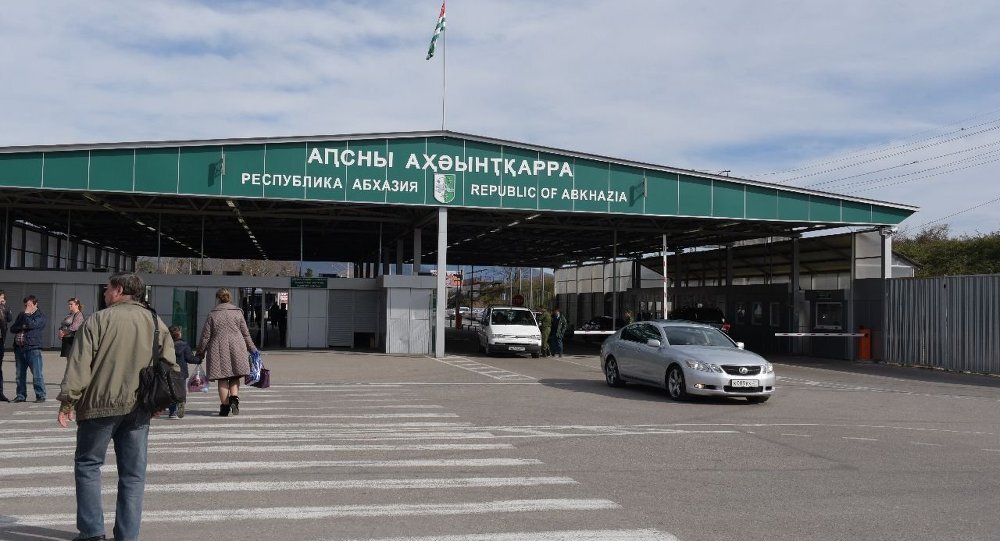
Abkhaz society has been gripped by another wave of intense indignation, this time connected with the expected restrictions on movement across the Russian–Abkhaz “border.”
The issue concerns information circulated by the Border Directorate of the Russian Federal Security Service (FSB) about an imminent change in the procedure for crossing the border by citizens holding dual—Russian and Abkhaz—citizenship.
In particular, from March 1 onward, entry into and exit from the Russian Federation by holders of dual citizenship will be carried out exclusively on the basis of a Russian passport. For violations of the rules, citizens of Abkhazia face administrative fines of up to 5,000 rubles (approximately 55 U.S. dollars), officials up to 50,000 rubles (550 dollars), and legal entities up to 800,000 rubles (8,800 dollars). Moreover, border guards will be entitled to deny departure from the Russian Federation to citizens traveling on an Abkhaz “passport.”
Notably, the de facto authorities initially offered no comment on the matter. The only clarification was provided by the Deputy Chairman of the State Security Service and Head of the Border Detachment, Rustam Latipov. According to him, the list of documents for crossing the border established by the agreement “On Mutual Visa-Free Travel of Citizens of the Russian Federation and the Republic of Abkhazia” has not changed, and provided that one of these documents has a valid expiration date, Abkhaz citizens may cross the border without hindrance.
The Consular Section of the Russian “Embassy” in Abkhazia—which should primarily be responsible for informing citizens of any changes regarding border crossing—also did not respond to the new restrictions, citing “lack of awareness,” and advised journalists to contact the border guards directly. At the same time, the head of the section, Ekaterina Pavlova, confirmed that under Russian law, a citizen of the Russian Federation must cross the border using a valid foreign passport or an internal passport, if provided for by relevant regulations.
Not immediately understanding the circumstances, Abkhaz users of Telegram channels erupted in angry remarks regarding the forthcoming changes: “Why are they treating us this way?”, “Russia is not interested in the Abkhaz people,” “Does this correspond to our friendly relations?”
Later, it emerged that the changes in the procedure for crossing the border apply not only to Abkhaz citizens with Russian citizenship, but to all Russian citizens who hold dual citizenship. The anger of the local population somewhat subsided, but a certain unease and confusion remained. As it later turned out, not without reason.
In explaining the necessity of the new measures, the FSB refers to Article 10 of the Federal Law of April 28, 2023, “On Citizenship of the Russian Federation,” according to which a Russian citizen holding dual or multiple citizenship is considered solely a citizen of the Russian Federation regardless of their place of residence, except in cases provided for by federal law or an international treaty. The Russian side states that the provisions of the agreements between Moscow and Sukhumi do not envisage the possibility for citizens of the Russian Federation who also hold Abkhaz citizenship to use Abkhaz documents when entering or leaving Russia. The FSB’s information also explains that “the Russian Federation has concluded three international treaties regulating issues of dual citizenship—with Tajikistan, Abkhazia, and South Ossetia—and none of them provides for the use of local documents by Russian citizens when crossing the border.”
It is important to note that the agreement “On Mutual Visa-Free Travel of Citizens of the Russian Federation and the Republic of Abkhazia,” concluded as early as 2009, establishes that “citizens of one party’s state, regardless of their place of residence, may enter, exit, transit through, and stay on the territory of the other party’s state without visas for up to 90 days using one of the valid documents” listed in the relevant annexes. For Abkhaz citizens, such documents include not only the so-called foreign passport but also the general internal passport. The agreement does not address the issue of border crossing by persons with dual citizenship, leaving this matter to the discretion of the citizens themselves. At that time, a significant portion of Abkhazia’s population already held Russian citizenship as a result of the policy of passportization carried out there.
Moreover, according to Paragraph 4 of Article 15 of the Constitution of the Russian Federation, “If an international treaty of the Russian Federation establishes rules different from those provided by law, the rules of the international treaty shall apply.” This means that with regard to Abkhazia, in principle, the provisions of the above-mentioned agreement should apply—at least until appropriate amendments are introduced—rather than those of the newly adopted Russian law.
The Russian Federation’s decision to change the border-crossing procedure may be connected to another noteworthy aspect. In particular, in April of last year, the State Duma adopted amendments to the law “On the Procedure for Exit from the Russian Federation and Entry into the Russian Federation,” establishing a ban on leaving Russia for citizens subject to military conscription from the day a draft summons is entered into the registry of issued (served) summonses by the military commissariat. Notably, the summons is duplicated in electronic form and is considered served from the moment it is posted in the citizen’s personal account on an information resource designated by the Russian government. The new law stating that a Russian citizen holding dual or multiple citizenship is regarded solely as a citizen of the Russian Federation, regardless of place of residence, combined with the circulated information about possible refusal to allow Abkhaz citizens to leave Russia, creates a rather telling picture. As the line goes in a well-known film, “Let everyone in, let no one out”…
Russia is interested in recruiting as many conscripts as possible for the war against Ukraine. According to a recently declassified U.S. intelligence report, this war has already cost Russia 315,000 killed and wounded servicemen—almost 90 percent of the personnel available at the beginning of hostilities. Rumors are circulating that in Russia even migrants without Russian citizenship are being forced to sign contracts for military service. Needless to say, this applies even more to those who hold a Russian passport…
Ekaterina Tsanava