
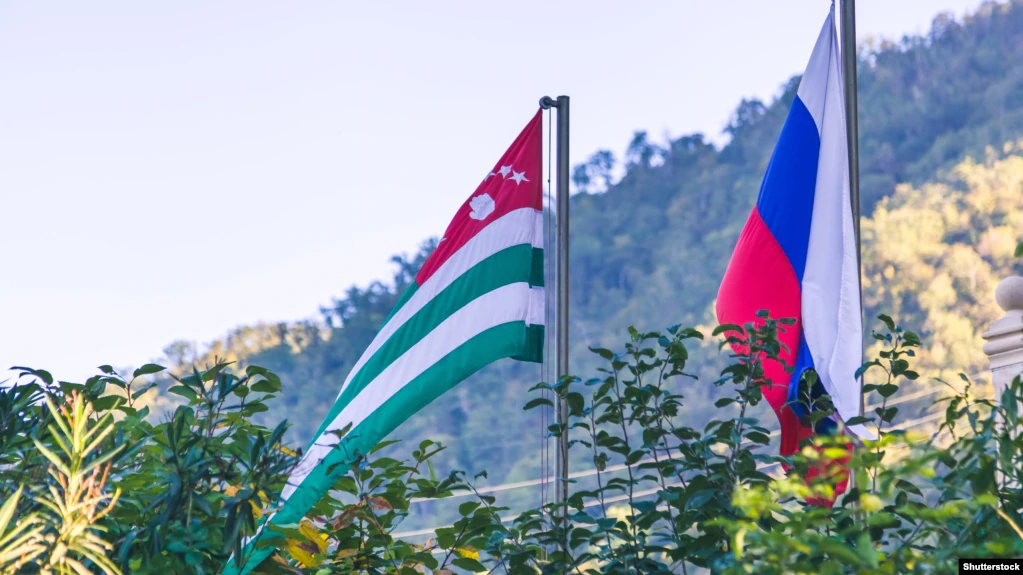
Russian Pressure on Abkhazia Is Gradually Intensifying…
For now, it remains relatively mild and restrained in nature. Moscow is not in a hurry to employ its full arsenal of instruments of influence against Abkhazia, probably realizing that activating even a third of them could lead to a complete and universal collapse.
It is strange that Russia—readily prepared to wipe entire cities and countries off the face of the earth, and indifferent not only to others but even to its own people—has for so long been courting from all sides a territory fully under its control…
Moreover, in essence, over the past 30 years Abkhazians have been left to their own devices—their dream came true: Russia financed them, ensured an acceptable standard of living, guaranteed security and inviolability. At the same time, it demanded nothing in return, set no conditions, and if any initiative came from Moscow that was unacceptable to Abkhazians, it was urgently withdrawn.
It would seem—what is Abkhazia to Russia? With a simple flick of a finger, Moscow could reduce it to dust, or spare it and inflict non-lethal but such severe injuries that Sukhumi would never forget… Who would object, who would care, and whom does Putin listen to, after all?
Yet an empathy-devoid Russia, capable of destroying entire unwanted countries, here demonstrates inexplicable patience…
This lasted not just for years but for decades. For more than 20 years, Moscow has sought the adoption by Abkhazia of a law permitting the sale of real estate to foreigners, but Abkhazians have consistently delayed. How many presidents there have been, and each maneuvered and evaded as best they could—so that the law has still not been adopted.
It appears that the Russian approach is finally changing. Not dramatically yet. Moscow has presented Abkhazia with a number of demands whose acceptance is categorically unacceptable to the majority of Abkhazians, including those currently in power. But the Russian Federation is not yet rushing to apply serious pressure.
Russia has begun to show Abkhazians its fangs. Not forcefully, limiting itself to soft signals delivered from a distance—such as monopolization of the fuel market, restrictions on energy flows, and “explanatory conversations” with defiant Abkhazians at the Psou… For now, all this is not painful and remains fairly tolerable. The fundamentals—financing of the Abkhaz budget, tourism, and exports of agricultural products from Abkhazia to Russia—remain untouched.
However, the process of tightening the screws has begun, and things will only get worse.
At the same time, it is clear that there will be no easy solutions. Recall how many months the debates surrounding the Pitsunda dacha lasted—a matter that was, in essence, local and, in theory, did not carry the nationwide, existential significance of the apartments law.
For months, Abkhazians delayed adopting that decision—beginning discussions, then postponing them, then introducing amendments, and then returning the issue to discussion again. Eventually, it had to be adopted, but, as already noted, this was a local matter.
How long Abkhazians will continue to delay the apartments issue—only God knows. The right of foreigners to purchase real estate was delayed for almost 20 years, and then, under pressure from Moscow, a more lenient formulation had to be devised—apartments. A law which, if adopted, would open the floodgates to a Russian demographic wave, but would provide a grace period of 15–20 years. Until projects are approved, land allocated, and construction begins—rest assured, all these procedures will also be delayed to the maximum extent…
Here we are dealing with an Abkhaz national peculiarity—their resistance to a vastly superior partner-adversary, in some sense, even commands respect.
They are completely dependent on Russia. Moscow could, if it wished, simply erase them from the face of the earth without anyone even noticing. Yet despite this, they risk going against the Kremlin’s wishes, delaying, and holding out until the very end. Few others in their position would be able to last so long.
Abkhaz society is also aided in this by the absence of blind deference to authority and by pluralism of opinions. The authorities cannot allow themselves to commit any arbitrariness and blindly follow orders from above—were it not for this, the law on the sale of real estate to foreigners would have been adopted many years ago, and Russians would now constitute the majority of Abkhazia’s population.
Abkhaz society is fairly free and open; accordingly, few Abkhazians can afford to act against its opinion…
Until recently, any confrontation between the authorities and the people in Abkhazia inevitably ended with the shameful flight of glutted presidents and prime ministers. This is precisely what made Abkhazia a unique place surrounded by Russia, where authoritarian regimes prevail, pluralism of opinion is absent, and elections are of a ritual nature.
We are seeing the first signs that Russia is beginning to break this reality. What is strange is not that it is starting to do so, but that it tolerated it until now. Abkhazia is a flaw in the system that must be erased—so that in Abkhazia everything is as it is in Russia and around it: no competitive elections, no opposition, no anti-government media…
Now it is not only the fate of investments, energy, and real estate that is being decided. Now the fate of Abkhaz society as such is being determined.
Will it be able to remain pluralistic and even, in its own way, democratic? Will it be able to preserve its capacity to resist dictates from outside? Or will Abkhazia eventually be turned into the North Caucasus, where free opinion has long been suffocated and governance is in the hands of local feudal lords accountable to Putin rather than to their own people?
Let us not rush ahead regarding outcomes. But the struggle ahead will be far from trivial.
If Abkhaz society manages not to scatter to the corners and to preserve its resilience, it is not excluded that delaying tactics may succeed for an indefinitely long time.
Tengiz Ablotia