
Abkhazia: Repressions announced, targets known
28/02/2024 09:28:32 Conflicts
It is necessary, gentlemen—necessary. Moscow demands it, and we must not offend it. We would not survive without it; we would perish, disappear. The Zainingurian enemy is just waiting, baring its fangs, sharpening them with a huge toothbrush gifted by the accursed West. And where would we be at such a time without Russia, if it takes offense and turns away? So it is time to stop being outraged. We must give the strategic friend everything it wants. Even sovereignty. We must also imitate it in everything—so as to match the high standard. And if anyone is dissatisfied with this, that person cannot be a well-wisher of Abkhazia. He is an enemy—an internal enemy linked to external enemies—and must be punished, and first of all silenced, so as not to drive the people mad. Decided! And that’s final!…
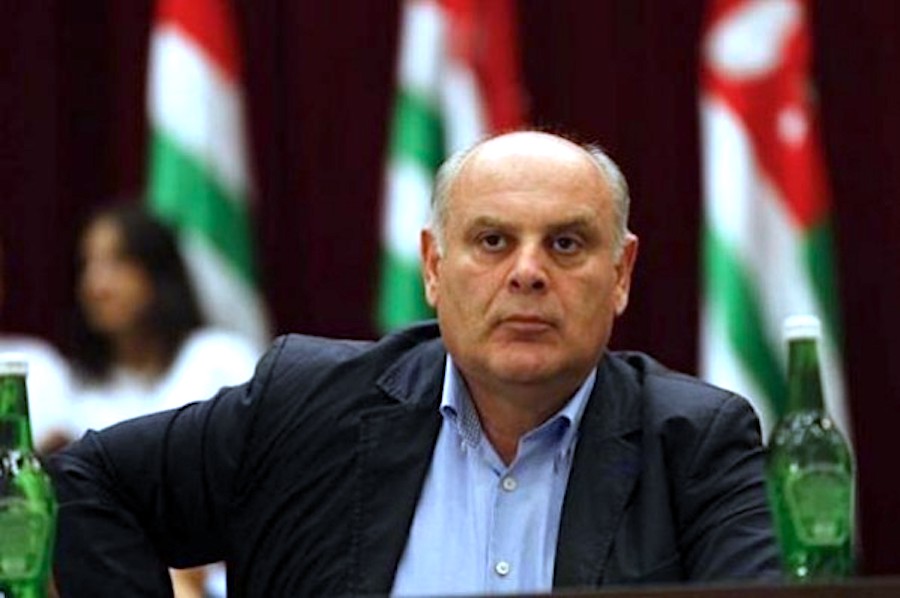
Roughly such was the main message of “President” Aslan Bzhania after his recent return from Russia, where he supposedly flew to address fuel and energy issues. Instead of solutions on those matters, the Abkhaz leader informed the people about yet another set of “certain obligations to Russia,” in particular about the “necessity” for all of Abkhazia to vote in the upcoming presidential elections of the Russian Federation for the “father-savior” Vladimir Putin, and also to erase freedom of speech in Abkhazia entirely, so that no one and nothing would prevent Moscow from bringing the annexation of the republic to its victorious conclusion, so that this process would continue “without unnecessary noise and dust,” and so that afterward the Kremlin would have the opportunity to present it to the world as “the humblest unanimous request of the Abkhaz people themselves”…
What was decided in Moscow regarding the fuel and energy problems so pressing for Abkhazia’s population, Bzhania did not say at the recent meeting of the collegium of the de facto Prosecutor General’s Office. And, in principle, this is understandable—after all, it was a meeting of the “Prosecutor General’s Office” collegium. What is strange is only that at that same meeting the “president” did not refrain from purely political statements, first of all informing those present that in Abkhazia there “are forces that strike at relations with Russia.” He recalled Karabakh, frightened people with the fate of “homeless peoples,” and in the end came to what, in fact, everything has been leading toward lately: all those who disagree with the policies of the ruling team—interacting with the Russian leadership according to the principle of “one hand washes the other”—must have their mouths shut, and if it cannot be done the good way, then it will be done the bad way.
I will cite a couple of excerpts from what the “president” said at that meeting: “Forces have appeared in the country that strike at relations with our practically only ally. […] If we discuss issues of interstate relations with the Russian Federation, a certain information attack begins. This testifies to coordinated work to destabilize the situation in Abkhazia, to destroy our statehood”; “In our state, people among us can allow themselves to say anything and at the same time remain unpunished”…
Aslan Bzhania cited as an example “a citizen sitting in the square with the surname Adleyba”: “A few days ago he stated that the leadership of Abkhazia received 3 billion rubles for ratifying the agreement between Abkhazia and Russia on the transfer of the complex of buildings in Pitsunda. Who should react to this? My nephews, my sons? Or do we have competent bodies that should make decisions to stop crimes of this kind, and so on?… This is our home, yours and mine. And what do we allow to be publicly discussed? People are being driven mad,” Bzhania said.
Economist Akhra Aristava also came under attack. He had earlier voiced the idea that Abkhazia needs to transition to its own monetary unit—to adopt laws on currency regulation with a mandatory condition including a clause on circulation, alongside the Russian ruble, of the Abkhaz apsar. How sound this idea is from an economic standpoint is a separate question. But the “president” likewise accused him of something close to incitement “to the destruction of statehood.”
“They are listened to, no one stops them. And they exert managed influence on our citizens. This is a known story. In Soviet times it was called ideological diversion. One need only seize a person’s consciousness, and that person becomes a material force in your hands—you can control him. And this is what our young Abkhaz state is facing,” Aslan Bzhania concluded.
At the same time, on the basis of the fact that critics of the policies of the current de facto authorities can still freely express their own opinions in Abkhazia, the “president” accused the relevant bodies of being “toothless” and called on prosecutors to direct at the “internal enemies” both swords depicted on the agency’s emblem: “A special mission rests with the people present in this audience. Since you have put on this uniform… There is also the emblem… What is there, a shield. And what else? A sword? Even two swords? There is no need to look for enemies somewhere far abroad. They can be everywhere. And each sword must be directed at them.”
It is said that even the security officials present in the hall listened to all this with widened eyes. Let alone the opposition and the public, whom Bzhania’s team in recent times has not ceased to shock more and more unpleasantly.
I will cite only a few reactions. The party “Forum of the People’s Unity of Abkhazia” stated that Bzhania’s words “about supposedly existing anti-Russian forces in Abkhazia cause serious damage to the country’s international image and to Russian–Abkhaz friendly relations that have withstood the test of time with dignity.” The party characterized such statements as “speculative rhetoric that does not contribute to stabilizing the already tense situation in the country.” Public and political figure Akhra Bzhania commented on the accusations against economist Akhra Aristava: “The president cannot condemn the aspiration for development or the creation of institutions that strengthen our country. Is it really a crime to reflect on the advantages of a national credit and currency policy, the ability to regulate prices in the domestic market, to depend less on fluctuations of foreign exchange rates, and, finally, to demonstrate the symbols of an independent economy? To condemn this, and moreover to propose prosecution, could only be done by a person who internally does not feel like a citizen of a sovereign state.” In his view, precisely this fundamental circumstance is the reason for other initiatives of the “president”—on foreign agents, apartments, Pitsunda, the sale of energy assets—as well as the “complete ignoring” of the facts of pressure by Russian border guards on Abkhaz citizens at the Psou.
And he is not the only one for whom Bzhania’s demands formed a single associative series with other initiatives of the “president,” rooted in Moscow. Many interpreted Bzhania’s statements as an attempt to create a purely propagandistic foundation for adopting the notorious foreign agents law recently introduced by him into Abkhazia’s “parliament.”
Nevertheless, the process was set in motion, and with lightning speed. In fulfillment of Aslan Bzhania’s instruction, Abkhazia began considering relevant legislative changes. And Article 124 of the Criminal Code on defamation, which they decided to apply to critics of the de facto authorities’ policies, was again chosen on the Russian model.
On February 20, the draft amendments to it were discussed at a committee meeting in the “parliament.” The amendments presented by the “Prosecutor General’s Office” and supported by the “president’s representative in parliament,” according to the official version, are intended to ease for investigative and judicial bodies the “proof of defamation,” but in reality—to bring any criticism under the defamation article. The authors propose that the “deputies” tighten criminal liability for defamation, abolish “corrective labor,” and increase the fine to 500,000 rubles (or up to five years’ imprisonment)—now no longer for the “intentional dissemination of false information,” but for the “dissemination of unreliable information.” At the same time, such an inquisitorial measure as a public renunciation of one’s words is encouraged “with the consent of the victim.”
Opposition to the adoption of the amendments proposed by the president was expressed not only by some “deputies,” but also by lawyers and the office of the Human Rights Ombudsperson. Human rights defenders note that the amendments proposed by the прокуратура conflict with the Constitution and the Criminal Procedure Code, allow a person to be held liable “for practically any information,” are aimed “at protecting representatives of the authorities who are often criticized by the public,” and may have “both a political background and far-reaching negative consequences for freedom of speech in Abkhazia.” “Introducing the prosecutor’s proposed amendments to the defamation article will lead to mass criminal prosecution of persons undesirable to the authorities,” opponents of the amendments believe. They are also convinced that adoption of the proposed amendments will deprive journalists of the opportunity to critically assess existing socio-political realities. In addition, lawyers who took part in the discussion assessed the fines provided for by the amendments as disproportionate compared to other articles of the Criminal Code and reminded the people’s representatives that, for example, the fine for battery is 10,000 rubles.
The opposition also spoke out against the adoption of the proposed amendments. In particular, the head of the veterans’ organization “Aruaa,” Temur Guliya, called the amendments “an instrument of suppression, infringement of human rights, and the fundamental principle—freedom of speech.” Other opposition political organizations, as well as public activists, shared this view.
As a result, the parliamentary committee did not give a positive recommendation for approval of this draft law at the session meeting. The final word remains with the deputies. The session meeting of the “parliament” is scheduled for February 28.
While awaiting the final decision, representatives of the public, journalists, and politicians continue today to warn legislators about the consequences.
“The defamation law is yet another opportunity for a weakened and failed government to protect itself from criticism by the people. The most surprising thing is that the government itself is demanding the adoption of this law. It is precisely the government that will then decide what can be considered ‘truth’ spoken about it and what ‘defamation.’ Whom to award with orders, medals, and positions, and whom to fine and persecute. This law is not about ‘defamation’; it is a law about universal and obedient ‘silence’ that the authorities demand from the people. Interestingly, our deputies and officials do not so zealously promote laws to combat corruption; they are not concerned about the informational closedness of the authorities; they are not troubled by the absurd кадровая policy of the state and weak financial discipline. It is important to them to strengthen and expand an article already existing in the Criminal Code. Tomorrow, perhaps, they will want the inclusion in the Criminal Code of the well-known Soviet Article 58 and NKVD ‘troikas.’ In other words, these amendments are another step by the authorities toward a small, ugly dictatorship, another decision to hold on to power longer,” writes Tengiz Djopua, a member of the Public Chamber of Abkhazia.
As journalist Izida Chania notes, “the situation with the media in Abkhazia is very bad, the information field is catastrophically narrowing, and amendments to the defamation article will be the final blow.” “If parliament adopts this decision, we will no longer speak of any democracy in Abkhazia,” she writes.
“The time we live in is so surreal… Personally, I am no longer surprised by anything. Each time it seems we have reached some bottom, new information appears, and you no longer want to believe this is possible. We are in an active phase of the struggle for freedom of speech. I hope we will fight and win,” writes her colleague Eleonora Giloyan.
Ekaterina Tsanava