
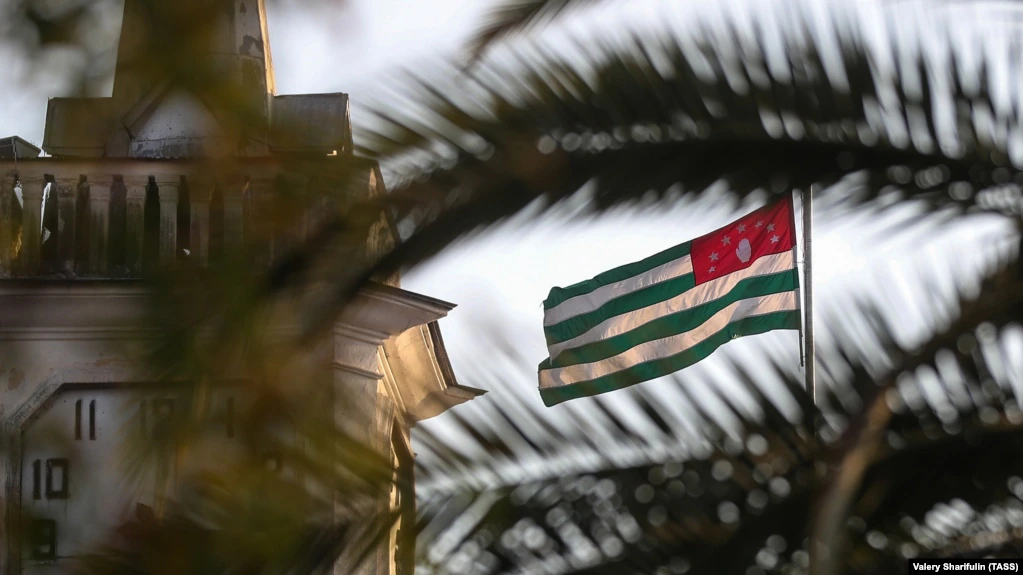
For more than fifteen years, the leadership of the partially recognized Abkhazia has been making desperate attempts to achieve, if not broad international recognition of its “independence,” then at least a minor increase in the number of UN member states recognizing it. Precisely for this purpose, Abkhaz athletes, cultural figures, and representatives of other professions were pushed with all possible effort into various events of all kinds. Significant efforts were made to sign agreements with chambers of commerce and other pseudo-state structures. So-called Abkhaz ambassadors actively tried to capture photographs of handshakes with locally accredited diplomats, presenting such images as official contacts. For Abkhazia, membership in the International Domino Federation—then headed by a Venezuelan—and the subsequent hosting of a world championship in Sukhumi, attended by a couple of dozen domino players, became a major event. Abkhazia also took its “honorable” place in ConIFA, the confederation uniting football associations of unrecognized territories, and even once became a “world” football champion.
Subsequently, the de facto authorities decided to raise the bar and aimed for equal participation in the Union State of Russia and Belarus. President Alexander Lukashenko was even invited to Sukhumi; although he admired, in his own words, the “paradise corner” and spoke of possible cooperation, he ultimately did not recognize Abkhazia. And without recognition, as is well known, membership in the Union State is out of the question.
Recently, the de facto Ministry of Foreign Affairs has intensified its activity toward BRICS, apparently placing great hopes on the current chairmanship of the Russian Federation, which will last until the end of the year. Inal Ardzinba repeatedly speaks about the need to participate in as many events as possible held within this interstate grouping, but so far the matter has not gone beyond meetings with representatives of Russia.
After 2008, Russia indeed provided significant assistance to Abkhazia in such matters. All possible instruments of pressure on particularly vulnerable states were used, ranging from direct threats and blackmail to banal checkbook diplomacy. However, Russia was guided more by its own interest in justifying its decision to recognize Abkhazia than by a desire to help it advance on the international stage, since a truly independent Abkhazia is, of course, unacceptable to Moscow. Pressure and bribery from Moscow produced some results. Today, besides Russia itself, Abkhazia is recognized by only four countries: Venezuela, Nicaragua, Syria, and Nauru. Notably, the small Pacific island states of Vanuatu and Tuvalu almost immediately withdrew their recognition. Apparently, long-term relations with the United States and the European Union proved more important to them than a one-time handout from the Kremlin. Despite all of Moscow’s efforts, even such loyal allies as Cuba and North Korea have not recognized Abkhazia. It is not excluded that one day, after a change of power, Venezuela and Nicaragua may also reconsider, especially since Caracas once came close to such a turn. Notably, prior to recognition, the de facto authorities of Abkhazia hosted high-ranking representatives of the UN, OSCE, and the European Union, whereas today the limit of their aspirations consists of meetings with the odious regimes of Assad, Maduro, and Ortega.
It is evident that recently Russia’s activity in expanding recognition of Abkhazia has noticeably declined. Perhaps, against the backdrop of the war in Ukraine, it simply does not wish to disperse resources, or perhaps it is attempting to punish the not entirely obedient Abkhaz. One should also not disregard the fact that Moscow does not wish to escalate relations with Georgia and irritate its government once again, particularly amid the noticeable warming of relations between them. It is no coincidence that quite recently the official representative of the Russian Ministry of Foreign Affairs, Maria Zakharova, stated that Moscow is focused on further normalization of bilateral relations with Tbilisi.
By comparison, Greenland, Scotland, and Northern Ireland, while formally lacking independence, possess it to a far greater extent than Abkhazia. Thus, Scotland and Northern Ireland are full members not of the unrecognized ConIFA, but of UEFA itself. Moreover, Northern Ireland cooperates independently of the United Kingdom with the EU in trade and many other areas. Greenland, for its part, voluntarily withdrew from the European Union altogether and concluded separate agreements with it.
And what does Abkhazia have—more precisely, what does it lack—fifteen years after recognition by Russia?
First and foremost, Abkhazia has not obtained the genuine sovereignty it so aspired to. It does not have the right to make independent decisions and defend its national interests. Under the guise of strategic partnership and legislative harmonization, Russia, with increasing pressure, imposes on the Abkhaz people laws and regulations alien to them. This is evidenced by the draft laws on apartments and foreign agents, the agreement on mutual recognition of court decisions in economic cases, the imposition by Russian capital of exclusively its own investments in strategic assets, as well as other steps aimed at establishing total control over Abkhazia.
All these years, economic dependence on Russia has only increased. The Abkhaz language is also on the verge of extinction, which is not surprising given the ongoing policy of Russification and complete orientation toward Russia. And after Russians obtain the right to acquire real estate, the demographic situation in Abkhazia will worsen even further, and not only the language but the Abkhaz people themselves will face the threat of complete assimilation.
Even the lands of Abkhazia are gradually passing to Russia. This was the case with the village of Aibga, which was annexed to the Adler district, and with the dacha in Pitsunda, transferred into the exclusive ownership of President Putin.
Thus, the “independence” of Abkhazia is increasingly becoming a pure formality, while Russia steadily draws it into its political, economic, and social space. And the argument that “Russia recognized us, so there is no need to fear annexation” can hardly be considered convincing. In exactly the same way, in February 2022 Russia recognized the independence of Ukraine’s Donetsk and Luhansk regions, and already in September incorporated them into its own territory. The Karabakh example also clearly demonstrates how unreliable the Russian Federation is as a guarantor for its allies.
The Abkhaz themselves are gradually beginning to realize the dominance of the Russian Federation and the looming threat of annexation, which will not be easy to avoid. But if they truly wish to preserve what they call sovereignty, alternatives do exist.
Back in 2004, proposals for the peaceful settlement of the conflict were developed in Tbilisi, providing for the internationalization of the peacekeeping process, the exclusion of instruments of war, and the renunciation of the use of force. Abkhazia was to be granted a special political and legal status with full and broad autonomy, fiscal control, and representation in the central authorities. At the same time, Abkhazia was guaranteed the observance of human rights and the protection of all freedoms, including national, religious, and others, economic growth, and the preservation of language and culture.
An even more advanced plan was proposed in 2008 before the start of the August war. It envisaged a federal structure of Georgia with the granting of Abkhazia the “broadest autonomy,” the provision of veto power to Sukhumi over decisions of Georgia’s central authorities affecting Abkhazia, the reservation for Abkhaz representatives of the post of Vice President of Georgia, as well as protection of the Abkhaz language, culture, and identity.
All these and other, no less interesting initiatives from Tbilisi still lie on the table awaiting their time. Moreover, today Georgia can already offer Abkhazia a real prospect of rapprochement with the European Union, and along with it access to financial funds, economic investment programs, social security, quality education, support for culture and science, employment opportunities, high-quality medical services, and much more. And this is not even to mention the existing free trade and visa-free regime with the EU.
It is time for the population of Abkhazia to set aside grievances and memories of the past—where, frankly speaking, both sides suffered equally—and to soberly, without emotion, look at where and how it sees its future: in a so-called independent Abkhazia, in reality fully dependent on Russia and awaiting complete absorption, or within Georgia, but with a genuinely sovereign status, solid international guarantees of security and inviolability, a preserved Abkhaz identity, and, most importantly, with the prospect of accession to the European Union with all the attendant benefits and privileges.
Ekaterina Tsanava