
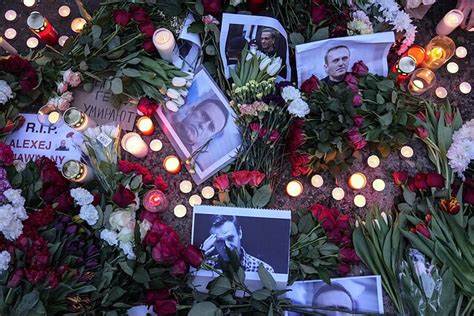
Russia is bidding farewell to opposition figure Alexei Navalny. Until very recently, he remained the only living, truly serious opponent of Putin across the entire 140-million-strong country. He died in the SHIZO (punishment isolation cell) of a prison located in the Yamalo-Nenets Autonomous Okrug, the region most distant from the capital. In terms of climate, this area is practically the Arctic, where for hundreds of kilometers one can encounter only reindeer and polar bears. He was killed methodically and systematically. After the failed poisoning with “Novichok” and his rescue by German doctors, Navalny showed reckless courage by returning to Russia. Putin did not give him a second chance.
Thousands of less well-known—and often completely unknown to the broader public—opponents of the regime are already sitting in Russian prison cells. This is not counting politicians Ilya Yashin and Vladimir Kara-Murza. Both sharply condemned the invasion of Ukraine by the Russian army and, like Navalny, principledly refused to emigrate. For this reason, Yashin was sentenced in December 2022 to 8 years and 6 months in prison under the article on “discrediting the army,” and Kara-Murza on April 17, 2023, to 25 years on charges of high treason, spreading false information about the Russian army, and cooperation with an undesirable organization. Both are listed as “foreign agents.” Navalny himself was even included in the list of individuals “in respect of whom there is information about involvement in extremist activity or terrorism”—not so much for political reasons as for his high-profile anti-corruption activities that undermined the foundations of the Putin regime.
The killing of the most popular and influential Russian opposition politician, a fighter against corruption of staggering масштабы associated with the Putin clan, who returned to and remained in Russia instead of fleeing abroad, has placed the final dots over Putin’s plans.
The main point is that it is now evident that Putin will leave the Kremlin only feet first. However, given his age and quality of life, the broadcast of “Swan Lake” on all Russian television channels will not happen any time soon. People of advanced age, including dictators, lose the flexibility that once helped them come to power and consolidate it. Putin is not yet old enough to abandon his obsessive ideas, which with each passing year become increasingly dangerous for the world, including for Russians themselves. Alongside clinging to power, he will still “fight” for the realization of his own conception of his messianic mission and the greatness of Russia.
Therefore, over the next one or two decades, Russia’s immediate neighbors—Ukraine, Georgia, and Moldova—will find themselves in the most vulnerable position. But first and foremost, this concerns Abkhazia and the Tskhinvali region, recognized by Putin as “equal partners.” If discussions in Tskhinvali are dead, then in Sukhumi for the second year now spears have been broken in internal disputes over whether it is appropriate to replicate all the practices and methods that Putin introduced in his country by merging with Russia into a single military-political whole.
Russia is currently demanding that Sukhumi adopt a law on foreign agents, which in its time allowed Putin to reduce almost to zero the possibility of expressing opinions alternative to the official line. The Sukhumi leadership, in particular “President” Aslan Bzhania, has directly stated that Western sponsors of the nongovernmental sector, hostile to Russia, cannot be represented in Abkhazia. “Foreign Minister” Inal Ardzinba, tapping his delicate fingers on a MacBook, reported to Bzhania that he had already obtained Moscow’s consent to finance Abkhazia’s civil society in place of the “unsuitable” Western sources.
Incidentally, this topic has taken on an unexpected development. The other day, an initiative appeared to tighten the law on defamation. According to the amendments, the “evidentiary base” required to prosecute under this article would be drastically simplified. If the changes are adopted, defamation could carry a prison term of up to five years, although there is a proviso: a person is exempt from criminal liability if the defamation is retracted. Such a repugnant practice of coercing public apologies has already taken root, for example, in Chechnya. Nor should one forget the briefly floated idea of involving Russian enforcers from the National Guard (Rosgvardiya) in maintaining public order in Abkhazia. This idea so alarmed the population that the draft agreement was immediately put back in a drawer—for better times.
All this clearly demonstrates that Abkhazia is rapidly sliding toward the Putin model of governance. And this means that very soon it will be necessary to forget about freedom of speech, rights to express opinions, to assemble, and to hold demonstrations—the latter will be taken care of by Rosgvardiya.
One wonders why Inal Ardzinba suddenly decided the other day to pay an unexpected visit to Ramzan Kadyrov.
You may ask: what does Navalny’s killing have to do with this—his body withheld from his family for weeks, and then across the country places for farewell ceremonies banned? It has to do with the fact that people have already begun to be detained in Abkhazia for holding memorial actions for Navalny, even though Abkhazia still lacks any legislative basis for doing so.
Well then, if you enter into a marriage with a state like Russia, living by “cave-gangster” rules, be prepared that your own Politkovskayas, Nemtsovs, Navalnys, and thousands of shattered lives will not be long in coming in your own home.
Razhdén Kadzhaya