
Treatment in Georgia: Who and Why Hinders a Good Cause Beyond Politics
06/07/2020 12:16:47 Conflicts
The most precious thing a person has is life; the most precious thing in life is health… This well-known ancient saying is understood by everyone on planet Earth. However, in the 21st century, when humanity is developing and progressing by leaps and bounds, these wise words are, unfortunately, often forgotten.
Reflecting on this topic is prompted by the situation that has been unfolding in Abkhazia’s medical sphere for two decades. Or rather, in the sphere of medical care.
In the first years after the end of the war, living under blockade, residents of Abkhazia were forced to make do with the little that the state could provide. And it provided little, and without receiving timely assistance, many people in the republic died.
Time passed, life changed, and access to medical institutions in Russia became possible. There was no point dreaming of anything else—since the possession of an Abkhaz passport made it possible to travel only to the neighboring Russian state. At the same time, even today, if the family budget does not allow such a luxury, people remain in the republic and entrust themselves to the mercy of local doctors. There is also a state program under which medical assistance can be received in Russian clinics free of charge, but this is a very lengthy process, it ultimately still turns out to be costly, and in recent years, due to Abkhazia’s debts to these clinics—it has become impossible altogether.
In the early 2000s, rumors began to spread throughout the republic about people who had gone for treatment beyond the Inguri. At first it concerned only a few individuals, but over time their number grew. And whereas initially people carefully concealed their trips to Georgia, now they do so quite openly, applying to various state structures to obtain referrals, permits, and a number of other important documents.
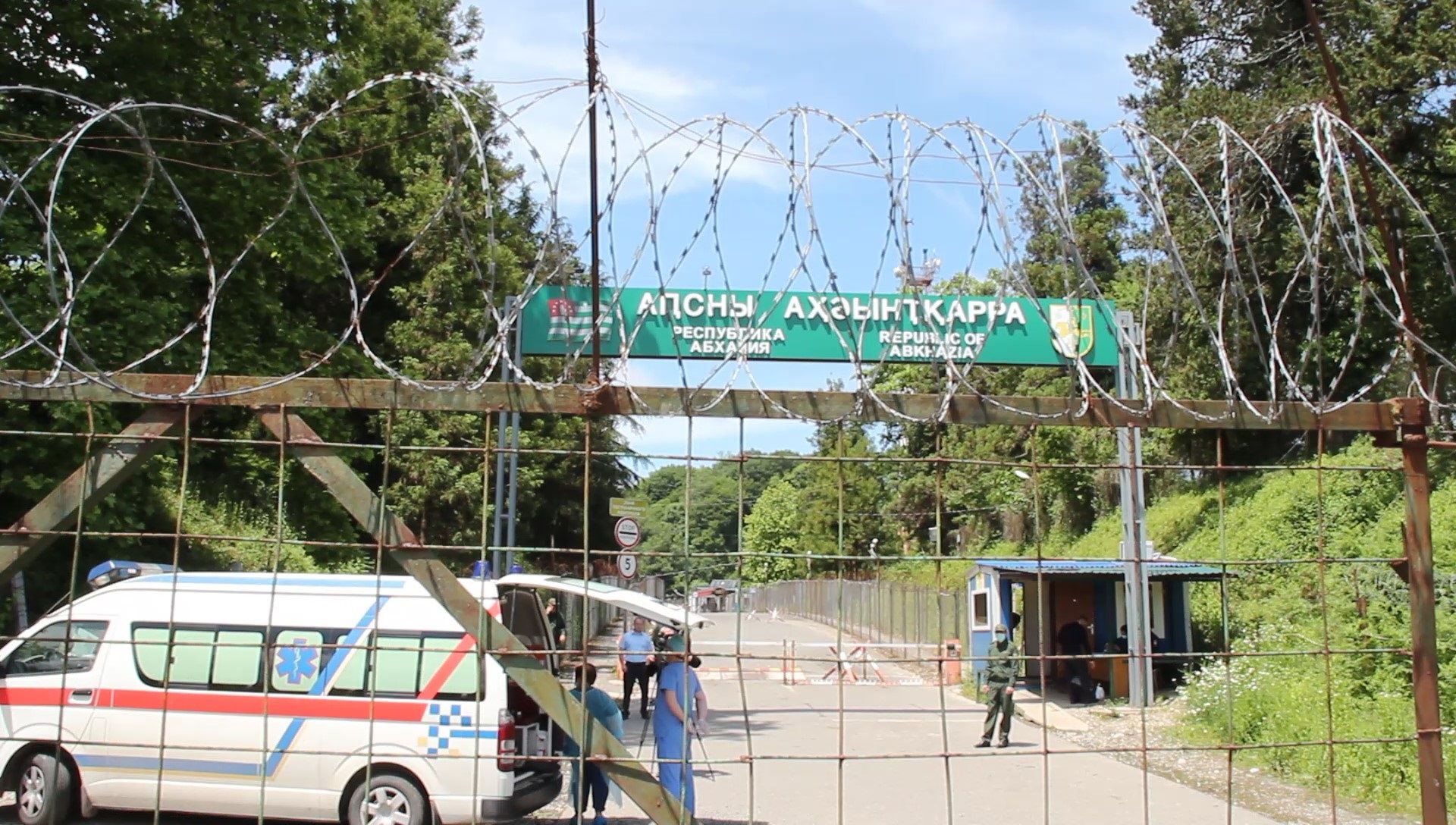
Now, during the global coronavirus pandemic, because of strict quarantine and restrictive measures, the vast majority of Abkhazia’s residents once again found themselves without choice. But despite the closed borders, there is still a loophole for those who urgently need medical assistance—only few people know about it. To this day, there is a medical institution operating in Abkhazia through which people can reach the adjacent territory of Georgia without any referrals or permits. A special vehicle from this medical facility can, at any time of the day, freely cross the border and transport a patient from Abkhazia. And all of this—free of charge…
The only obstacle that may arise for a patient or their accompanying relatives comes from Russian border guards who are stationed at every checkpoint in the Gali district. If a patient, despite all their veiled threats and persuasion, does not change their mind about going to Georgia, then upon returning they face numerous misfortunes. The first problems arise when crossing the Russian–Abkhaz border. A citizen may suddenly be found to have “passport discrepancies,” to the extent that the Border Service of the Russian Federation may prohibit entry into its territory. In addition, a resident of Abkhazia who has sought assistance from Georgian doctors begins to be asked for additional certificates, which in turn must be confirmed by new certificates—and so on endlessly. And “unexpectedly,” payments of pensions, benefits, and many other entitlements begin to be delayed. And again, all of this occurs at the instigation of Russian structures, of which there are many on the territory of Abkhazia…
But the main problem for those considering the possibility of receiving modern treatment in Georgia is the myth of compulsory acquisition of Georgian citizenship. In Abkhazia, people are persistently convinced that Georgians treat only those who have accepted Georgian citizenship for free, and that for non-citizens treatment will cost a considerable sum…
“Free cheese is only in a mousetrap—you know that. To receive free treatment in Georgia, you will have to accept Georgian citizenship or pay a lot of money,” they told our interlocutor Naira (name changed), who many years ago decided to undergo surgery in Tbilisi.
“We are all convinced that this is supposedly a mandatory requirement. They also say that they inject some vaccines there so that a person will die at home after some time,” Naira continues.
According to the woman, she decided to go to Georgia after several clinics in Krasnodar named a treatment cost of 80–100 thousand, while Abkhaz doctors could not even establish a diagnosis. “This was an impossible amount for my family, and I had no other choice,” she said. No one in Georgia spoke to her about Georgian citizenship. She underwent examinations and then a complex operation free of charge. “All these rumors are spread deliberately so that a person becomes afraid and does not go for treatment in Georgia. And you know, many people here believe it and do not go. I know many such people,” Naira says.
The fact that no one requires and has never required anyone to accept Georgian citizenship is also confirmed by the Office of the State Minister of Georgia for Reconciliation and Civic Equality:
“This information is absolute nonsense and does not correspond to reality. On average, 1,000–1,200 patients from Abkhazia come for treatment each year, and not one of them will be able to name a single case where someone demanded money or a Georgian passport. In the nine years of operation of this Referral Program, there have been only up to 10 cases of acquisition of Georgian citizenship, and all of them were based on the personal requests of the patients themselves.”
Patients from Abkhazia continue to travel for treatment to this day, although according to the Ministry of Health of the “Legitimate Government of Abkhazia” (as it is referred to in Georgia), amid the coronavirus epidemic the flow has decreased somewhat: arrivals first undergo a mandatory two-week quarantine, and then treatment begins according to plan.
The referral program itself for residents of Abkhazia remains unchanged—despite the pandemic, which has caused difficulties in the financial and medical sectors worldwide, including in Georgia, absolutely all medical services that the Georgian state offered to residents of Abkhazia remain in force and all of them continue to be free of charge.
In addition, various private initiatives are operating in Georgia; private funds provide assistance to patients from Abkhazia and their accompanying persons. Among them is the “Monk Andria Fund,” which has been operating for several years through private donations. Hardly anyone in Abkhazia knows that this good cause was supported last year by the world-famous Turkish actor Çağatay Ulusoy, who visited Tbilisi on a charitable visit.
When the life of a loved and dear person is at stake, politics, quarrels, and grievances recede into the background. Everything possible must be done to save life and health. And every person is free to decide independently where and from whom to receive treatment. What matters is not the location, but the qualification of the doctor and the modernity of the equipment. Because what is at stake is a human life, which must be saved at any cost. It is a pity that politicians remember this only when illness knocks at the doors of their own homes…
Kristina Avidzba
The text contains toponyms and terminology used in the self-proclaimed Republic of Abkhazia