
Georgian–Abkhaz–Russian Energy Knot: What Should Abkhazia Fear?
18/08/2020 14:18:44 Conflicts
A long time ago humanity invented electricity, and today we cannot imagine our lives without it. Electric power is needed for almost everything: from small and large household appliances of everyday necessity to transport and the resources for a comfortable life.
But try to imagine that one day the electricity in your home is cut off. Not for preventive purposes or due to technical problems, not for a few minutes or a couple of hours, but forever. And not only in your home—but across the entire republic. Can you picture the situation? Of course, it is not a tragedy of universal scale, but there is little pleasant about it. Suddenly—once—and electricity disappears from all of Abkhazia; it is gone everywhere.
A frightening picture. But alas, quite realistic.
For 27 years Abkhazia has been consuming electricity virtually for free. For a quarter of a century the republic has only increased volumes, without repairing, without paying for generation. At the same time, Abkhazia has some of the lowest electricity prices in the world. And the sector is falling apart more and more each year. And instead of development, Abkhazians patch holes—holes that only grow in number every year.
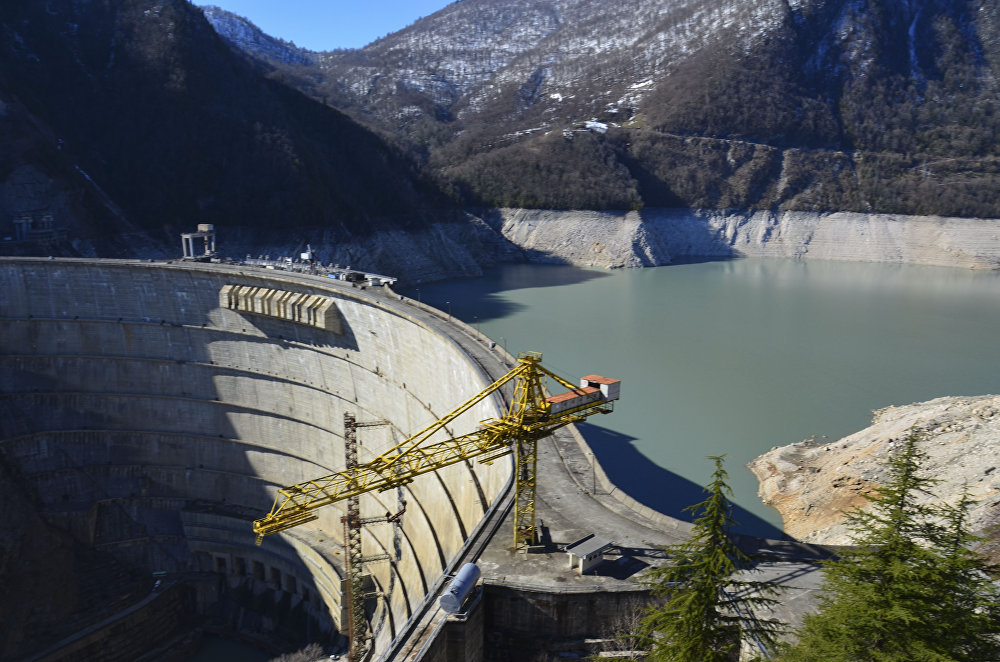
Officials of very different levels have spoken about the dire condition of the republic’s energy sector. “Today the energy sector is in the most deplorable state, and this is despite the fact that we have substantial resources. Today we receive electricity only from the Inguri HPP. We have not yet used the possibilities of small-scale energy; there is the possibility of using alternative energy. But we have done practically nothing. Our entire energy system is outdated and is in critical condition. How will tourism and agriculture develop if after some time this system collapses?”—this is how, during his presidency, Raul Khajimba spoke about energy. Officials of various levels echoed him. But it went no further than words.
According to the Abkhaz economist Anatoly Otyrba, the situation “is so serious that it poses a threat to national and state security.” “Despite the fact that, according to the claims of the heads of ‘Chernomorenergo,’ Abkhazia receives 40% [in reality, in recent years this figure has exceeded 40%, and in winter reaches almost 100%—ed.] of the energy produced by the Inguri HPP, and the key facilities of the complex are located on our territory, the complex itself is legally Georgian and all its facilities located on the territory of Abkhazia are on its balance sheet. That is, legally the entire Inguri HPP complex is Georgian and there is nothing Abkhaz about it. Moreover, even the share of electricity received by Abkhazia is not legally formalized in any way,” says Otyrba. According to him, all relations with the Georgian side are built on the basis of oral agreements, which, it should be noted, Georgia has not violated even once.
In general, this agreement on the distribution of electricity between Georgia and Abkhazia right after the end of the war is, of course, unprecedented. And for almost three decades now Georgia—albeit not with its own money—repairs, services, and maintains the Inguri HPP. Tell me, why not? I will explain—there are hundreds of small and large energy facilities in Georgia. The loss of the Inguri HPP for the Georgian energy sector, which has been developing at a gigantic pace in recent years, is negligible. Whereas for Abkhazia it is a catastrophe, because the republic has no other power source. Which means there is no alternative. But for some incomprehensible reason that does not fit in the head, Abkhazia time after time tries to put sticks in the wheels, creating obstacles for foreign companies repairing the Inguri HPP. There have been many examples, of various kinds. One of the latest is that the company that won an international tender in 2019 to build a road to the station has for a long time been unable to start work because of all sorts of reasons invented by Russian border guards stationed on the Abkhaz–Georgian border.
The whole situation with Abkhazia’s energy sector resembles a popular American amusement ride—sometimes it is stormy, sometimes it develops at breakneck speed. Every year during periods of power outages in Abkhazia, wide discussion begins again about the issue of paying for the electricity flow, which supposedly has always been carried out from Russia. But in January of the current year, when rolling blackouts were introduced in the republic, information suddenly surfaced that “Georgia is again buying Russian electricity to supply powerless Abkhazia.” Moreover, the Ministry of Economy of Georgia issued a statement that “the supply of electricity to Abkhazia from Russia is carried out on the basis of a contract executed between the Commercial Operator of Georgia’s Electricity System and the Russian company Inter RAO.” According to that same ministry, for this “a short-term contract was executed and Abkhazia will receive electricity via the Salkhino power line, which is part of Georgia’s energy system.”
Shock! The outrage of Abkhazia’s residents knew no bounds, because this statement—later safely disavowed by Inter RAO’s press service—revealed possibly one of the largest gray money-laundering schemes. It is simple. Each year Abkhazia’s budget spent on average 600 million rubles to pay for electricity that Russia provided to the republic during аварийные periods. It turns out that at the same time Georgia was paying Russia for that very electricity. But one way or another, the lie was exposed. Only no one in Abkhazia explained to the population how things actually stand. Amid many problems, this issue again receded into the background. But people did not forget. And now, when Abkhazia has once again faced a problem, the question has arisen again. And again—complete silence from the authorities.
“If Georgia was paying the Russians for electricity that they were giving us, why does our government not want to say this? Is it some secret of the century or is there some new deception here? Whether we like it or not, in the energy issue we are tied to Georgia—and note, without any problems all these years the issues were being resolved. And then suddenly some absurdity. Russia is earning twice on us, it turns out?!”—our interlocutor Andrei reflects.
In his reflections, the elderly Sukhumi resident Arkady is sharper. “Do we—ordinary people—not understand what this means?! Russia, as a benefactor, seems to be helping us, but in reality it is warming its hands on our misfortune, taking money from the Georgians and from our meager budget! Is this friendship?! How can this even be?!”—Arkady is outraged.
According to the Abkhaz economist Anatoly Otyrba, despite the fact that electric generators whose capacity exceeds Abkhazia’s needs are located on the territory of Abkhazia, legally it is fully energy dependent. “All of us, citizens of Abkhazia, should today pray to God that Georgia, and especially the world community, do not recognize the political sovereignty of Abkhazia, because if they recognize it under its current legal relations with Georgia, according to which it has no share in the Inguri HPP,” Otyrba believes.
Against the background of all this so cleverly tangled шум, the words of the former head of the company “Chernomorenergo,” Aslan Basaria, which he said when bidding farewell to the staff, look very prophetic—“all energy specialists in all the post-war years have always been guided by the fact that the energy system will remain national.” They have become even more relevant now, during the period when a group of Russian specialists is working in Abkhazia, studying the republic’s energy system. Their arrival was perceived ambiguously in Abkhaz society, believing that this inspection, disguised as assistance, will lead to the sale of the energy system.
“Russia has tried more than once to buy our energy system, but our leaders have always managed to avoid this. But this time our authorities, I think, will not be able to defend this issue. Next year the Inguri HPP will stop for repairs, and what will we do if Russia does not give us electricity? So it turns out that the Russians simply waited for a convenient moment to finally resolve this issue,” our interlocutor Adgur is convinced. In his opinion, Russia will blackmail Abkhazia until it gets what it wants. And Abkhazia’s energy security can be forgotten forever.
P.S.
Russian military bases located on the territory of Abkhazia pay half as much as ordinary citizens. The tariff for individuals today is 40 kopecks per kilowatt. Russian military personnel, equated to state authorities, pay 20 kopecks per kilowatt.
It turns out that Abkhazia, buying electricity from Russian companies at a price of almost 3 rubles, sells it to those same Russian military bases for 20 kopecks.
In turn, Georgia, paying for the electricity flow to Abkhazia, gives the opportunity to live comfortably not only to the residents of the republic but also to the Russian military, whose number grows every year.
Astanda Bganba
The text contains toponyms and terminology used in the self-proclaimed Republic of Abkhazia