
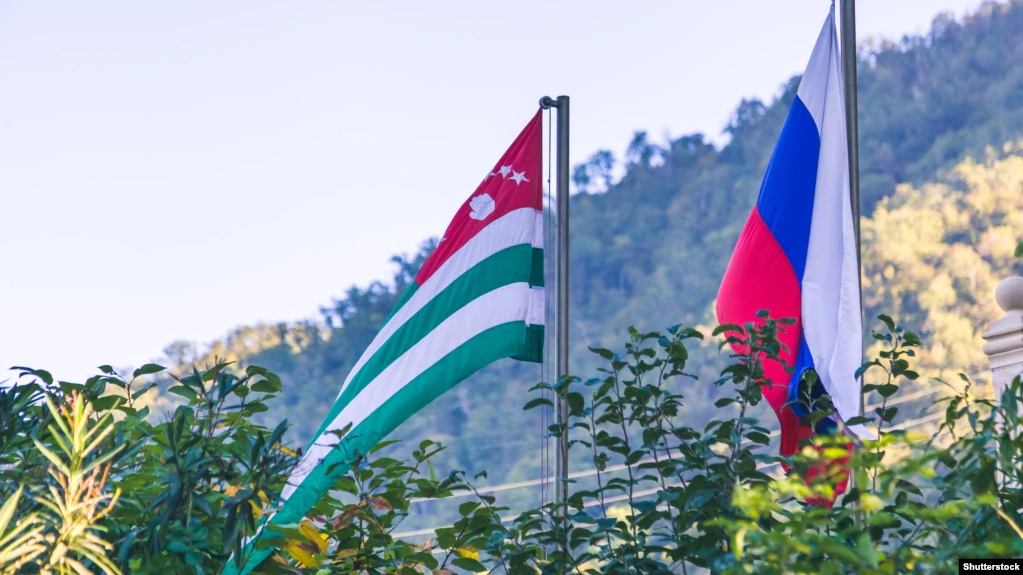
Why does Moscow need Abkhazia in the "Union State", when it is going to join RF voluntarily?
03/11/2023 12:22:54 Conflicts
After the outbreak of the war in Ukraine in 2022, the ultimate goal of Russian policy toward the surrounding world became quite transparent: Russia intends to incorporate everyone and everything along the perimeter of its borders until it encounters an insurmountable obstacle in the form of proportionate military and political power. In parallel with the war in Ukraine, Russian policy also acquired more concrete contours with regard to Abkhazia. One could say that Russia has launched a war there as well, though so far without the use of weapons. Everyone understands that forcing Sukhumi to adopt a whole range of laws, including legislation on apartments, as well as the seizure of strategic economic assets, differs in form only from the “operation to compel Georgia to peace” in 2008 and the current war aimed at the “denazification” of Ukraine.
Despite the obvious nature of Russia’s expansionist ambitions, the de facto authorities of Abkhazia are increasingly speaking of their desire to join the “Union State of the Russian Federation and Belarus.” Sukhumi’s leaders claim that membership in the “Union State” would strengthen the status of the partially recognized republic on the international stage, ensure its security even more reliably, and, moreover, allow it to receive more preferences and subsidies from Russia. At the same time, they persistently remain silent about all the drawbacks of this Kremlin project. The opposition also does not particularly challenge it, fearing to spoil relations with Moscow. Only local civil activists, NGOs, and journalists express restrained concerns.
However, the main issue here is not a meticulous calculation of the balance between debit and credit, but a much more global question: why have the official Kremlin authorities, and first of all Vladimir Putin, so far not reacted in any way to the “persistent requests” coming from Sukhumi?
First of all, it should be noted that in order to accept a new member into the “Union State,” it is necessary to regulate the formal side of the issue: such a member can only be a sovereign state recognized by both Russia and Belarus. Minsk does not recognize the independence of Abkhazia, which in itself makes this idea unworkable at the current stage. It should be recalled that Lukashenko has consistently refrained from taking such a step since 2008, when Russia unilaterally, in violation of international law, recognized the “independence” of Sukhumi and Tskhinvali. Explaining his motivation in one of his interviews, he stated that Moscow refused to compensate Minsk for the damage that Belarus would incur in the event of recognizing these territories contrary to international law and the inevitable negative reaction of the international community.
Since that time, the international situation has only worsened: by now Russia is a world record-holder in the number of sanctions imposed on it, even surpassing Iran and North Korea. Thus, Lukashenko has no motivation to change his position on this issue. Moreover, such a tripartite union would, first of all, reduce the international status of Lukashenko himself and of Belarus to the level of Sukhumi. In addition, within the existing 1+1 format, it is much easier for Minsk to resolve issues of lobbying its own interests with Moscow, whereas expanding the format by adding another member who is also focused on receiving benefits from Russia would deprive Minsk of its exclusive access to Russian resources, which have already turned out to be far smaller than promised.
The tales about some “golden rivers” for Belarus turned out to be yet another Kremlin fake. In reality, according to the World Bank report for 2021, Belarus was Russia’s largest debtor. By the end of 2022, 38 countries owed Russia a total of $26.54 billion, of which Belarus accounted for as much as $8.5 billion. In addition, direct assistance from Russia makes up about 40% of Abkhazia’s budget revenues, covering all social obligations, salaries, and much more, while Belarus receives no such gifts, and Moscow meticulously drives Minsk into a debt trap. Therefore, if Abkhazia truly hopes to gain additional resources from Moscow by joining the “Union State,” it should take these extremely important nuances into account.
Given the current state of affairs, it is difficult to imagine a situation in which the Kremlin would insist on Belarus recognizing Abkhazia, while Lukashenko would refuse Putin. This means only one thing: for some reason, Putin is not interested either in Minsk’s recognition of Sukhumi or, even more so, in including Abkhazia in the “Union State.” This may presumably be due to the fact that in recent years Moscow has been satisfied with Georgia’s policy and would not want to trigger a new escalation of relations.
However, there is another version: Putin has a concrete plan for the annexation of Abkhazia. This is supported both by the war aimed at dismembering and absorbing Ukrainian territories and by Russia’s internal problems. In the Russian North Caucasus, there are seven national autonomous republics, similar in status to Abkhazia within the Georgian state. Using Chechnya as an example, Putin vividly demonstrated how he knows how to resolve issues of separatism. Against this background, leaving on the Caucasus a successful example of separatism would be a bomb planted under Russia’s own territorial integrity.
And in general, on what grounds should Moscow treat Sukhumi as an equal partner if it itself maintains it while ensuring its security? And what benefit would Russia gain from admitting Sukhumi into the “Union State”? In fact, Abkhazia is completely dependent on Russia and is already integrated into it much deeper than Minsk is: its entire financial system is tied to the Russian Central Bank; the unit of account is the Russian ruble; the “army” has practically been dissolved and its functions are performed by Russian troops subordinate to Russian command; the education system is also Russian; most residents carry Russian passports in their pockets; pensions, salaries, and social benefits are paid from Russian subsidies; the local elite is economically fully tied to Moscow, where it is allocated “quotas” for business activities, where it keeps its capital, elite real estate, and financial assets, and where their children prefer to live.
Thus, in principle, only a small step remains: to populate the territory with settlers from Russian provinces—and there you have a ready-made new region of the Russian Federation.
Moreover, Abkhazia, while still entertaining illusions about formal recognition by Moscow, is clearly pursuing a course toward even closer rapprochement with Russia. So why should Moscow accept Sukhumi into the “Union State” when Abkhazia is, in essence, moving toward voluntary direct accession to the Russian Federation?!